Rare 2016 Volkswagen XL1 Plug-in Hybrid With Minimal Mileage Heads to Auction in the Netherlands

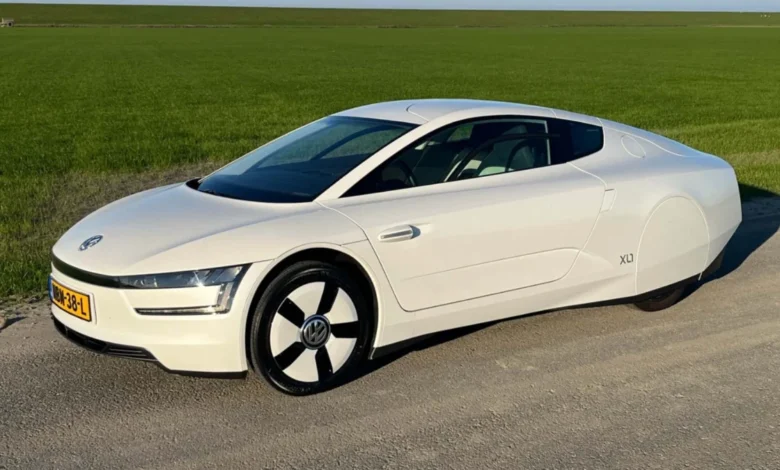
Long before the modern automotive landscape became dominated by mass-market battery-electric crossovers and long-range electric sedans, the Volkswagen Group embarked on a visionary and technically audacious engineering quest. Known internally as the "one-liter car," the project aimed to create a fully functioning, road-legal production vehicle capable of consuming just one liter of fuel per 100 kilometers—equivalent to an astounding 235 miles per US gallon, or roughly 282 imperial mpg. Today, one of the rarest physical manifestations of that ambitious decade-long R&D program has surfaced on the European secondary market. A remarkably well-preserved, 2016 model-year Volkswagen XL1 with just over 1,000 miles on the odometer has been listed for public auction on the Catawiki platform in the Netherlands, offering collectors and automotive historians a rare opportunity to acquire a pristine slice of hyper-efficient mobility.
The Genesis and Evolution of the One-Liter Dream
The chronological roots of the Volkswagen XL1 stretch back to the turn of the millennium. The project was conceived and championed by Ferdinand Piëch, the legendary and notoriously demanding former chairman of the Volkswagen Group. Piëch was famous within the global automotive industry for establishing seemingly impossible engineering parameters and refusing to compromise until his technical teams brought them to life.
The primary objective was straightforward in theory yet exceptionally difficult in practice: build a production-ready vehicle that could transport two occupants in comfort while sipping a mere 1.0 liter of fuel per 100 kilometers. The development timeline spanned more than a decade through multiple iterations, testing the absolute limits of Volkswagen’s aerodynamic, materials science, and powertrain engineering divisions.
The experimental journey began in earnest with the 2002 Concept 1L, presented by Piëch himself when he drove the prototype to the Volkswagen annual shareholder meeting in Wolfsburg. Built around a tandem seating configuration and a lightweight magnesium frame, the initial concept proved that the physical mathematics of the one-liter goal were achievable. However, transitioning a radical aerodynamic study into a safe, reliable, and marketable production vehicle required years of iterative refinement.
Subsequent concepts followed—including the 2004 L1 concept—which gradually shifted from tandem seating to a staggered side-by-side seating layout to improve cabin usability and cross-wind stability. By the late 2000s, the powertrain philosophy shifted from purely diesel-mechanical to a more sophisticated plug-in hybrid architecture, culminating in the official debut of the production-spec XL1 at the 2013 Qatar Motor Show.
Engineering Marvel: Aerodynamics and Lightweight Construction
When Volkswagen finally commenced limited production of the XL1, the resulting machine bore a closer resemblance to an aerospace project or an experimental Le Mans prototype than a conventional hatchback or sedan. To achieve maximum efficiency, engineers focused heavily on reducing resistance through drag and mass reduction.
The vehicle’s distinctive teardrop silhouette was meticulously shaped in a wind tunnel, resulting in a sensational drag coefficient ($C_d$) of just 0.189—making it one of the most aerodynamically slippery production cars in automotive history. To save every possible gram of weight, the XL1 utilized a carbon-fiber-reinforced polymer (CFRP) monocoque chassis and body panels constructed using advanced resin transfer molding techniques. This carbon-intensive construction predated the commercial rollout of similar structures by rival luxury manufacturers and contributed heavily to the car’s featherlight curb weight of just 1,852 pounds (840 kilograms).
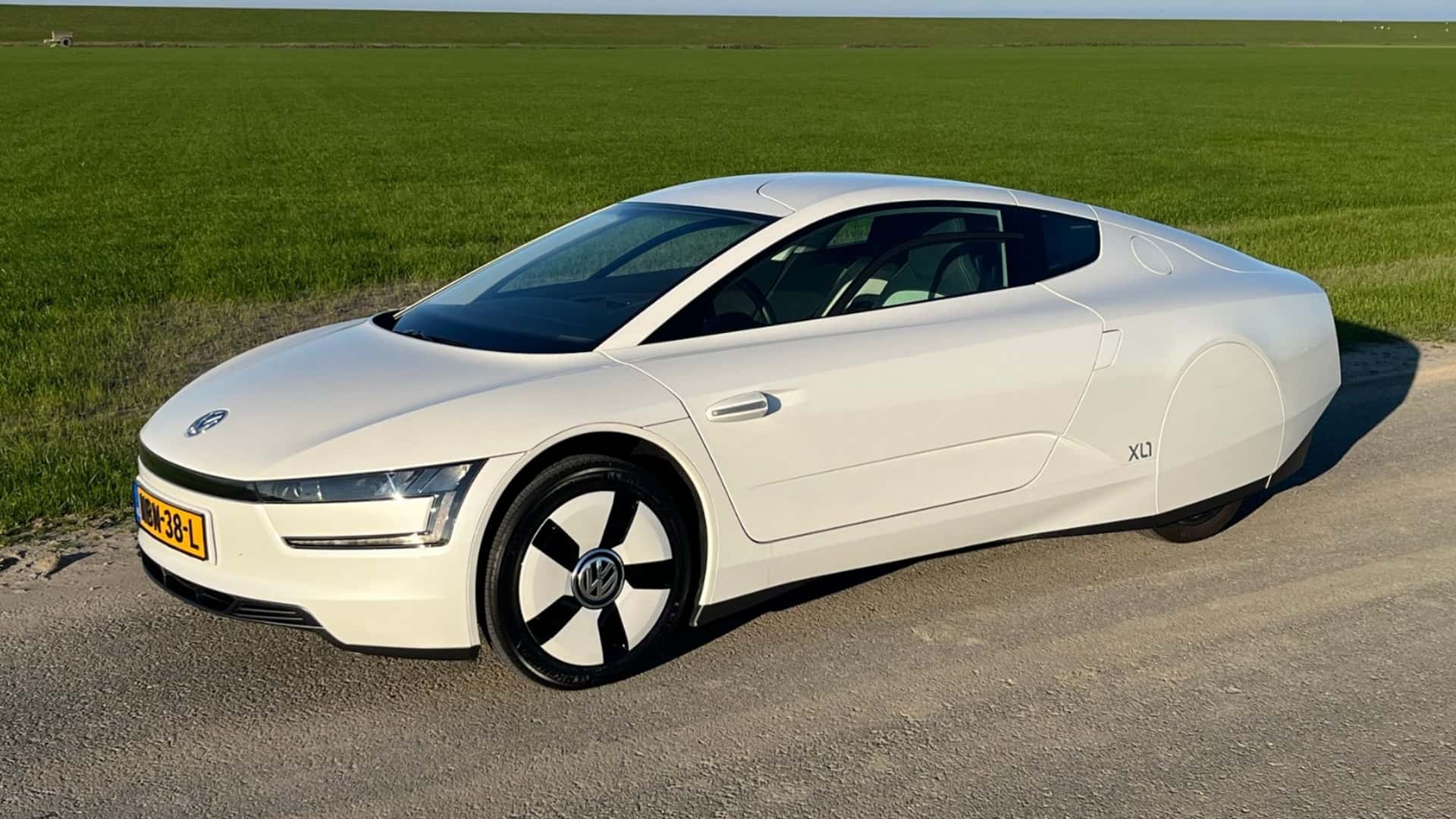
Access to the minimalist cabin was granted via striking butterfly doors that hinged upward into the roof structure. Inside, the two seats were strategically offset rather than positioned directly abreast. This staggered configuration allowed Volkswagen to narrow the passenger compartment significantly, directly shrinking the frontal area of the car and further reducing aerodynamic drag without forcing occupants into an uncomfortably cramped tandem seating arrangement.
Powertrain Dynamics and Performance Realities
Beneath the lightweight carbon-fiber skin lay an unconventional and highly complex mechanical layout. The XL1 featured a mid-engine configuration, housing an 800-cubic-centimeter, two-cylinder common-rail turbo-diesel (TDI) engine paired with an electric motor integrated into a seven-speed dual-clutch transmission (DSG). Energy was stored in a 5.5-kilowatt-hour lithium-ion battery pack, enabling the vehicle to travel up to 31 miles (50 kilometers) on pure electricity under laboratory testing cycles.
Because the plug-in hybrid system was incorporated late in the development cycle, early charging logistics were famously quirky. The car required a bulky, 50-pound removable external charging box stored in the rear cargo area to interface with standard electrical grids.
Operating in tandem, the diesel engine and electric motor produced a combined output of 68 horsepower and 103 pound-feet of torque. Due to this modest power figure, performance metrics were decidedly un-supercar-like: the sprint from zero to 60 miles per hour required nearly 13 seconds, and the vehicle possessed a top speed electronically limited to 99 mph. However, performance was never the car’s mandate. Volkswagen engineers famously noted that the XL1 required a mere 8 horsepower to maintain a constant cruising speed of 62 mph against atmospheric resistance.
Rarity, Valuation, and the Collector Market
Volkswagen originally intended to produce a limited run of 250 units at its Osnabrück facility in Germany, placing the vehicle in an elite category of rarity. At its launch in 2013, the XL1 carried a staggering price tag equivalent to approximately $150,000 USD, reflecting the immense cost of manufacturing carbon-fiber monocoques and specialized aerodynamic components. Consequently, the vehicle was rarer than many contemporaneous hypercars, including the Bugatti Veyron.
The specific 2016 model currently listed on Catawiki in the Netherlands represents one of the final examples produced before the assembly line wound down. Showing just over 1,000 miles (approx. 1,672 kilometers) on the digital odometer, the vehicle has been cataloged by auction specialists in exceptional cosmetic and mechanical condition. Current pre-auction estimates suggest the hammer could fall near the $140,000 threshold, matching or closely trailing its original manufacturer’s retail price.
Economic and Industry Implications
From a purely financial or utilitarian perspective, industry analysts note that acquiring an XL1 as a daily commuter vehicle makes little economic sense. Even factoring in its legendary fuel economy, the vehicle’s six-figure acquisition cost creates a breakeven timeline spanning decades. Furthermore, the vehicle relies on diesel fuel, a commodity that has experienced significant price volatility and regulatory pressure across European markets in recent years. Modern battery-electric vehicles offer lower operating costs, instantaneous torque, and complete independence from petroleum infrastructure.
Nevertheless, automotive historians and market observers view vehicles like the XL1 through a different lens. Rather than a logical transport solution, the Volkswagen XL1 stands as a technological tour de force—a physical monument to an era when a major global manufacturer was willing to invest immense capital into proving the absolute limits of internal combustion and hybrid efficiency. For high-end collectors, museums, and enthusiasts of alternative-fuel history, this low-mileage Dutch auction presents a unique window to acquire an irreplaceable milestone of automotive engineering.
Related posts: