The Sigma 15mm f/1.4 DC: Technical Prowess Meets the Elusive "Soul" of an Image

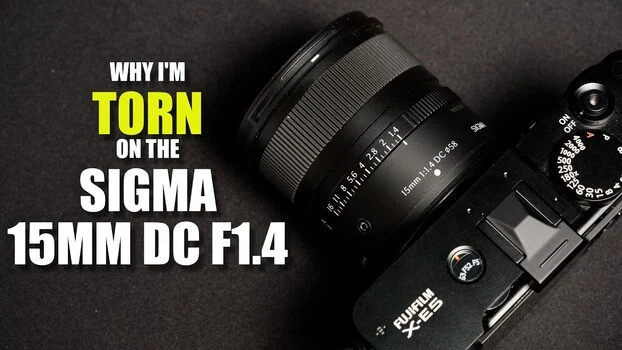
In the ever-evolving landscape of photographic equipment, the pursuit of the perfect lens often leads to a fascinating paradox: a device can meticulously meet every technical specification, yet fall short of evoking a profound emotional response when put to the test in real-world shooting scenarios. The Sigma 15mm f/1.4 DC, a lens that has garnered considerable attention for its impressive specifications and competitive pricing, serves as a compelling case study in this discernible gap between numerical performance and the intangible "feeling" an image conveys. Photographer Luca Petralia, through his detailed analysis and practical demonstrations, explores this dichotomy, shedding light on why a technically superlative lens might not always resonate with a photographer’s artistic sensibilities.
Petralia’s comprehensive review, conducted using the Sigma 15mm f/1.4 DC mounted on a Fujifilm X-E5 camera body, delves into the multifaceted aspects of the lens, from its physical attributes to its image rendering capabilities. The physical construction of the Sigma 15mm f/1.4 DC is, by all accounts, commendable. Weighing a modest 225 grams, it strikes an admirable balance, avoiding the tendency to make even a compact camera feel front-heavy. This lightweight design is particularly beneficial for photographers who prioritize portability and agility. A notable feature that Petralia highlights is the inclusion of an aperture ring, a significant addition that marks a departure for Sigma’s contemporary DC line, with the 12mm being the only other lens in this series to incorporate such a physical control. This tactile feedback is often cherished by photographers who prefer direct manipulation of exposure settings, contributing to a more intuitive shooting experience.
Further bolstering the lens’s practical appeal is its robust build quality and weather-sealing. The lens features a gasket at the mount, providing a crucial barrier against dust and moisture, a feature that significantly enhances its utility in challenging environmental conditions. The construction predominantly utilizes high-quality plastics, a material choice that contributes to its lightweight nature without compromising durability. Priced within the $500 to $600 range, the Sigma 15mm f/1.4 DC presents an exceptionally compelling proposition on paper. A wide-angle lens with an f/1.4 maximum aperture, boasting such a compact form factor and accessible price point, leaves very little room for objective criticism regarding its specifications.
However, as Petralia’s analysis underscores, the true measure of a lens extends beyond its tabulated performance metrics. The image quality delivered by the Sigma 15mm f/1.4 DC follows a similar trajectory of technical excellence. Petralia describes the lens’s output as "clinical," a term that suggests precision and accuracy, but perhaps lacking in artistic flair. In terms of sharpness, the center of the image is remarkably crisp even at the widest aperture of f/1.4. The corners, while not as sharp as the center at this aperture, exhibit significant improvement as the lens is stopped down, reaching commendable levels of detail around f/5.6. Intriguingly, the sustained sharpness of the central area means that even when stopping down to f/5.6 or beyond, the discernible improvement in overall image sharpness on a high-resolution sensor, such as the 40-megapixel sensor of the Fujifilm X-E5, is often minimal, rendering the need to stop down for sharpness alone less critical.
Vignetting, a common characteristic of wide-angle lenses, is effectively managed by the Sigma 15mm f/1.4 DC. It is largely resolved by f/2.8, a testament to its optical design. Similarly, chromatic aberration, while present, is subtle enough to require deliberate effort to detect, an indication of Sigma’s sophisticated optical correction techniques. The bokeh, the aesthetic quality of the out-of-focus areas in an image, is another area where the lens performs admirably, especially for a wide-angle perspective. It maintains a pleasing smoothness, even when the aperture is stopped down, a characteristic that can add a refined dimension to portraits and subject isolation.
Despite this array of technical achievements, Petralia articulates a singular, yet profound, reservation: the lens produces an image that is technically correct but, in his estimation, fails to "speak to your soul." This subjective critique points to a deeper consideration in lens selection, one that transcends the purely objective. Autofocus performance is reported as robust, with Petralia attributing any missed shots in continuous autofocus mode to the Fujifilm camera body rather than the lens itself, noting a consistent behavior with other lenses under test. This observation further emphasizes the separation between the lens’s inherent capabilities and the overall system’s performance.
Petralia’s framing of the issue encapsulates a fundamental truth that resonates far beyond the Sigma 15mm f/1.4 DC. He posits that "character" and technical correction are not synonymous, and the prevailing trend in modern lens design increasingly prioritizes the latter. Manufacturers have achieved remarkable advancements in mitigating optical aberrations, flattening field curvature, and ensuring edge-to-edge sharpness. While these improvements are undeniably beneficial, they have also contributed to a proliferation of lenses that are described as "clinical." This technical perfection, while ideal for certain applications, can sometimes lead to images that feel sterile or devoid of a distinctive visual signature.
The implication for photographers is clear: when faced with multiple lens options, the most practical approach is to introspect and define what one truly desires from an image. A lens engineered for maximum optical correction provides a clean, predictable image file that performs consistently across various shooting conditions. This type of lens is ideally suited for documentation, travel photography, and everyday shooting scenarios where reliability and straightforward results are paramount. Conversely, a lens that possesses more inherent "optical personality" may trade some of that consistency for a rendering style that a photographer will either deeply appreciate or find challenging to work with. Neither approach is inherently superior; however, understanding one’s artistic inclination beforehand can prevent the scenario of acquiring a technically flawless lens and subsequently experiencing a subtle sense of emptiness in one’s photographic output.
The comparative analysis presented in Petralia’s video offers invaluable insights for different types of photographers. For those invested in the Fujifilm ecosystem seeking the pinnacle of image quality, he still champions the Fujifilm 18mm f/1.4. While this lens commands a significantly higher price, is larger, and heavier, Petralia finds its rendering to possess a certain "soul" that the Sigma lens, in his view, lacks. This comparison highlights the premium placed on subjective rendering characteristics, even when faced with a technically superior and more affordable alternative.
On the more budget-conscious end of the spectrum, the Viltrox 15mm f/1.7 emerges as a noteworthy contender. Priced at approximately half the cost of the Sigma lens, it sacrifices half a stop of maximum aperture and the physical aperture ring. However, Petralia suggests that it offers a more characterful and, for many, a more enjoyable shooting experience for the money. This comparison underscores the notion that significant photographic enjoyment and artistic expression can be achieved without necessarily opting for the most technically advanced or expensive equipment.
For Sony shooters, the calculus shifts slightly. The Sony 15mm f/1.4 is positioned as a direct competitor, sharing a similar "clinical" rendering style but at a higher price point. The nuances of where each of these lenses fits within a photographer’s workflow and creative aspirations, and the reasons behind Petralia’s continued appreciation for the Fujifilm 18mm f/1.4 despite its drawbacks, are best understood by experiencing his insights directly.
The ultimate verdict on the Sigma 15mm f/1.4 DC, as articulated by Petralia, is that it caters to a specific, albeit narrow, segment of the photographic market. The lens makes the most sense for an individual who actively seeks a compact, lightweight, f/1.4 wide-angle lens that incorporates an aperture ring and offers a precisely rendered, "clinical" look, all while adhering to a budget of around $500. For this particular user, the Sigma 15mm f/1.4 DC is an exemplary choice, delivering precisely what they are looking for. The broader implication of this analysis is a call to action for photographers to prioritize their individual creative goals and technical needs when selecting new gear. Understanding the inherent strengths and potential limitations of each lens, not just in terms of specifications but also in its subjective rendering characteristics, is crucial for building a lens collection that truly empowers photographic vision. The decision of which 15mm lens deserves a place on one’s camera ultimately rests on a personal understanding of what constitutes an ideal photographic experience.