Pennsylvania Allocates $37 Million in Federal NEVI Funds to Add 515 Public EV Charging Ports Across the Greater Philadelphia Region

The Commonwealth of Pennsylvania is injecting $37 million of federal National Electric Vehicle Infrastructure (NEVI) funding into a sweeping expansion of public electric vehicle (EV) charging infrastructure throughout the greater Philadelphia metropolitan area. Announced by the Pennsylvania Department of Transportation (PennDOT), the initiative will introduce 515 new public charging ports, addressing a critical regional shortfall in EV supply equipment and expanding overall charging availability by 27% across Bucks, Chester, Delaware, Montgomery, and Philadelphia counties. Within Philadelphia County alone, the project represents a monumental 53% surge in available public charging infrastructure, signaling a decisive shift toward localized, neighborhood-centric EV accessibility.
This strategic funding allocation is part of PennDOT’s broader, roughly $100 million statewide community charging initiative. By reaching beyond traditional highway corridors and diving deep into dense urban neighborhoods and suburban commercial hubs, state transportation officials aim to eliminate range anxiety for residents who have historically been sidelined from the EV revolution due to logistical constraints, chief among them the lack of private home garages and driveways.
Bridging the Urban Charging Gap with Curbside Solutions
The most transformative aspect of Pennsylvania’s latest funding distribution is its heavy emphasis on curbside and on-street charging. For urban dwellers living in row homes, apartments, or condominiums without dedicated off-street parking, owning an electric vehicle has traditionally presented a frustrating logistical challenge. Traditional charging models rely heavily on home garage installations, leaving urban renters and street-parked vehicle owners reliant on sparse public infrastructure.
To combat this disparity, specialized providers have secured substantial capital to build out localized infrastructure. It’s Electric PA has been awarded $2.93 million to deploy 157 on-street Level 2 charging ports distributed across 13 distinct Philadelphia neighborhoods. These ports are designed to integrate seamlessly into existing streetscapes, allowing residents to plug in overnight or while parked near their residences.
Concurrently, Voltpost has secured dedicated funding to install an additional 62 curbside ports spanning the four surrounding suburban counties of Bucks, Chester, Delaware, and Montgomery. By bringing low-cost, convenient Level 2 charging directly to the curb, these projects democratize EV ownership, ensuring that the transition to sustainable transportation is accessible to urban populations who do not own private driveways.

Expanding DC Fast Charging and High-Traffic Hubs
While Level 2 chargers cater to overnight and neighborhood parking, the Pennsylvania Department of Transportation has not overlooked the urgent demand for rapid refueling. Long-distance commuters, commercial fleets, and drivers requiring rapid turnaround times depend heavily on Direct Current (DC) fast chargers.
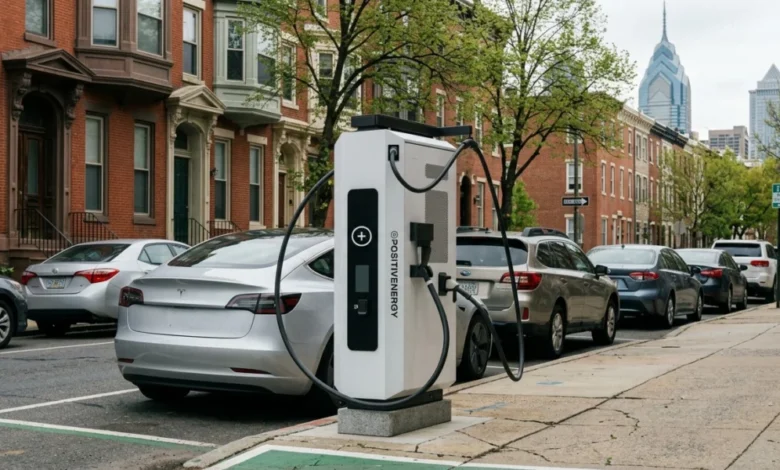
To address this demand, PositivEnergy has been awarded $7.2 million to install 54 DC fast-charging ports distributed across 11 Philadelphia Parking Authority (PPA) lots. These strategic locations will transform standard municipal parking facilities into high-speed energy hubs, allowing drivers to substantially replenish their vehicle batteries in a fraction of the time required by standard Level 2 units.
Furthermore, major private-sector charging networks continue to play a pivotal role in the commonwealth’s infrastructure buildout. Tesla has received two separate awards of $392,000 each, funding the installation of eight fast-charging ports per site at popular regional retail hubs: a Royal Farms location in Broomall and a Wawa convenience store in Plymouth Meeting. Integrating high-speed chargers into familiar, high-traffic commercial waypoints ensures that EV drivers can seamlessly incorporate vehicle charging into their daily errands, mirroring the convenience of traditional gasoline refueling stations.
The Evolution of the Federal NEVI Program
The financial catalyst behind Pennsylvania’s aggressive expansion is the federal NEVI program, established under the landmark Bipartisan Infrastructure Law enacted by the Biden administration. Designed to build a nationwide, interconnected network of EV chargers along designated Alternative Fuel Corridors, the five-year federal initiative allocated a total of $171.5 million to the Commonwealth of Pennsylvania.
During the initial phase of the NEVI rollout, federal guidelines strictly mandated that states prioritize high-speed charging stations along primary interstate highways and major freight corridors. However, federal rules permit states to pivot funding toward broader community-based and regional charging projects once the Federal Highway Administration (FHWA) officially certifies that a state has fully satisfied its primary highway corridor requirements.

Pennsylvania achieved this vital milestone significantly faster than many of its peers. On September 22, 2025, the Federal Highway Administration formally certified that Pennsylvania had met its corridor charging obligations. This certification unlocked the flexibility needed to redirect capital into urban neighborhoods, suburban communities, and municipal parking lots.
To date, Pennsylvania has successfully constructed 54 EV charging stations utilizing dedicated NEVI funds—a performance metric that places the commonwealth more than double ahead of any other state in the nation in terms of realized NEVI project deployment.
Rigorous State Standards and Program Requirements
To ensure long-term reliability, safety, and accessibility, PennDOT has enforced strict compliance criteria for all award recipients participating in the community charging program. According to published state guidelines, every proposed station must feature a minimum of four functional charging ports, guaranteeing redundancy and reducing the likelihood of driver wait times.
Additionally, individual ports must deliver a minimum continuous power output of 6 kW to ensure efficient energy transfer. Accessibility is another cornerstone of the initiative: every funded station must incorporate at least two ADA-compliant parking spaces, ensuring that drivers with disabilities have unhindered access to charging infrastructure.
To maintain broad vehicle compatibility across diverse automotive makes and models, all ports are required to utilize standardized J1772 or Combined Charging System (CCS) connectors. Furthermore, in strict adherence to federal trade policies and manufacturing mandates, all hardware and equipment deployed under the program must meet rigorous Buy America requirements, supporting domestic manufacturing supply chains.
Comprehensive Timeline and Future Funding Rounds

The current batch of 71 awards in the southeastern Pennsylvania region represents just one phase of the commonwealth’s comprehensive statewide strategy. As implementation moves forward, PennDOT has outlined a structured timeline to bring these ambitious projects from blueprint to reality.
For the southeastern regional awards announced in this cycle, the estimated project schedule initiates environmental reviews spanning November 2026 through January 2027. Following the completion of environmental compliance assessments, official grant and intergovernmental agreements are slated for execution across January and February 2027. While administrative approvals will soon be finalized, motorists will need to exercise patience; extensive physical construction, grid interconnection work, and final safety commissioning must take place before these new charging ports are energized and open to the public.
Meanwhile, the statewide funding rollout continues to progress across other geographical sectors. Applications for the western region of Pennsylvania closed on November 20, initiating evaluation phases for Pittsburgh and surrounding western counties. Simultaneously, municipal and private stakeholders in central and eastern Pennsylvania have been given a submission deadline of March 12, 2027, to apply for subsequent rounds of community charging grants.
Socioeconomic and Environmental Implications
The rapid scaling of public charging infrastructure carries profound implications for Pennsylvania’s economy, public health, and environmental footprint. Transportation remains one of the largest contributors to greenhouse gas emissions within the commonwealth. By systematically removing infrastructural barriers to EV adoption, PennDOT’s initiatives directly support state and federal climate goals aimed at curbing carbon emissions and improving regional air quality, particularly within densely populated urban centers like Philadelphia, where vehicular pollution disproportionately impacts local communities.
From an economic standpoint, the large-scale deployment of charging infrastructure stimulates local engineering, construction, and electrical contracting sectors, creating high-paying green-collar jobs throughout the region. Furthermore, the strategic placement of chargers at municipal parking lots, convenience stores, and commercial corridors provides an indirect economic boost to local businesses, as EV drivers frequently patronize nearby retail establishments while their vehicles are plugged in.
As Pennsylvania moves closer to executing its remaining regional funding rounds and transforms millions in federal investment into tangible, operational hardware, the commonwealth is solidifying its position as a national leader in modern transportation infrastructure. By balancing high-speed highway connectivity with equitable, neighborhood-level curbside charging, PennDOT is establishing a scalable blueprint for the future of American electric mobility.