Google DeepMind has officially announced the launch of EmbeddingGemma 2, marking a significant evolution in on-device machine learning capabilities. Building upon the foundational success of its predecessor—which garnered over 20 million downloads following its introduction—the new model expands edge-computing horizons by natively integrating text, code, images, audio, and video into a unified, high-dimensional embedding space. Designed specifically to operate efficiently on consumer hardware, EmbeddingGemma 2 features 740 million parameters and is released under a commercially permissive Apache 2.0 license, positioning it as a powerful tool for developers seeking to build privacy-first, offline-capable artificial intelligence applications without relying entirely on cloud infrastructure.
The release of EmbeddingGemma 2 arrives at a critical juncture in the artificial intelligence industry, where privacy regulations, bandwidth constraints, and the demand for real-time responsiveness are accelerating the shift toward edge computing. Historically, sophisticated multimodal retrieval systems—those capable of cross-referencing audio clips with text queries or extracting visual information from video files—required substantial computational resources, often mandating expensive cloud API calls. The initial iteration of EmbeddingGemma, introduced by Google last year, demonstrated that developers hungered for lightweight, high-performance text embedding models that could run locally on smartphones, laptops, and IoT devices. The immense community response, exceeding 20 million downloads for power-efficient tasks such as local semantic search and Retrieval-Augmented Generation (RAG) pipelines, proved that edge AI was no longer a niche requirement but a mainstream developer priority.
Responding to this demand, Google DeepMind’s research engineers Sahil Dua, Henrique Schechter Vera, and their broader team engineered EmbeddingGemma 2 using technology derived directly from enterprise-grade Gemini Embedding models. By anchoring the architecture in the advanced frameworks of Gemma 4, the engineering team successfully built a sub-1-billion-parameter model capable of handling diverse modalities. A key engineering achievement in EmbeddingGemma 2 is its shared text tokenizer and audio encoder with Gemma 4. This architectural synergy allows developers to deploy both the embedding model and the generative model concurrently in a unified pipeline, drastically reducing the combined memory footprint on resource-constrained hardware.

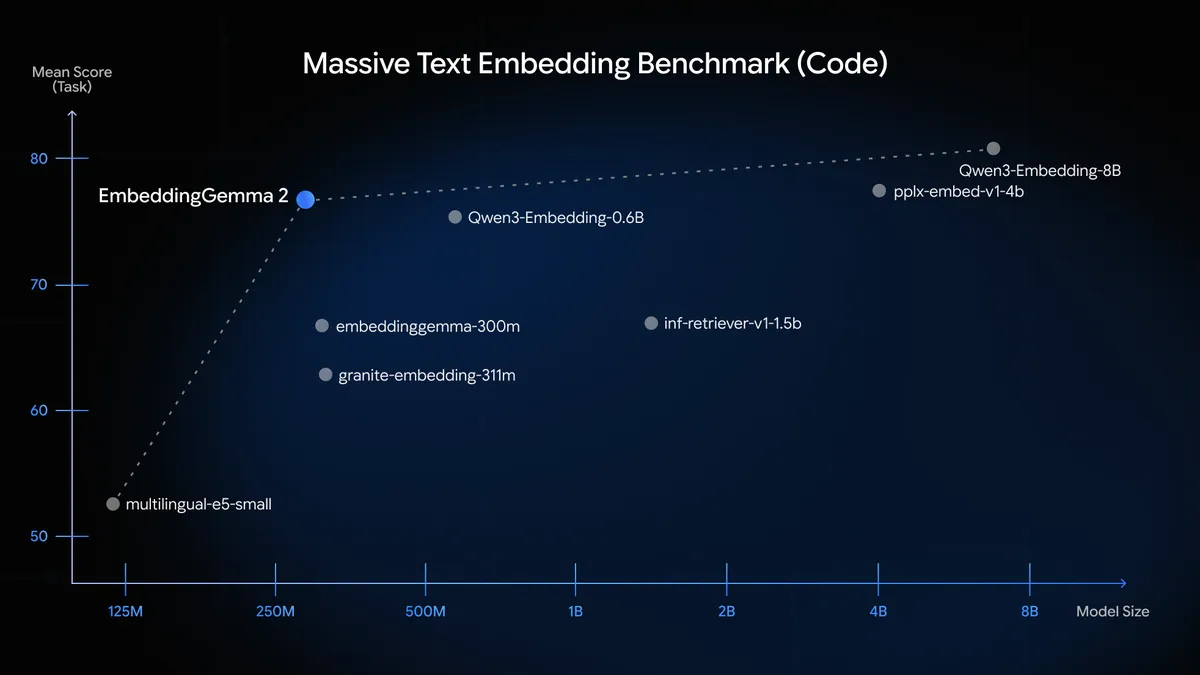
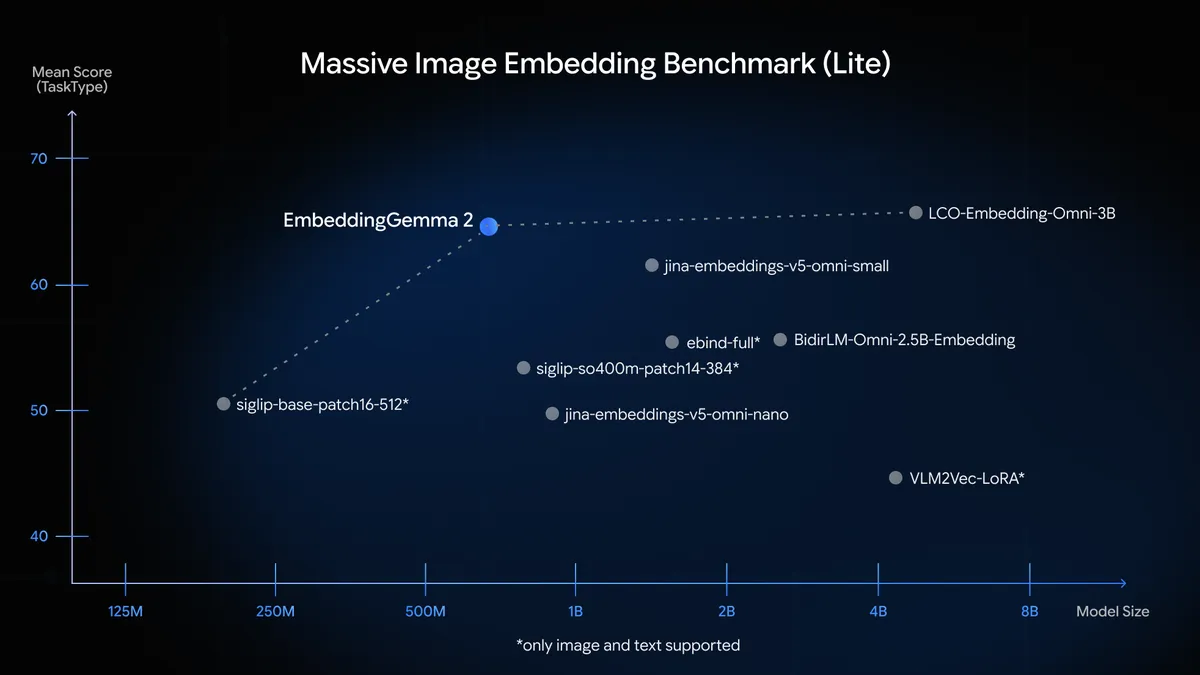
Performance benchmarks released by Google DeepMind underscore substantial leaps forward across multiple computational domains. While maintaining the robust multilingual text performance established by its predecessor, EmbeddingGemma 2 registers a dramatic 9.92-point improvement on code performance within the Massive Text Embedding Benchmark (MTEB Code), surging from 68.76 to 78.68. This leap makes the model exceptionally well-suited for local codebase indexing, semantic code search, and advanced coding agent retrieval tasks. Furthermore, across rigorous evaluations in vision, video, document processing, and audio benchmarking, EmbeddingGemma 2 establishes a new efficiency standard for models under one billion parameters, frequently outperforming specialized models more than twice its physical size.
The implications of these performance gains for developers and enterprise software architects are profound. By bringing robust semantic search, intelligent routing, and precise cross-modal retrieval directly to edge hardware, EmbeddingGemma 2 solves three persistent challenges in application development: data privacy, network latency, and offline operational dependency. Because embeddings are generated locally on the device, sensitive user data—ranging from personal voice memos and private photographs to proprietary enterprise source code—never needs to be transmitted to an external server. This localized processing inherently complies with stringent data protection frameworks such as GDPR and CCPA, while simultaneously eliminating the latency associated with network round-trips to cloud servers.
To fully exploit these capabilities, Google has integrated EmbeddingGemma 2 across several of its developer ecosystems and tools. Through the Google AI Edge Gallery, users can experiment with features like Instant Media Search, which allows individuals to use text or images to pinpoint top matches in a media library based on semantic similarity. Similarly, the Video Moments Finder leverages the model to locate precise temporal markers in long video files using straightforward text or audio queries. For more complex workflows, developers can combine EmbeddingGemma 2 for local file retrieval with Gemma 4 for contextual reasoning via the Google AI Edge Foresight application. Additionally, real-time decision engines can be constructed for classification, routing, and predictive capabilities by utilizing the MediaPipe Decision Task API.
Industry analysts and early-access developer communities have responded positively to the launch, noting that the Apache 2.0 licensing model removes significant legal and financial barriers for commercial adoption. Startups and enterprise organizations alike can now integrate sophisticated multimodal search capabilities into proprietary software without encountering restrictive licensing fees or mandatory data-sharing clauses. By democratizing access to state-of-the-art embedding technology, Google DeepMind has lowered the barrier to entry for building next-generation, context-aware applications that respect user privacy.
To facilitate a seamless adoption process, Google DeepMind has collaborated closely with foundational technology partners to ensure EmbeddingGemma 2 integrates smoothly into existing developer workflows upon launch. Comprehensive documentation, model cards, and specialized guides detailing inference optimization and fine-tuning via sentence-transformers have been published on the official AI and developer portals. As edge computing continues to mature, the introduction of EmbeddingGemma 2 marks a definitive step toward ubiquitous, intelligent, and private artificial intelligence operating quietly and efficiently on the devices we use every day.
Related posts: