Gemini 4 Argon: Our Next Era of Frontier Intelligence Ushers in Advanced AI Capabilities for Enterprise and Cybersecurity

Google has officially introduced Gemini 4 Argon, marking a significant milestone in its artificial intelligence roadmap and establishing a new benchmark for frontier intelligence. Designed specifically to sustain deep, multi-step reasoning across complex, long-horizon workflows, Argon is currently rolling out to a select group of trusted cybersecurity defenders through the Fairwind Program. This launch represents a foundational shift in how Google builds and operates internally, while also setting the stage for broader enterprise, developer, and consumer deployments following a rigorous, phased safety evaluation.

The introduction of Gemini 4 Argon arrives at a pivotal moment in the generative artificial intelligence landscape. Over the past several years, the industry has transitioned from models optimized for rapid conversational responses to systems capable of complex problem-solving, advanced mathematics, and extended contextual reasoning. Google’s latest architecture addresses a critical bottleneck in enterprise adoption: the need for models that can maintain coherent reasoning trajectories over hundreds of thousands of input and output tokens without losing sight of the primary objective. By expanding the output token limit to an industry-leading one million tokens—a massive leap from the previous 64,000-token threshold—Argon provides the cognitive headroom required to tackle intricate, multi-layered problems in a single execution trajectory.
Expanding Horizons in Software Engineering and Enterprise Workflows
Gemini 4 Argon’s technical prowess extends across multiple high-stakes domains, notably real-world software engineering, quantitative finance, legal research, and automated business processes. Internally, thousands of Google engineers have leveraged the model to accelerate specialized coding tasks, conduct exhaustive codebase migrations, and design complex algorithms.

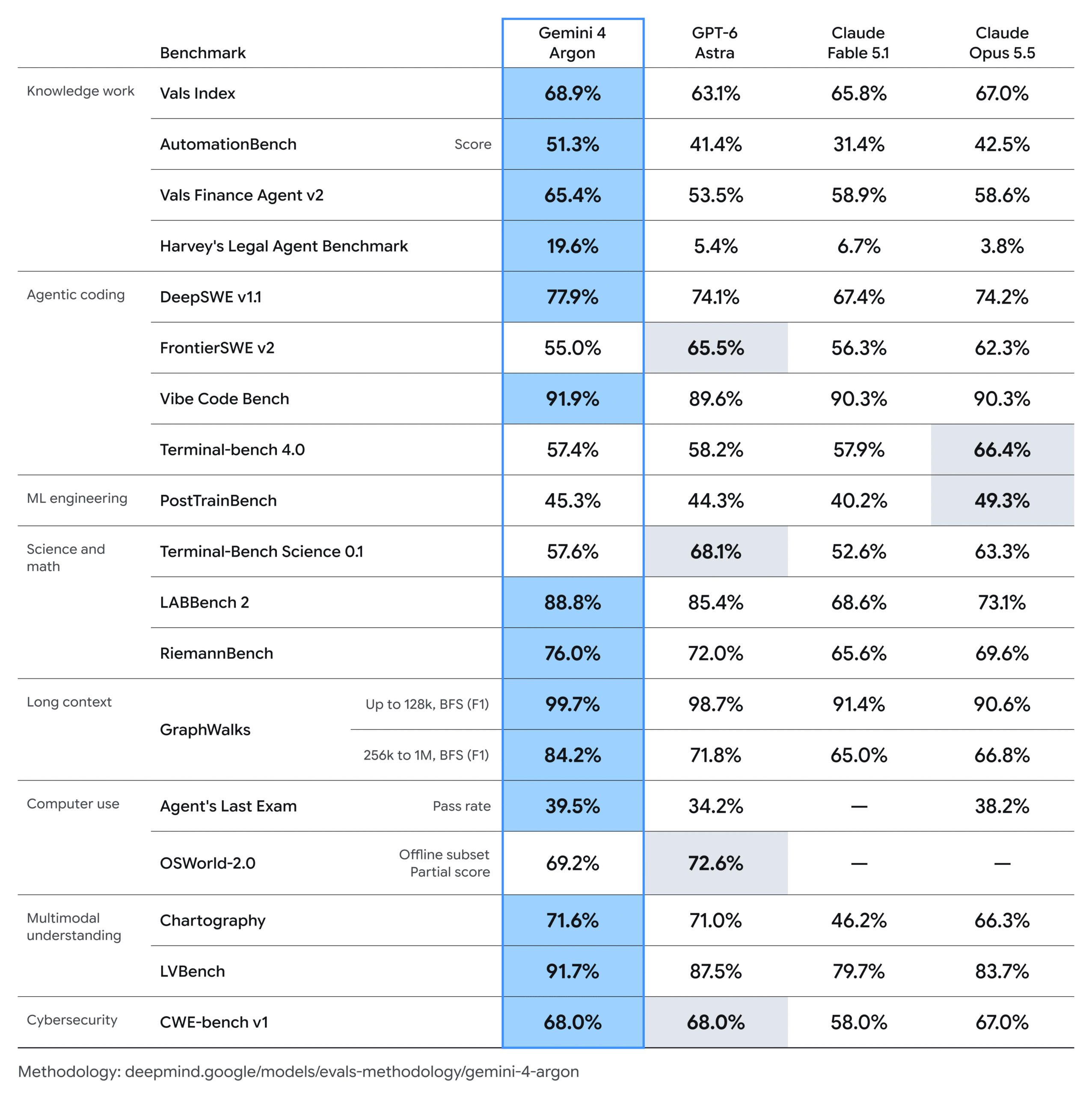
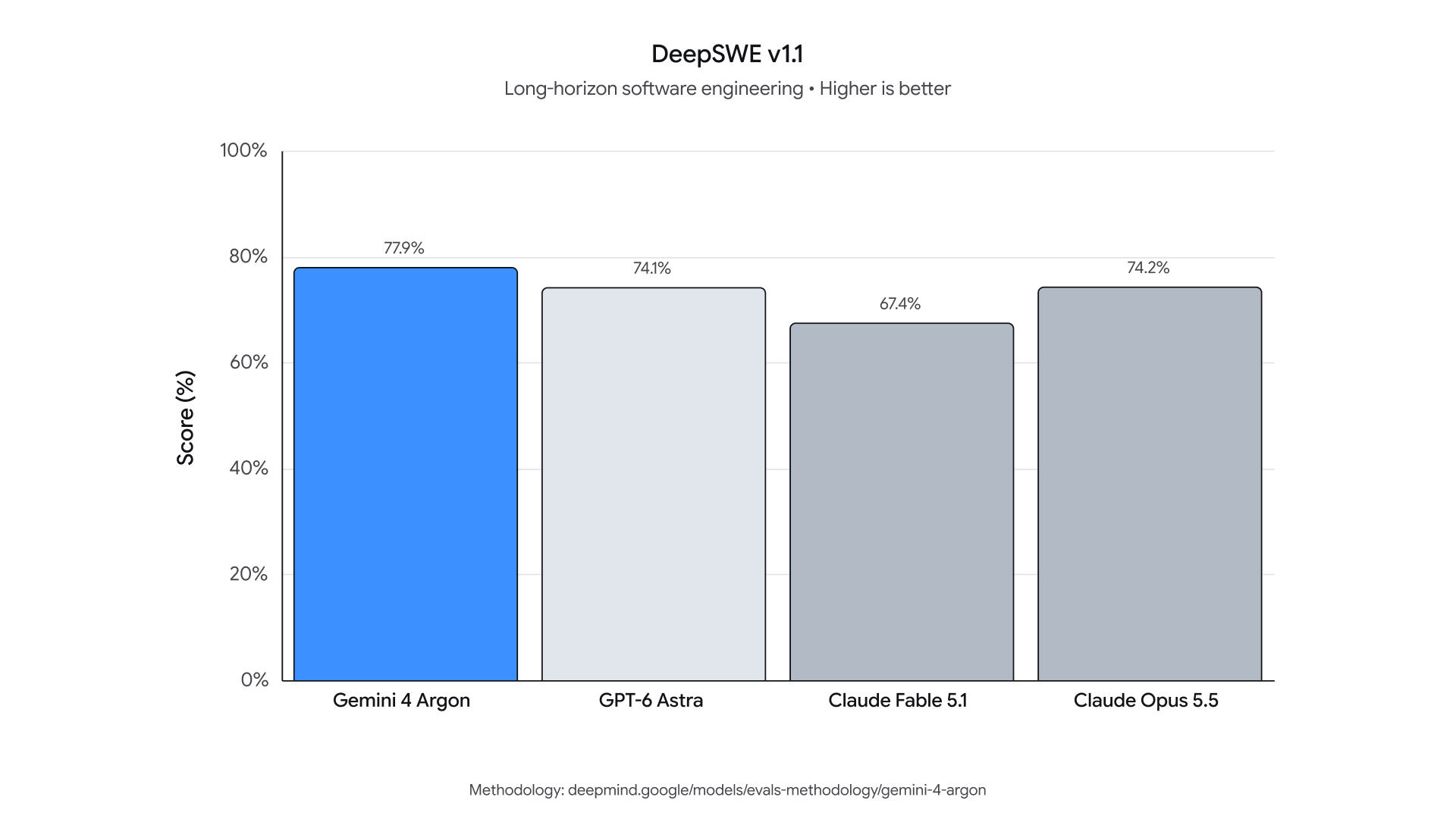
Performance metrics underscore these capabilities. Argon has established a new state-of-the-art score of 77.9% on DeepSWE v1.1, a rigorous benchmark measuring performance in real-world, long-horizon software engineering tasks. Furthermore, the model leads the Vals Index, an evaluation framework that measures economic impact across finance, coding, legal, and tax work, with sectors weighted by their respective contributions to the United States Gross Domestic Product.
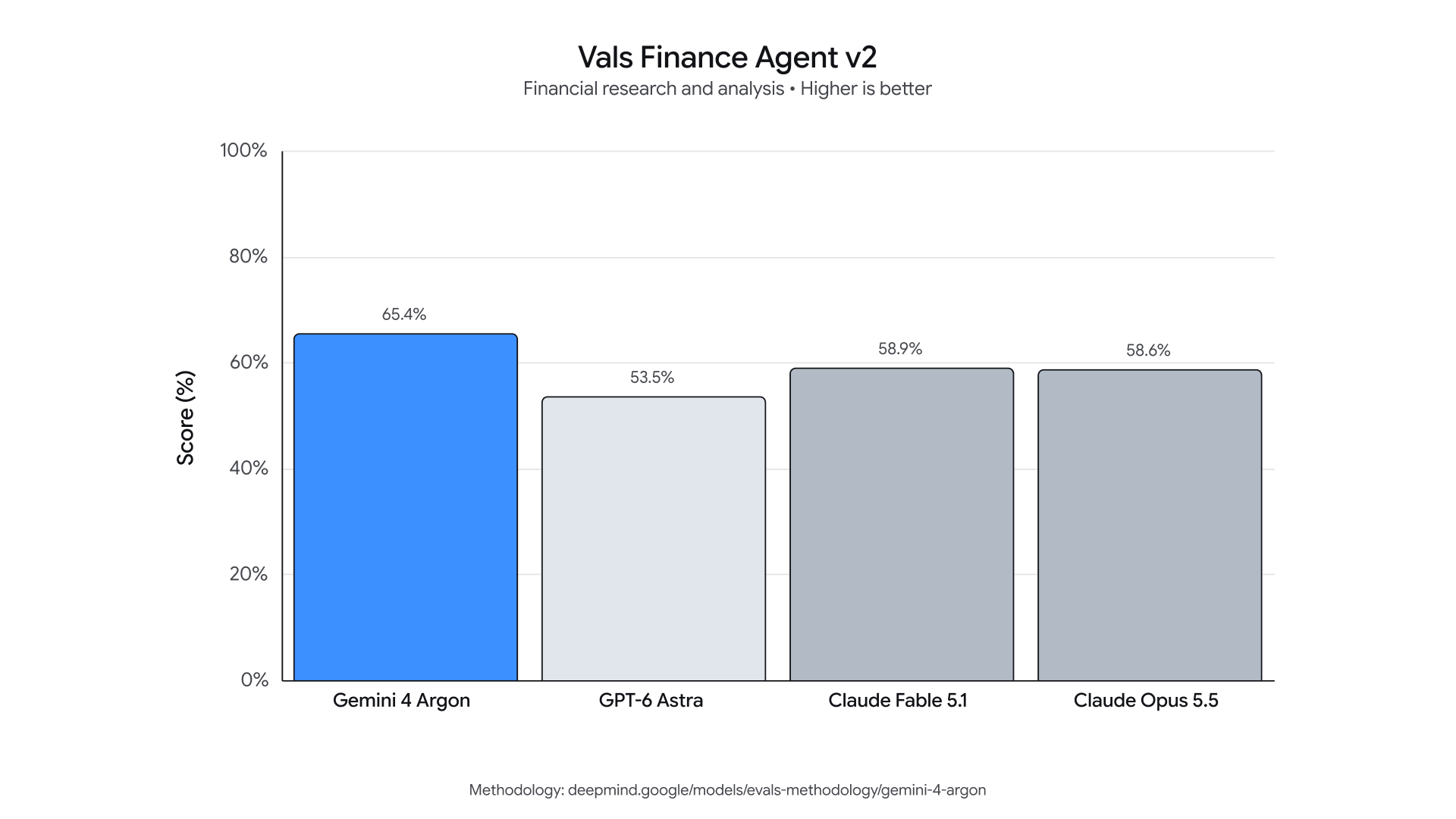
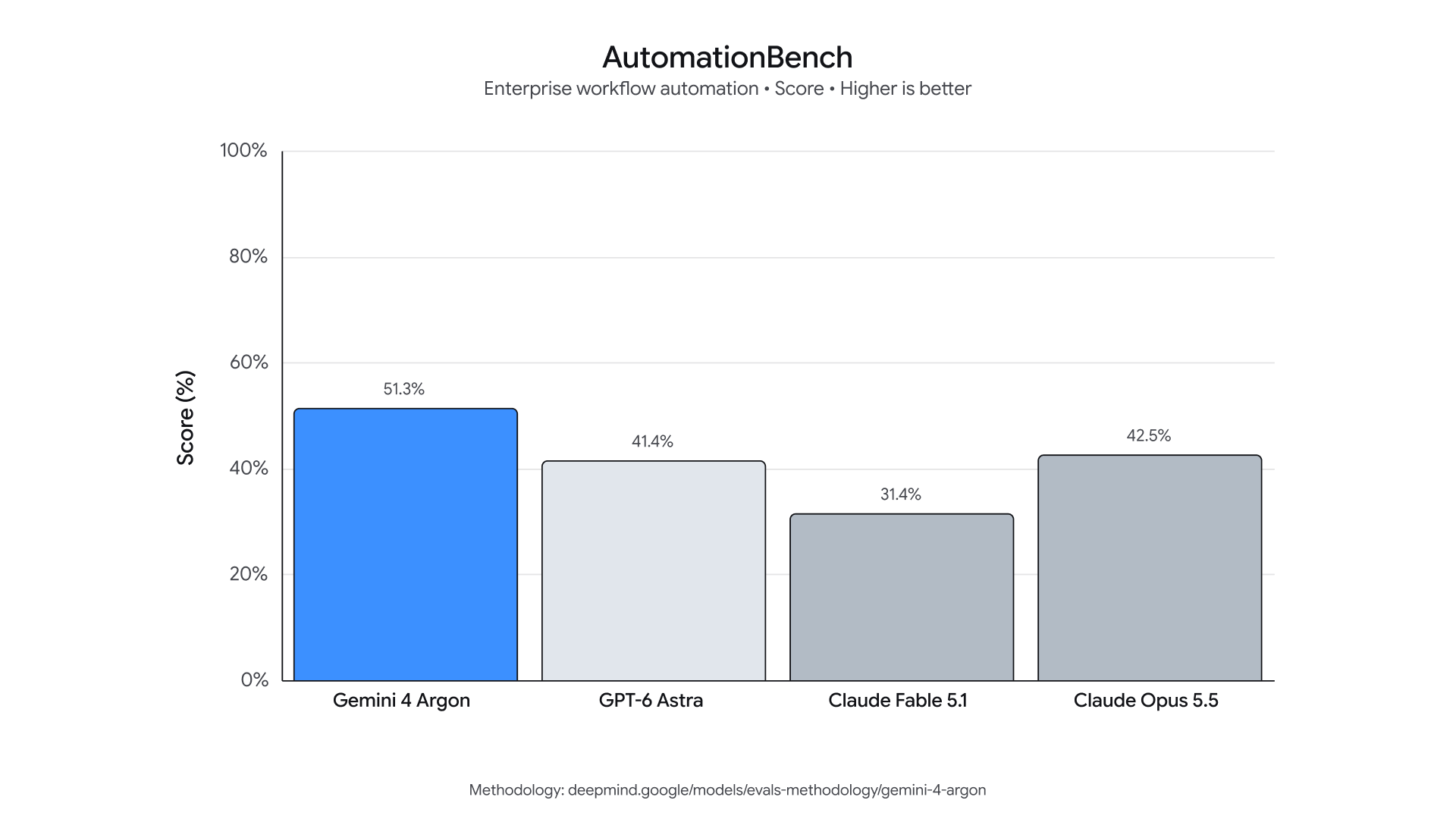
In specialized professional domains, Argon demonstrates similar dominance. It leads the Vals Finance Agent v2 benchmark for multi-step financial research and ranks at the top of Harvey’s Legal Agent Benchmark for complex legal research and document drafting. For general enterprise automation, the model secured the number one position on Zapier’s AutomationBench with a score of 51.3%, measuring end-to-end execution across core business functions.

Multimodal comprehension remains a cornerstone of the Gemini architecture. Argon excels in visual understanding tasks, such as professional financial chart analysis, multi-document synthesis, and long-form video comprehension. On LVBench, which evaluates long video understanding, the model achieved a state-of-the-art score of 91.7%, proving its capacity to extract actionable insights from hours of visual data.
Transforming Defensive Cybersecurity
A defining characteristic of the Gemini 4 Argon rollout is its specialized training for defensive cybersecurity operations. Recognizing the evolving threat landscape, Google has trained Argon to autonomously discover, validate, and remediate critical software vulnerabilities. For trusted cyber defenders and internal security teams, Google is releasing Argon without traditional cyber guardrails, empowering security professionals to leverage its full capabilities against sophisticated threats.
Early real-world deployments highlight the tangible impact of this approach. Cybersecurity firm Wiz has integrated Argon into its Scan for Good initiative, a program dedicated to protecting critical public infrastructure by proactively identifying and remediating high-risk exposures. During initial testing, Argon uncovered a critical zero-day vulnerability that exposed sensitive personal information across hospital software utilized globally—a severe risk that previous frontier models had failed to detect.
On CWE-bench v1, which evaluates an artificial intelligence system’s ability to remediate security vulnerabilities, Argon tied for first place with a top score of 68%. This performance builds upon the foundational security capabilities demonstrated by earlier iterations like the 3.8 Flash Cyber model on CWE-bench v0, illustrating a rapid trajectory improvement in automated vulnerability discovery and patching.

Rigorous Safety Frameworks and Phased Deployment
The deployment of frontier-level intelligence necessitates unprecedented safety protocols. Recognizing the dual-use nature of advanced AI models—where capabilities useful for defense can theoretically be repurposed for misuse—Google is utilizing a phased release schedule. The company is actively participating in the United States government’s voluntary pre-release model access process while gradually expanding availability to trusted partners.
To mitigate risks before broad availability to developers, enterprises, and consumers, Google has implemented a comprehensive safety framework centered on four core pillars:
-
Defending Against Misuse: Argon is engineered to refuse harmful requests related to cyberattacks or chemical, biological, radiological, and nuclear (CBRN) threats while preserving legitimate, dual-use scientific research. Safety teams have enhanced monitoring techniques to observe the model’s internal activations, enabling the early detection of potential misuse. Internal and external red teams subjected the model to exhaustive manual and automated adversarial testing.
-
Mitigating Prompt Injections: The model exhibits unprecedented resilience against indirect prompt injections, a complex attack vector where malicious instructions embedded in external data attempt to hijack model behavior. Through automated red teaming and adversarial training, Gemini 4 Argon leads the industry in prompt injection robustness on Gray Swan’s Indirect Prompt Injection benchmark.

-
Monitoring for Misalignment: To prevent models from deviating from user intentions during complex execution paths, Google is deploying advanced mitigation systems that monitor Argon’s chain-of-thought reasoning in real time, halting execution when anomalous behavior is detected. Google advocates for industry-wide reasoning transparency, arguing that preserving visibility into a model’s thought process is essential for diagnosing alignment risks.
-
Hardening Evaluation Environments: In alignment with emerging agent control roadmaps, Google has isolated and sealed its sandboxed testing environments prior to high-risk training and evaluations, establishing security best practices intended to be shared across the broader technology ecosystem.
Commercial Availability and Pricing Structure
Gemini 4 Argon will launch with an introductory pricing model set at $2 per million input tokens and $10 per million output tokens. To support cost-effective enterprise scaling, cached input tokens will receive a 95% discount off the standard input token price.
Following the initial rollout phase with cyber defenders and specialized testers, Argon will become accessible to developers and enterprise customers through paid API channels, as well as to consumers subscribed to Google AI Ultra. As organizations increasingly demand autonomous systems capable of bridging the gap between raw compute and complex enterprise workflows, Gemini 4 Argon establishes a new baseline for what artificial intelligence can achieve in professional and technical environments.
Related posts: