Critical Memory Corruption Flaw in Google Brotli Decoder Exposes Global Infrastructure to Remote Code Execution

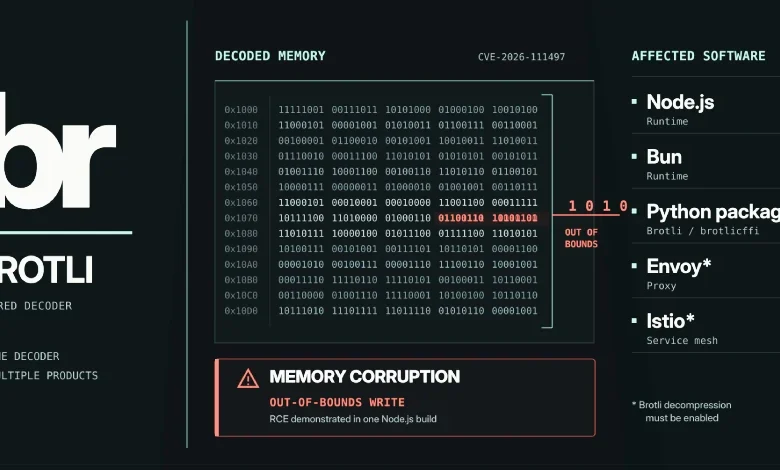
A severe memory-corruption vulnerability, cataloged as CVE-2026-111497, has emerged within the widely used Google Brotli compression library, triggering a comprehensive security scramble across the global software ecosystem. The flaw, which allows for unauthorized memory overwrites during the decompression process, impacts a vast array of critical infrastructure components, including runtime environments like Node.js and Bun, high-performance web proxies such as Envoy and Istio, and common Python utility packages. Because Brotli is a foundational compression format for web traffic, the vulnerability’s reach is extensive, potentially enabling unauthenticated attackers to trigger application crashes, initiate memory leaks, or achieve full remote code execution (RCE).
The vulnerability stems from a flaw in the C-based implementation of the Brotli decoder. When an application attempts to decompress a maliciously crafted Brotli stream, the decoder can be tricked into writing data beyond the boundaries of its allocated buffer. This buffer overflow mechanism creates a window for memory corruption that, in specific configurations, can be weaponized to execute arbitrary code. The discovery of this vulnerability has highlighted the inherent risks of shared low-level library dependencies, where a single bug in a foundational codebase propagates into disparate software environments, each requiring its own independent patching cycle.
A Chronology of Discovery and Disclosure
The timeline of CVE-2026-111497 is particularly notable due to the "hidden" nature of the underlying fix. The root cause of the vulnerability was addressed within the Google Brotli source code on February 27, 2026. At the time of that commit, the security implications of the logic error were not fully understood, and the fix was integrated into the codebase without an immediate public security advisory or a coordinated release. Consequently, the vulnerable code remained embedded in versions of the library deployed globally for months.
It was not until October 21, 2026, that the issue was formally identified as a high-severity security risk by the Codex Security team at OpenAI. Researchers Khai Tran and Sylvie Mayer were instrumental in identifying the potential for exploitation, which they subsequently reported to maintainers. The disclosure triggered a wave of coordinated releases. Node.js and Google issued patches on that same day, initiating a cascading series of updates across the software supply chain. Since then, maintainers of Bun, Envoy, Istio, and various Python packages have scrambled to release updated binaries to mitigate the risk of exploitation.
The Scope of Exposure: Technical Implications
The technical impact of CVE-2026-111497 varies significantly depending on how a specific application utilizes the Brotli library. The flaw is fundamentally an input-handling vulnerability; therefore, it only poses a threat when a system or application is configured to decompress untrusted Brotli data.

In the context of JavaScript runtimes, such as Node.js and Bun, exposure is primarily tied to the fetch() API and common middleware. When these runtimes automatically process responses with the Content-Encoding: br header, they invoke the vulnerable decoder. Similarly, back-end frameworks like Express.js—specifically when using body-parsing middleware—are susceptible if they are configured to unpack incoming Brotli-compressed request bodies.
For network infrastructure, including Envoy proxies and the Istio service mesh, the vulnerability is localized to configurations where Brotli decompression is explicitly enabled as a filter. If the feature is disabled, the system remains protected from the flaw regardless of the library version in use.
The Python ecosystem presents a unique set of challenges. Because popular HTTP clients such as requests, urllib3, httpx, and aiohttp automatically decode Brotli responses if the brotli or brotlicffi packages are installed, an application can be vulnerable simply by virtue of having these dependencies present in its environment, even if the application code itself does not directly invoke Brotli functions.
Industry Reactions and Threat Analysis
The severity of the vulnerability has led to disparate scoring among industry standard-bearers. Google, as the primary maintainer of the Brotli format, assigned the flaw a CVSS 4.0 score of 9.2, classifying it as "critical." Conversely, Red Hat and the Node.js project team have adopted a more conservative assessment, labeling the vulnerability as "important" or "high," with a CVSS score of 8.1. These differences reflect varying interpretations of the difficulty required to weaponize the flaw in real-world scenarios.
The security firm Imperva, which conducted an in-depth analysis of the exploitability of the bug, demonstrated that it is possible to achieve remote code execution on an unpatched Node.js 24.22.0 build running on Linux/ARM64. Their research, internally dubbed "Node2Shell," involved delivering the malicious payload both as a standard HTTP response and as an Express request body. While Imperva’s proof-of-concept confirmed the feasibility of an attack, it also noted that the exploit process is complex and required multiple attempts to succeed.
Despite the theoretical risk, there have been no confirmed reports of the vulnerability being exploited in the wild. Both CISA (the Cybersecurity and Infrastructure Security Agency) and Red Hat have reported no evidence of active exploitation or the existence of reliable, widespread, or "off-the-shelf" proof-of-concept code that would lower the barrier to entry for malicious actors.

Mitigation and Remediation Strategies
The primary defense against CVE-2026-111497 is the prompt application of patches. Given that the vulnerability exists in a library that is often statically linked or bundled within other software, updating the system-wide library is rarely sufficient. Users must update the specific application or runtime environment that contains the vulnerable decoder.
The following steps are recommended for security administrators:
- Inventory Assessment: Identify all systems running Node.js, Bun, Envoy, Istio, or Python environments that include the
brotliorbrotlicffipackages. - Version Verification: Compare current versions against the patched versions listed in security advisories (e.g., Node.js 22.23.4, 24.22.1, 26.12.1; Bun 1.4.4; Envoy 1.40.0, etc.).
- Deployment of Updates: Prioritize the deployment of patched versions. It is essential to remember that for containerized environments, simply updating the base image is not enough; the service must be restarted and the container rebuilt to ensure the old, vulnerable decoder is cleared from memory.
- Workarounds: In environments where immediate patching is impossible, security professionals should consider disabling Brotli decompression at the edge or within the application configuration. While removing
brfrom theAccept-Encodingheader may appear to be a viable strategy, it is often ineffective because it only informs the server of the client’s preference; a malicious server can still force a compressed response, triggering the vulnerability in the client.
Broader Implications for Software Supply Chain Security
The discovery of CVE-2026-111497 serves as a stark reminder of the complexities inherent in modern software supply chains. The fact that a critical vulnerability could persist in a foundational library for months—even after a functional fix had been committed to the source code—underscores the need for better communication between open-source maintainers and downstream consumers.
Furthermore, this event highlights the "dependency blindness" that plagues many organizations. Because the vulnerability exists within a library that is often a secondary or tertiary dependency (e.g., a dependency of a web framework, which is a dependency of the main application), many automated scanners may fail to flag the risk effectively. The delay in GitHub’s advisory process and the initial lack of coverage in standard dependency-scanning tools like Dependabot suggest that security teams must move beyond simple automated alerts and maintain a more proactive, manual oversight of their critical software dependencies.
As the industry continues to rely on high-performance, complex libraries for data compression and network efficiency, the risks associated with memory-unsafe languages (like C) in these components will remain a persistent concern. The transition toward memory-safe alternatives or more rigorous formal verification of such core libraries may eventually become a standard industry requirement. For now, the imperative remains clear: transparency, timely patching, and a deep understanding of one’s own software bill of materials (SBOM) are the most effective defenses against the quiet, underlying threats that inhabit the digital infrastructure.
Related posts: