Automating Knowledge Graph Population: Extracting Entities and Triples from Unstructured Text with an LLM

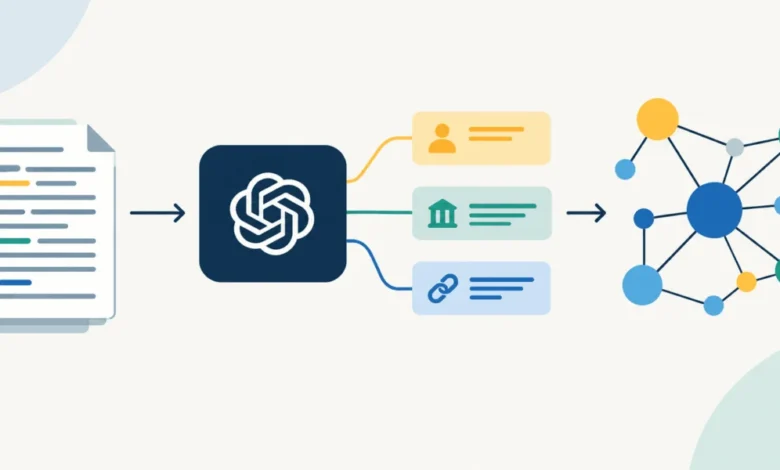
The paradigm of modern information retrieval is undergoing a significant transformation, moving away from purely probabilistic vector-based search toward deterministic, graph-augmented architectures. While vector search excels at capturing semantic similarity, it remains inherently susceptible to the "hallucination" phenomenon, where Large Language Models (LLMs) generate plausible but factually incorrect information. To mitigate this, developers are increasingly turning to Knowledge Graphs (KGs) to serve as a ground-truth foundation. By integrating structured data into Retrieval-Augmented Generation (RAG) pipelines, systems can cross-reference generated text against verified facts. However, a major bottleneck persists: the labor-intensive process of converting vast amounts of unstructured human language into structured graph data. This article outlines an automated methodology to extract structured entities and relationships from raw text, transforming them into Subject-Predicate-Object-Context (SPOC) quads using local, open-source LLMs deployed via Ollama.
The Evolution of Knowledge Representation
For decades, the semantic web relied on the Resource Description Framework (RDF) to represent information as triples: (Subject, Predicate, Object). This structure allows machines to interpret the relationships between entities, such as "Alan Turing" (Subject) "is" (Predicate) "a mathematician" (Object). While powerful, standard triples lack the nuance required for dynamic, evolving datasets. In a modern enterprise RAG system, knowing the source of a fact is as important as the fact itself.
By introducing a fourth dimension—the "Context"—developers can track the provenance, temporal validity, and authority of a statement. A SPOC quad, such as ("Alan Turing", "was born", "in London", "Wikipedia_Biography_2024"), provides an audit trail that allows a system to weigh conflicting information. If a document suggests a different birthplace, the system can prioritize the source with the higher authority or more recent timestamp.
Technical Prerequisites and Environment Setup
The transition from unstructured text to a populated knowledge graph is now accessible to individual developers, thanks to the accessibility of local LLMs. The deployment of models such as Llama 3.2 via the Ollama framework allows for high-performance data extraction without the data privacy risks or costs associated with cloud-based API calls.
To initiate this workflow, developers must first ensure the Ollama server is operational. In a standard Linux or macOS environment, the server runs as a background process, listening for requests. Using the subprocess module in Python, a developer can programmatically start the server, verify the installation of the desired model—Llama 3.2 is highly recommended for its balance of speed and reasoning capability—and begin the extraction process.
The essential dependencies for this pipeline include the wikipedia library, which provides a clean interface for content ingestion, and the requests library to handle the JSON-formatted communication between the local Python script and the Ollama API. By setting the auto_suggest parameter to False in the Wikipedia API, the system avoids common pitfalls where entities with similar names are misidentified, ensuring the data source remains precise.
The Extraction Pipeline: From Narrative to Structure
The core of the automation lies in the prompt-engineering strategy applied to the LLM. Unlike traditional Natural Language Processing (NLP) techniques that rely on brittle regex patterns or dependency parsing, LLMs demonstrate an advanced ability to understand the intent behind a sentence.
When feeding text to the model, the instructions must be explicit. The system is instructed to act as a data extraction engine, outputting strictly valid JSON. A typical prompt requires the model to isolate the subject, identify the relational predicate, and extract the object. By enforcing a zero-temperature setting, developers ensure that the model remains deterministic, producing the same structured output for identical input text—a necessity for building consistent, reliable databases.
The normalization step is equally critical. In practice, LLMs may return varying key names, such as "sub" vs. "subject" or "pred" vs. "predicate." A robust post-processing layer in Python is required to intercept the JSON output, normalize the keys to a standard schema, and inject the "Context" variable, which labels the origin of the data. This ensures that the downstream QuadStore receives a clean, uniform stream of data.
Constructing the QuadStore
The QuadStore acts as a lightweight, in-memory graph database. In a production environment, this might be replaced by a graph-native database like Neo4j or an RDF store like Apache Jena. However, for prototyping and mid-sized applications, a Python-based dictionary or list-of-tuples implementation is highly efficient.
The add method in the QuadStore class performs a critical deduplication check. Before a new quad is appended to the database, the system verifies that the specific combination of Subject, Predicate, Object, and Context does not already exist. This prevents the "graph bloat" that can occur when the same fact is extracted multiple times from different paragraphs of the same source. The query method then allows for complex filtering, where a user can retrieve all facts associated with a specific subject or context, providing the granular control necessary to ground LLM responses.
Empirical Results and Performance Analysis
Tests conducted on short biographies, such as that of Alan Turing, illustrate the efficiency of this approach. From approximately 1,200 characters of raw text, an LLM can reliably extract between 10 to 15 unique, high-fidelity quads. These quads capture diverse information, ranging from biographical milestones ("was born in London") to professional achievements ("led Hut 8").
This data is then ready for immediate ingestion into a Graph-RAG system. The primary advantage here is the reduction in latency. Because the extraction is performed locally and the graph storage is optimized for rapid lookup, the system can answer fact-based queries in milliseconds. Furthermore, because the source context is embedded in every quad, the system can provide citations to the user, significantly increasing the transparency of the AI-generated responses.
Broader Implications for AI Infrastructure
The integration of LLMs with automated Knowledge Graph population marks a shift toward "self-organizing" data systems. Historically, building a knowledge graph required teams of data engineers to manually define ontologies and curate links. This new automated approach allows organizations to treat their existing, massive archives of unstructured text—PDFs, internal documentation, and research papers—as a living, breathing knowledge base.
However, analysts note that while this process is highly effective for fact extraction, it is not without challenges. The accuracy of the knowledge graph is entirely dependent on the quality of the source text and the reasoning capabilities of the LLM. If the source text contains errors or bias, the graph will propagate those inaccuracies. Therefore, the "Context" field is not just a feature for retrieval; it is a critical tool for governance. By knowing the source of every fact, administrators can periodically purge or update the graph as new information becomes available, ensuring the system remains current.
Conclusion and Future Outlook
Automating the population of a knowledge graph with SPOC quads represents a pivotal advancement in the development of reliable AI. By combining the linguistic flexibility of Llama 3.2 with the structural rigor of a QuadStore, developers can create systems that are both conversational and factually grounded. This "3-tiered" architecture—comprising raw text retrieval, vector search, and graph-based verification—provides a comprehensive solution to the challenges of modern information management. As this technology matures, we can expect to see a decline in AI-related misinformation, replaced by systems that are capable of reasoning over structured facts with the precision of a traditional database and the fluidity of a modern language model. The loop has been closed: raw data is no longer a liability, but the fuel for a more accurate, transparent, and deterministic future in artificial intelligence.