Court Orders Seizure of Radaris.com and Sister Domains in Landmark Daniel’s Law Enforcement Action


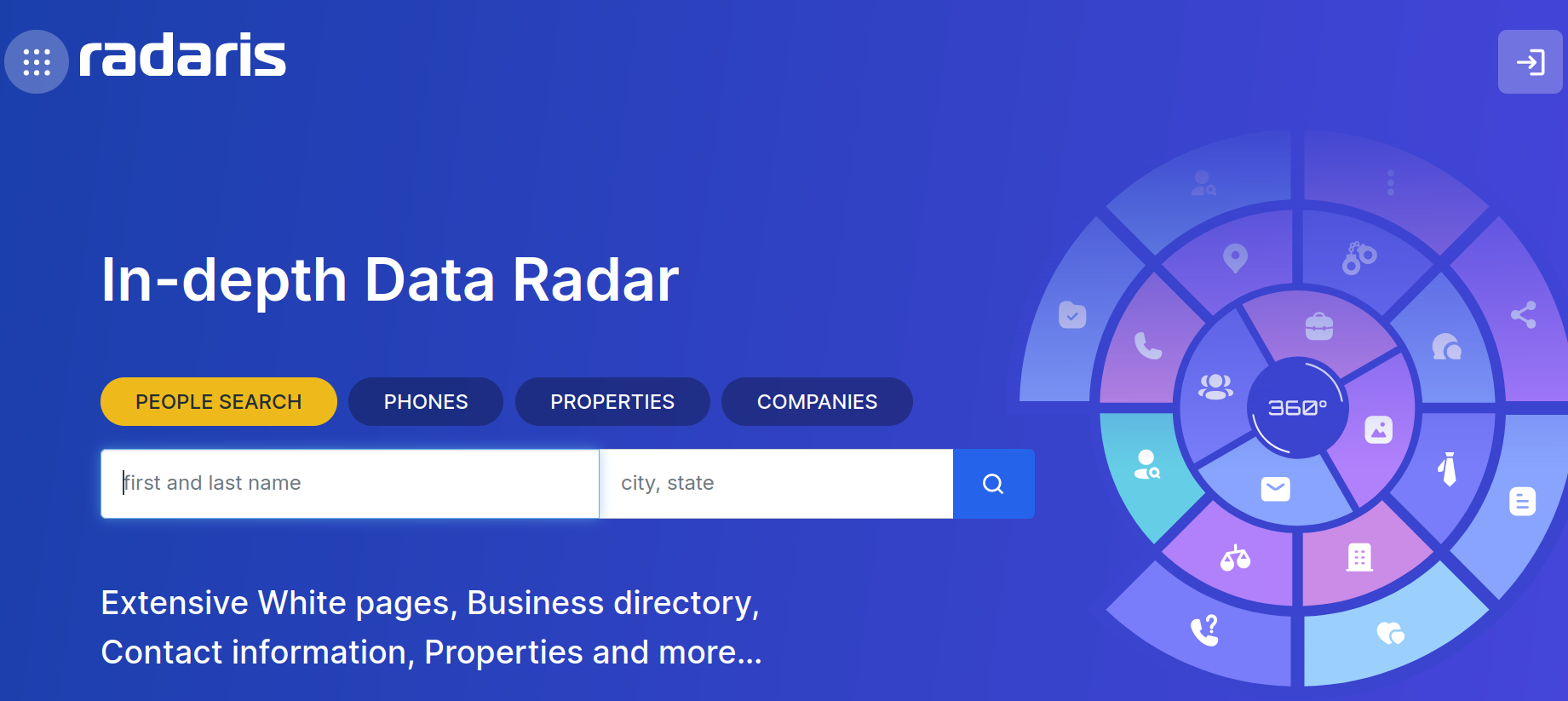
The opaque world of consumer data brokering faced a historic judicial reckoning after a federal and state legal crusade led to the forfeiture of radaris.com and more than a dozen associated people-search domains. For years, Radaris operated as a fixture of the unregulated information economy, systematically ignoring requests to purge personal dossiers from its index. That strategy of evasion collapsed under the weight of a New Jersey privacy statute designed to protect public servants from harassment and targeted stalking. In a decisive ruling, a New Jersey court ordered the transfer of Radaris’s primary internet real estate directly to the plaintiffs, setting a high-stakes precedent for the multi-billion-dollar data harvesting industry.
The enforcement action stems from a relentless compliance campaign spearheaded by Atlas Data Privacy Corp, a firm that initiated legal proceedings against Radaris in February 2024. The lawsuit alleged that the consumer intelligence broker flagrantly violated New Jersey’s Daniel’s Law. Named in honor of Daniel Anderl—the son of U.S. District Judge Esther Salas, who was tragically murdered at her home by a disgruntled litigant who obtained the family’s address online—the statute mandates the complete removal of personal identifiable information for judges, prosecutors, law enforcement personnel, and their immediate families from commercial databases. Crucially, the legislation carries severe financial penalties, assessing statutory fines of $1,000 per violation against entities that disregard verified takedown requests.
A Chronology of Evasion and Corporate Shell Games
The collapse of the Radaris domain empire was years in the making, characterized by a complex cat-and-mouse game of legal deflection, fake executive personas, and offshore corporate restructuring. The operational roots of Radaris trace back to Russian-born brothers Igor and Dmitry (also known as Dan) Lubarsky, who established residency in Massachusetts while overseeing an extensive portfolio of people-search portals, affiliate revenue programs, and online dating services.
In March 2024, investigative reports published by cybersecurity journalist Brian Krebs unmasked the Lubarsky brothers as the true masterminds behind Radaris. The reporting revealed that the company had long utilized a fictitious chief executive officer named "Gary Norden" to front the enterprise, issuing press releases and courting investors under the fabricated identity. When confronted by reporters, legal representatives for the brothers initially threatened defamation litigation, falsely claiming the enterprise was actually operated by Ukrainian nationals residing in Ukraine. However, defense counsel later conceded in court filings that the "Gary Norden" persona was entirely invented.
As litigation intensified, the corporate structure behind Radaris underwent a constant state of flux. Atlas Data Privacy Corp CEO Matt Adkisson described the defense strategy as an elaborate "island-hopping" phase designed to frustrate judicial oversight. Whenever plaintiffs neared a viable judgment, the operating entity behind the websites would quietly dissolve, replaced overnight by newly minted shells incorporated in offshore tax havens such as the Marshall Islands, the British Virgin Islands, and Seychelles.
In one instance, after defense attorneys asserted that Radaris was managed by a newly designated entity in the Marshall Islands, private investigators retained by Atlas discovered that the purported management corporation did not legally exist at the time of the claim. This jurisdictional shell game mirrored tactics used in a 2017 class-action lawsuit, where Radaris was initially hit with a $7.5 million default judgment. When plaintiffs attempted to collect, defense attorneys successfully halted a domain transfer by arguing that the true owner was a Cyprus-based firm named Bitseller Expert Limited, thereby depriving the actual owners of due process. Rather than re-litigating against the shifting corporate entities at the time, plaintiffs allowed the case to stall—a victory by attrition that Radaris relied upon for nearly a decade.
Uncovering the Data Broker Ecosystem Through Internal Documents
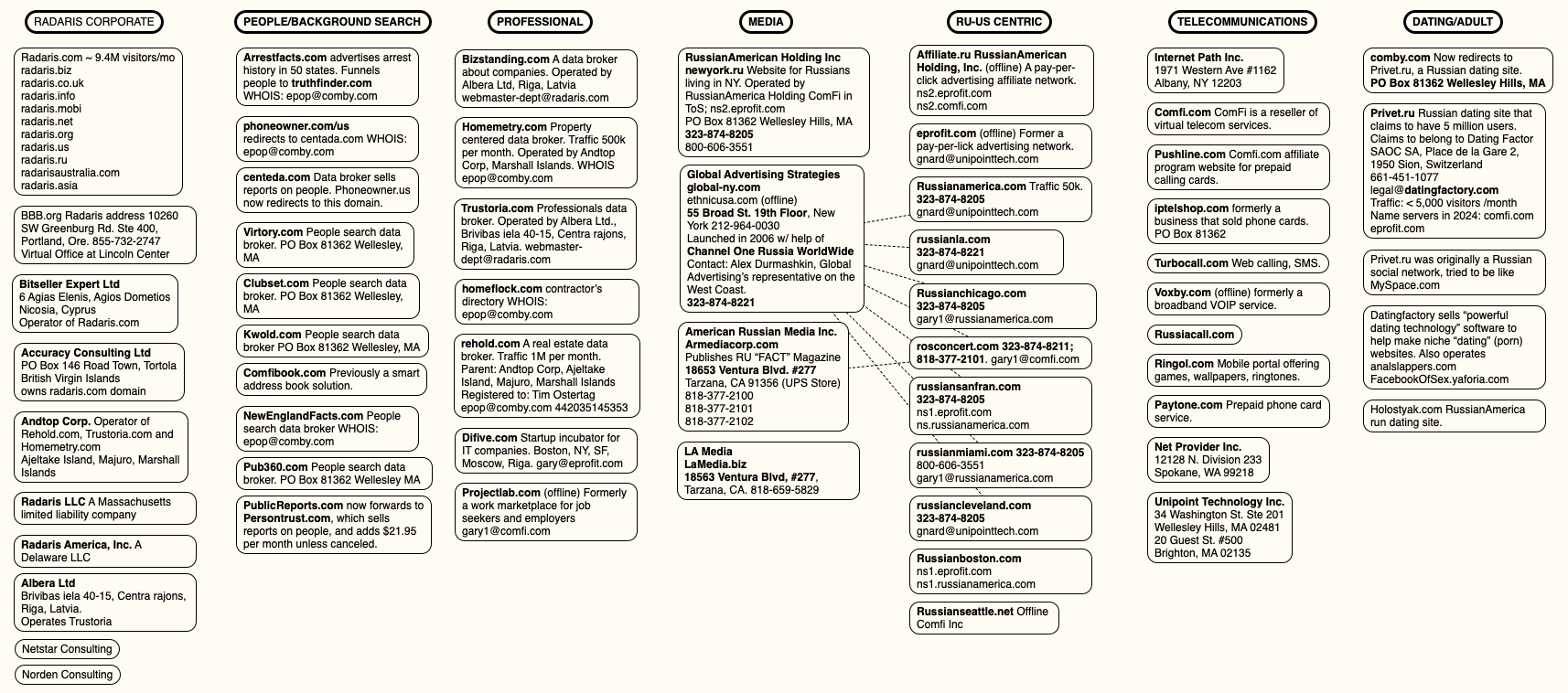
The turning point in the recent litigation arrived when Atlas secured more than 10,000 internal emails, financial statements, and operational documents through the discovery process. According to Atlas, these records definitively map out the centralized architecture of the Radaris network, demonstrating that nominal legal entities—including Radaris America Inc., Bitseller Expert Limited, Digital Orbit Corp, Core Solutions Group Inc., Lucky Solutions Inc., Virtura Corp, Veripages Inc., Nuform Solutions Inc., Growth Data Advisors Inc., and Property Experts Inc.—were merely fractional facades for a single unified operation.
The evidentiary corpus established that at least 25 distinct people-search websites shared a centralized infrastructure managed by a small collective near Boston, utilizing the same financial accounts, merchant processors, and administrative mail domains such as difive.com, centerex.com, and eprofit.com. Financial documents reviewed during the litigation shed light on the lucrative nature of the enterprise. Radaris.com reportedly generated approximately $42,000 per month, while sister site Veripages.com brought in an estimated $45,000 monthly through lucrative partnerships with major marketing conglomerates like the Lifetime Value Company, which operates consumer search brands such as PeopleLooker, PeopleSmart, NumberGuru, and vehicle history provider Bumper.
Furthermore, the documents revealed financial ties between the Radaris network and Onerep, a privacy-management firm that claims to help individuals scrub their data from people-search engines. Investigators noted a circular business model wherein data operators simultaneously launched lookup engines while profiting from removal services, effectively monetizing both the exposure and the remediation of consumer privacy.

Legal Defenses and Constitutional Challenges
Following the New Jersey court’s August ruling, which found that the defendants had repeatedly squandered opportunities to mount a defense, the domain radaris.com was officially transferred to Atlas. The site now bypasses its former data-brokering functionality entirely, redirecting visitors to an official notice detailing the court-mandated transfer.
Legal representatives for the defendants have pushed back against the proceedings. Attorney Victor Worms, who took over representation in the matter, argued that the default judgment and subsequent domain transfer are legally void. In statements to the press, Worms asserted that Radaris.com is a website domain rather than a recognized legal entity with the capacity to sue or be sued, indicating that defense counsel has filed motions to vacate the judgment and intends to pursue appellate remedies to contest what they categorize as an unconstitutional forfeiture.
At the same time, the broader data broker industry has mobilized en masse against Daniel’s Law. Approximately 150 consumer data firms currently targeted by Atlas lawsuits have coordinated a massive legal counter-offensive, successfully shifting at least 70 of the cases into federal court. The industry’s central legal argument contends that Daniel’s Law is overly broad and violates First Amendment protections governing the dissemination of publicly available information. While the U.S. Court of Appeals for the Third Circuit has yet to issue a definitive ruling on the statute’s constitutionality, legal analysts anticipate that the constitutional battle will inevitably reach the Supreme Court of the United States.
Legislative Landscape and the Broader Implications for Digital Privacy
The legal friction surrounding Daniel’s Law highlights a growing nationwide legislative push. At least 14 states have enacted statutes modeled after New Jersey’s framework, with numerous others considering similar measures to shield public officials from digital harassment. However, the legal road remains treacherous; in August 2025, a federal district court struck down West Virginia’s iteration of Daniel’s Law, declaring it facially unconstitutional under the First Amendment.
Privacy experts argue that targeted state-level protections, while vital for law enforcement officers and judges, fail to address the systemic vulnerabilities plaguing the broader American population. Justin Sherman, a privacy researcher and author examining the data broker economy, points out that commercial data aggregators derive their foundational inventory from records legally classified as "public documents"—including voter registries, marriage licenses, property filings, motor vehicle databases, and court documents.
Without comprehensive federal privacy legislation that restricts how commercial entities harvest, aggregate, and monetize publicly accessible records, the people-search ecosystem will continue to adapt. Sherman notes that despite continuous public scandals—such as a massive breach at IDScan.net that exposed the driver’s license data of more than 153 million Americans—federal lawmakers have repeatedly stalled comprehensive data protection bills due to intense lobbying from big tech, social media conglomerates, and emerging artificial intelligence sectors.
As the legal battles over radaris.com and the constitutionality of Daniel’s Law proceed through the appellate courts, the case serves as a watershed moment in digital accountability. It demonstrates that while offshore shell companies and automated legal attrition have historically insulated data brokers from liability, coordinated multi-jurisdictional enforcement can successfully pierce corporate veils and dismantle the infrastructure of online surveillance capitalism.
Related posts: