Ostium Trading Platform Suffers 23.7 Million Dollar Security Breach Following Off-Chain Price Feed Manipulation

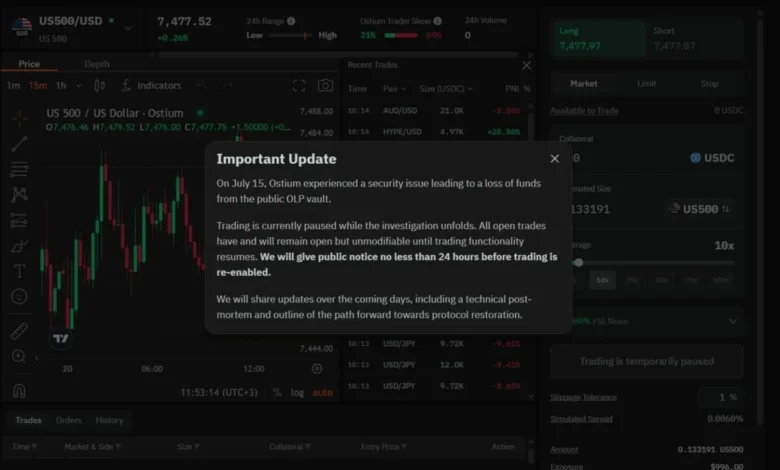
The decentralized trading protocol Ostium has confirmed a major security incident resulting in the theft of approximately $23.75 million in digital assets from its liquidity provider vault. The breach, which occurred last week, was the result of a sophisticated compromise of the platform’s off-chain infrastructure, specifically targeting the systems responsible for delivering real-time price data to the blockchain-based protocol. By manipulating these data feeds, the attacker was able to deceive the system into accepting fraudulent price reports, allowing them to execute high-volume trades that generated massive, artificial profits at the expense of the platform’s liquidity providers.
While the financial loss is significant, Ostium management has emphasized that the attack was surgical in nature, targeting the vault used by liquidity providers rather than the collateral held by individual traders. According to official statements from the company, trader funds were stored in a separate smart contract architecture that remained isolated from the exploit. Consequently, existing positions held by users were not liquidated or stolen, though the platform remains in a state of suspended animation as security teams work to fortify the infrastructure.
Technical Mechanics of the Oracle Manipulation Attack
The exploit against Ostium highlights a recurring vulnerability in the decentralized finance (DeFi) ecosystem known as an oracle attack or price manipulation exploit. Ostium operates as a decentralized perpetual exchange on the Arbitrum network, a Layer 2 scaling solution for Ethereum. To facilitate trading of both traditional assets (such as commodities or currencies) and cryptocurrencies, the protocol relies on "oracles"—external data streams that provide the current market price of an asset to the blockchain.
In this instance, the attacker did not find a flaw in the smart contracts themselves, but rather in the "off-chain infrastructure" that feeds data into these oracles. By gaining unauthorized access to this infrastructure, the perpetrator was able to inject illegitimate price reports that were formatted to appear as valid, verified data. With the ability to control the perceived price of an asset within the Ostium ecosystem, the attacker opened large leveraged positions. By then reporting a favorable price movement through the compromised feed, they were able to close those positions almost instantaneously, extracting millions of dollars in value from the liquidity provider (LP) vault.

This type of attack is particularly devastating because it bypasses the traditional security audits of on-chain code. While the smart contracts may be programmed correctly to execute trades based on the data they receive, they have no inherent way to verify if the external data source itself has been compromised unless robust, multi-source verification systems are in place.
Chronology of the Incident and Response
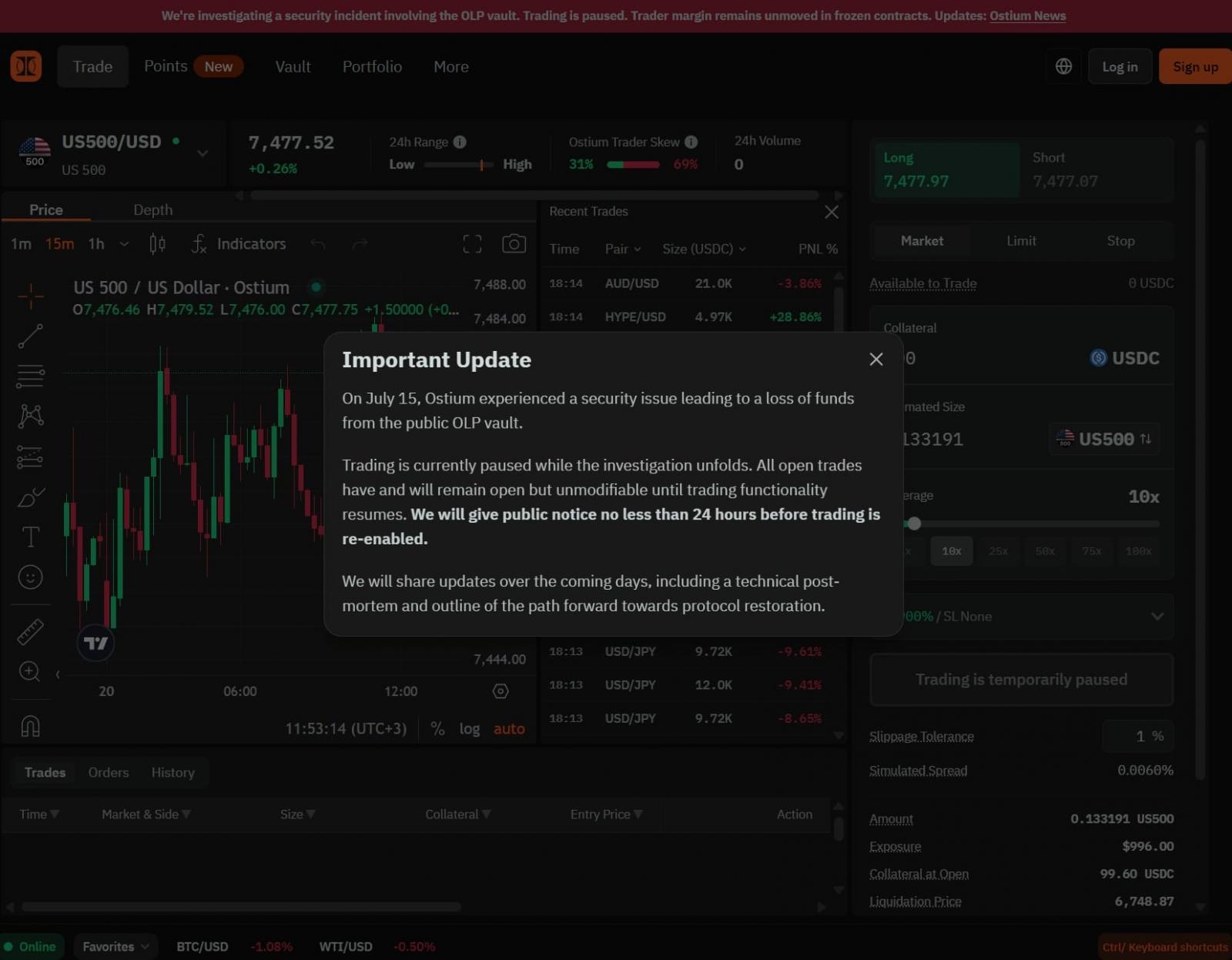
The security breach was first detected on July 16, 2024. Within 60 minutes of the first suspicious transaction, Ostium’s automated monitoring systems and core team identified the anomaly and moved to pause all trading activities. This rapid response likely prevented further depletion of the liquidity provider vault, which serves as the counterparty for trades on the platform.
Immediately following the suspension of services, Ostium issued a brief notification to its community via social media, stating that trading had been paused due to a "security incident." At that stage, the full extent of the loss was not publicly disclosed as the company began a forensic investigation into the movement of funds and the nature of the breach.
By July 21, five days after the initial exploit, Ostium provided a more comprehensive update. The company confirmed the $23.75 million figure and identified the specific point of failure in their off-chain pricing infrastructure. They also clarified the status of user funds, providing relief to retail traders who feared their collateral had been drained. The company has since been in communication with law enforcement agencies and blockchain security firms to track the movement of the stolen assets.
Asset Tracking and the Role of Tornado Cash
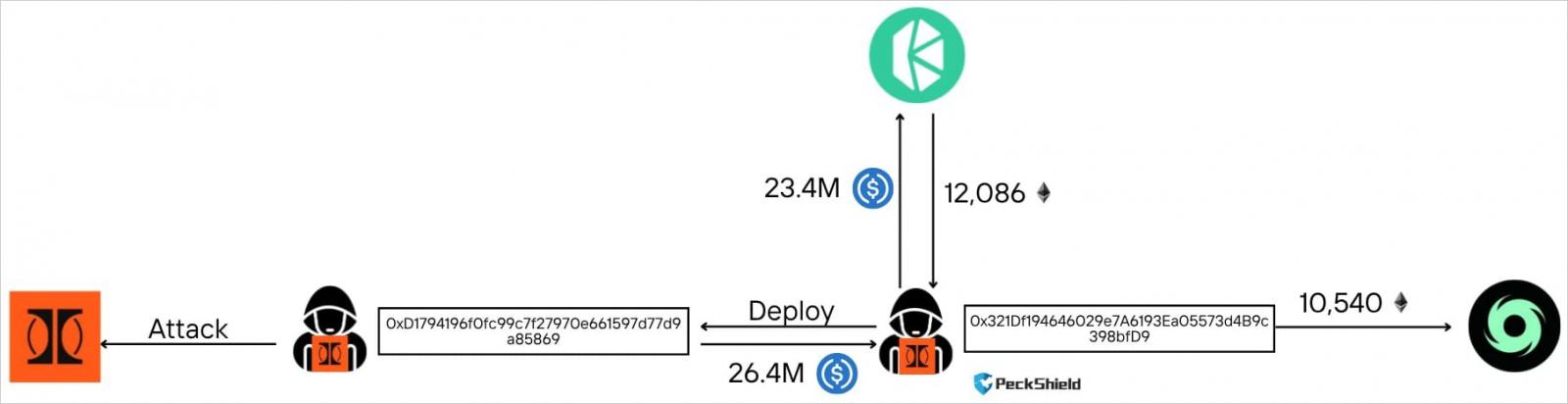
In the aftermath of the heist, blockchain security firm PeckShieldAlert provided a detailed breakdown of the attacker’s movements. After draining the liquidity vault of USDC—a stablecoin pegged to the U.S. dollar—the exploiter moved quickly to obscure the paper trail. The stolen USDC was swapped for approximately 12,080 Ethereum (ETH) through various decentralized exchanges to prevent the funds from being frozen by Circle, the issuer of USDC.

Once the funds were converted to ETH, the attacker began the laundering process. Records indicate that at least 10,540 ETH was moved into Tornado Cash, a decentralized non-custodial privacy solution. Tornado Cash uses zero-knowledge proofs to allow users to break the on-chain link between a depositor and a withdrawer, making it a frequent tool for cybercriminals looking to "clean" stolen cryptocurrency.
The use of Tornado Cash complicates recovery efforts significantly. While the initial movement of funds to the mixer is visible on the public ledger, once the assets are withdrawn from the protocol’s "anonymity pool," they appear as fresh ETH with no direct link to the Ostium exploit. This highlights the ongoing tension between privacy tools in the crypto space and the needs of law enforcement to combat financial crime.
Impact on Liquidity Providers and Retail Traders
The internal architecture of Ostium played a crucial role in mitigating the damage to the broader user base. In many DeFi exploits, the entire "Total Value Locked" (TVL) of a protocol is at risk. However, Ostium utilized a modular approach to fund management.
- Liquidity Provider (LP) Vault: This vault acts as the "house." When traders win, they are paid from this vault; when they lose, their losses are added to it. This was the primary target of the attack.
- Trader Collateral: This consists of the funds deposited by individual users to open and maintain their own positions. These funds were housed in a separate smart contract that the attacker’s price manipulation did not directly access.
As a result, while the "house" lost nearly $24 million, individual traders did not lose their underlying collateral. However, the suspension of the platform has left these traders in a state of limbo. Their positions—whether long or short—are currently frozen. Ostium has stated that these positions will remain recorded as they were at the time of the pause. When the platform eventually resumes operations, these positions will be "marked to the reopening price," a move intended to ensure fairness but one that introduces market risk for traders who cannot manage their positions during the downtime.
Broader Implications for the DeFi Sector
The Ostium breach serves as a stark reminder of the "Oracle Problem" in decentralized finance. As protocols seek to bridge the gap between blockchain technology and real-world financial markets, they become increasingly dependent on external data. This dependence creates a centralized point of failure in an otherwise decentralized system.
Industry analysts suggest that this incident may lead to a renewed push for more robust oracle designs. Many protocols are moving toward "decentralized oracles" like Chainlink or Pyth, which aggregate data from dozens of independent sources to prevent a single compromised feed from affecting the system. If Ostium was relying on a more centralized or proprietary off-chain feed, this will likely be a primary focus of their upcoming technical post-mortem.
Furthermore, the incident underscores the security challenges of Layer 2 (L2) ecosystems. While Arbitrum offers the speed and low costs necessary for high-frequency trading platforms like Ostium, the rapid pace of development on L2s sometimes outstrips the implementation of comprehensive security redundancies.
The Path to Recovery and Reopening
Ostium has committed to a transparent recovery process. The company is currently working on a detailed "post-mortem" report that will provide a technical breakdown of exactly how the off-chain infrastructure was compromised. This report is highly anticipated by the security community as it may reveal new tactics being used by sophisticated threat actors in the crypto space.
As for the resumption of trading, the platform remains cautious. Management has promised to provide at least 24 hours’ notice before the system goes live again. During this period, the team is not only patching the vulnerability that led to the exploit but also "hardening" the entire infrastructure to prevent similar attacks in the future.
The most significant challenge facing Ostium moving forward is the restoration of its liquidity. With $23.75 million gone from the LP vault, the protocol’s ability to facilitate large trades is severely diminished. The company will likely need to seek new capital injections or implement an incentivized recovery plan to encourage liquidity providers to return to the platform.
The incident at Ostium is a sobering chapter in the ongoing evolution of decentralized trading. It highlights that even when smart contracts are secure, the bridges to the outside world—the data feeds and off-chain servers—remain prime targets for exploitation. For the DeFi industry to reach mainstream maturity, the security of these "off-chain" components must become as rigorous as the "on-chain" code they support.
Related posts: