Tesla Deploys Mobile Superchargers and Accelerates Permanent Expansion Ahead of Thanksgiving Travel Rush

As millions of motorists prepare to hit American highways for the Thanksgiving holiday, electric vehicle infrastructure has once again taken center stage. Tesla has deployed a targeted fleet of mobile Supercharger stalls to some of its historically most congested travel corridors in California and Arizona. This tactical deployment represents the company’s most organized and proactive holiday mitigation strategy to date, designed to prevent the multi-hour bottlenecks that plagued holiday travelers in previous years.
Alongside these temporary installations, Tesla has accelerated its long-term network growth, reporting a substantial surge in permanent station openings across the United States over the preceding two months. These combined efforts highlight an evolving approach to EV infrastructure management, blending rapid emergency deployment with sustained capital investment to meet the demands of a rapidly expanding electric vehicle market.
Strategic Deployment of Mobile Superchargers
The immediate focus of Tesla’s holiday intervention centers on 29 temporary mobile Supercharger stalls strategically positioned at high-traffic intersections along vital interstate routes. According to data released by Tesla’s charging division, the temporary infrastructure has been distributed across four critical locations known for severe seasonal bottlenecks.

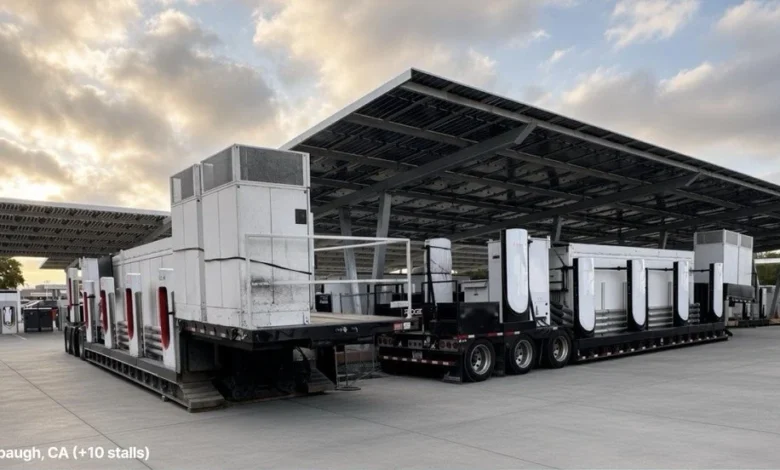
The largest concentration has been established in Firebaugh, California, where two flatbed trailers loaded with Supercharger posts and tall power cabinets have been positioned beneath the station’s existing solar canopy, adding 10 temporary stalls. Additional mobile units have been deployed in the California Central Valley—a notorious stretch for holiday congestion between the San Francisco Bay Area and the Los Angeles basin. The Bakersfield Olive Drive station has received eight additional stalls, while the Bakersfield Copus Road location—a site previously utilized for off-peak pricing incentives during the 2021 holiday season—has added four direct-pavement stalls.
The sole non-California location in this current deployment wave is Holbrook, Arizona. Situated along Interstate 40, Holbrook serves as a critical lifeline for motorists traveling between Southern California and Albuquerque. Because the route features limited alternative fast-charging infrastructure, the addition of seven pavement-mounted temporary stalls aims to mitigate the risk of severe stranding or extended queues in the northern Arizona corridor.
While Tesla has not officially specified whether these particular mobile units rely on local grid connections, onboard battery systems, or trailer-mounted energy storage, previous iterations of mobile infrastructure have occasionally incorporated high-capacity storage solutions. However, the reliance on mobile assets also brings operational complexities. Past deployments of battery-backed Megapack chargers—such as those used during the 2024 holiday season—faced isolated reliability hurdles, including a notable fire incident involving a mobile Supercharger trailer at a station in Baker, California, on New Year’s Day in 2023. Nevertheless, the presence of these units offers a crucial buffer during peak traffic windows.
Accelerating Permanent Network Expansion
While the 29 temporary stalls provide localized relief, industry analysts emphasize that permanent infrastructure growth remains the primary indicator of network health. Tesla reports that it has successfully opened 1,027 permanent Supercharger stalls across 91 distinct sites throughout the United States in the 56 days leading up to the holiday travel period.

This output averages approximately 18 new stalls per day, with individual sites averaging more than 11 stalls each. Comparative data from market intelligence firms highlights the significance of this pace. During the third quarter of the year, Tesla added roughly 1,287 fast-charging ports domestically—averaging about 14 ports per day—while competitors such as IONNA and Walmart added 378 and 344 ports, respectively. The recent acceleration represents an estimated 30 percent increase in deployment velocity compared to earlier in the year, signaling a return to aggressive expansion targets.
This rebound in construction cadence follows a tumultuous period for the company’s infrastructure division. Earlier in the year, sweeping corporate restructuring—including the abrupt downsizing of Tesla’s dedicated charging team—led to temporary project slowdowns and raised concerns among consumers and industry observers regarding the future trajectory of the Supercharger network. The recent surge in installations suggests that the scaled-down organization has successfully streamlined its supply chain, permitting processes, and contractor networks to resume rapid deployment rates that outpace any other domestic charging provider.
Operational Enhancements: Attendants and Virtual Queues
Beyond physical hardware expansion, Tesla has implemented sophisticated software and operational protocols to streamline traffic flow at bustling stations. For the current holiday window, the company has deployed on-site attendants at its most critical locations to manage vehicle queues, direct drivers to available stalls, and resolve minor payment or charging initiation issues.
Complementing human oversight is the broader rollout of Tesla’s virtual queue system. Piloted at just five locations in May following widespread calls for organized waiting systems at overcrowded stations, the feature has now expanded to approximately 300 sites nationwide. The virtual waitlist allows drivers to secure their place in line digitally via the Tesla mobile application without blocking driveways or creating chaotic physical lines, thereby reducing driver frustration and optimizing the turnover rate of available stalls.

Historical Context and Holiday Stress Tests
The Thanksgiving holiday has long served as the ultimate stress test for the North American electric vehicle charging ecosystem. During the Thanksgiving travel window in 2025, Tesla’s domestic network handled more than 2 million individual charging sessions and delivered over 70 gigawatt-hours (GWh) of energy. Remarkably, the company reported that only 0.76 percent of those sessions involved a reported wait time, demonstrating a high degree of operational resilience even under immense seasonal pressure.
However, this level of reliability was hard-fought. Early milestones in the mass adoption of EVs—particularly between 2018 and 2019—were marred by severe infrastructure bottlenecks. During the 2019 Thanksgiving holiday, motorists traversing California’s Central Valley reported multi-hour queues at key Supercharger hubs like Firebaugh and Baker, prompting widespread media scrutiny and driving home the urgent need for network scaling.
In response, Tesla pioneered various mitigation tactics over the subsequent years, including the introduction of off-peak discounted or free charging hours to temporally distribute travel demand, alongside targeted hardware deployments. The current strategy of combining permanent construction surges with proactive mobile staging reflects a maturing network operator anticipating traffic surges rather than reacting to crises after they occur.
Broader Industry Implications and Market Dynamics

The steady maturation of Tesla’s Supercharger network carries profound implications for the broader transition to electric mobility in the United States. As more automotive manufacturers adopt the North American Charging Standard (NACS) and grant their respective EV fleets access to the Supercharger network, the demand placed on existing infrastructure will continue to intensify exponentially.
While competing charging networks—backed by federal initiatives like the National Electric Vehicle Infrastructure (NEVI) program and private investments from traditional energy and retail giants—are steadily coming online, Tesla remains the dominant force in high-speed domestic charging availability. The company’s ability to scale permanent installations past the threshold of 1,000 stalls every two months establishes a benchmark that competing networks have struggled to match in both speed and reliability.
Furthermore, the integration of hardware deployment, software-driven queue management, and active human supervision points toward a future where EV road-tripping closely mirrors the seamless refueling experience of traditional internal combustion vehicles. As public policy increasingly favors zero-emission transportation, the reliability and scalability of fast-charging infrastructure will remain a cornerstone of consumer confidence.
Conclusion
Tesla’s multifaceted approach to the Thanksgiving travel rush—characterized by the tactical placement of 29 mobile Supercharger stalls, the rapid inauguration of over a thousand permanent stalls, and the widespread implementation of virtual queues—underscores a strategic pivot toward proactive network management. While temporary trailers and pavement units offer localized relief along notorious bottlenecks in California and Arizona, the broader acceleration of permanent infrastructure highlights a renewed commitment to network expansion following earlier corporate restructuring. As the electric vehicle market continues its upward trajectory, the successes and operational hurdles observed during high-demand travel windows will undoubtedly shape the future standards of public EV charging across North America.
Related posts: