A 1961 Electric Shopper Discovered on Craigslist Proves Low-Speed Electric Vehicles Have Barely Evolved in Six Decades

The contemporary market for low-speed electric vehicles (LSEVs) has experienced a notable resurgence in recent years, driven by urban congestion, stringent emissions regulations, and a demand for affordable personal mobility. Modern iterations like the quirky Citroën Ami, introduced in 2020, and its stylish Italian sibling, the Fiat Topolino—named after the affectionate Italian term for "little mouse"—have captured the public imagination. Yet, a closer examination of automotive history reveals a fascinating reality: despite decades of supposed technological advancement, the foundational concept, performance capabilities, and utility of these micro-cars have remained virtually unchanged since the dawn of the 1960s.
This technological stagnation is starkly highlighted by a vintage listing currently circulating on Craigslist, featuring a remarkably preserved 1961 Electric Shopper built by the Electric Car Company of California. While modern urban EV buyers marvel at the compact dimensions and modest specifications of today’s quadricycles, historical evidence suggests that the blueprint for the modern city runabout was perfected more than half a century ago.
A Blast From 1950s America Design-Wise
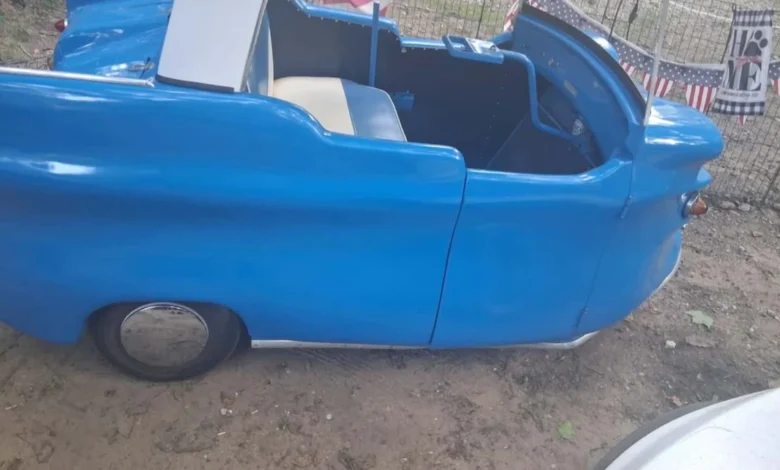
At first glance, the 1961 Electric Shopper looks less like a utilitarian commuter and more like a scaled-down automotive artifact plucked directly from a mid-century American postcard. Measuring scarcely larger than a pair of oversized footwear, the vehicle nevertheless embraces the flamboyant styling tropes of its era. It proudly features sculpted, protruding headlights, distinctive tail fins, and a contrasting white roof that mimics the two-tone paint schemes popular on full-sized sedans of the late 1950s and early 1960s.
The aesthetic is both whimsical and charming, embodying an era when automotive design prioritized personality alongside function. Yet beneath its playful exterior lies a surprisingly serious engineering effort to solve the very same urban mobility challenges that manufacturers grapple with today.
Comparative Specifications: Past Versus Present
When evaluating the performance metrics of the 1961 Electric Shopper against contemporary micro-EVs like the Fiat Topolino, the similarities are striking, underscoring just how little the fundamental physics of light electric transport have shifted over the decades.
The Electric Shopper is propelled by a modest 1.5-horsepower electric motor mounted at the rear, turning the rear wheels with enough torque to navigate flat suburban neighborhoods. Energy is stored in a rudimentary lead-acid battery pack, a technology that was heavy and energy-dense by 1960 standards but severely limited compared to modern lithium-ion chemistries. Despite these primitive power sources, the Shopper achieves an estimated driving range of approximately 30 miles on a single charge.
To put this into perspective, the modern Fiat Topolino—utilizing decades of incremental advancements in electrical efficiency—offers a maximum range of roughly 46 miles. While the Topolino represents a 50% improvement in range, the fact that a vehicle built in 1961 can achieve two-thirds of the distance of a modern equivalent built five decades later is a testament to the fundamental efficiency of lightweight, low-speed vehicle architecture.
Top speeds tell a similarly parallel story. The Electric Shopper caps out at an unhurried 18 miles per hour, trailing only a hair behind the initial U.S. market specification of the Fiat Topolino, which debuted at 19 mph. While Fiat has since introduced software updates that elevate the Topolino’s top speed to 25 mph—thereby unlocking legality on designated residential and low-speed public roadways—the operational envelope of both vehicles remains remarkably constrained to local errands, neighborhood commutes, and closed-campus transportation. Furthermore, while modern EVs rely on over-the-air software calibrations to unlock performance, the 1961 Shopper achieved its maximum output through mechanical simplicity.
Rarity, Valuation, and Collectibility
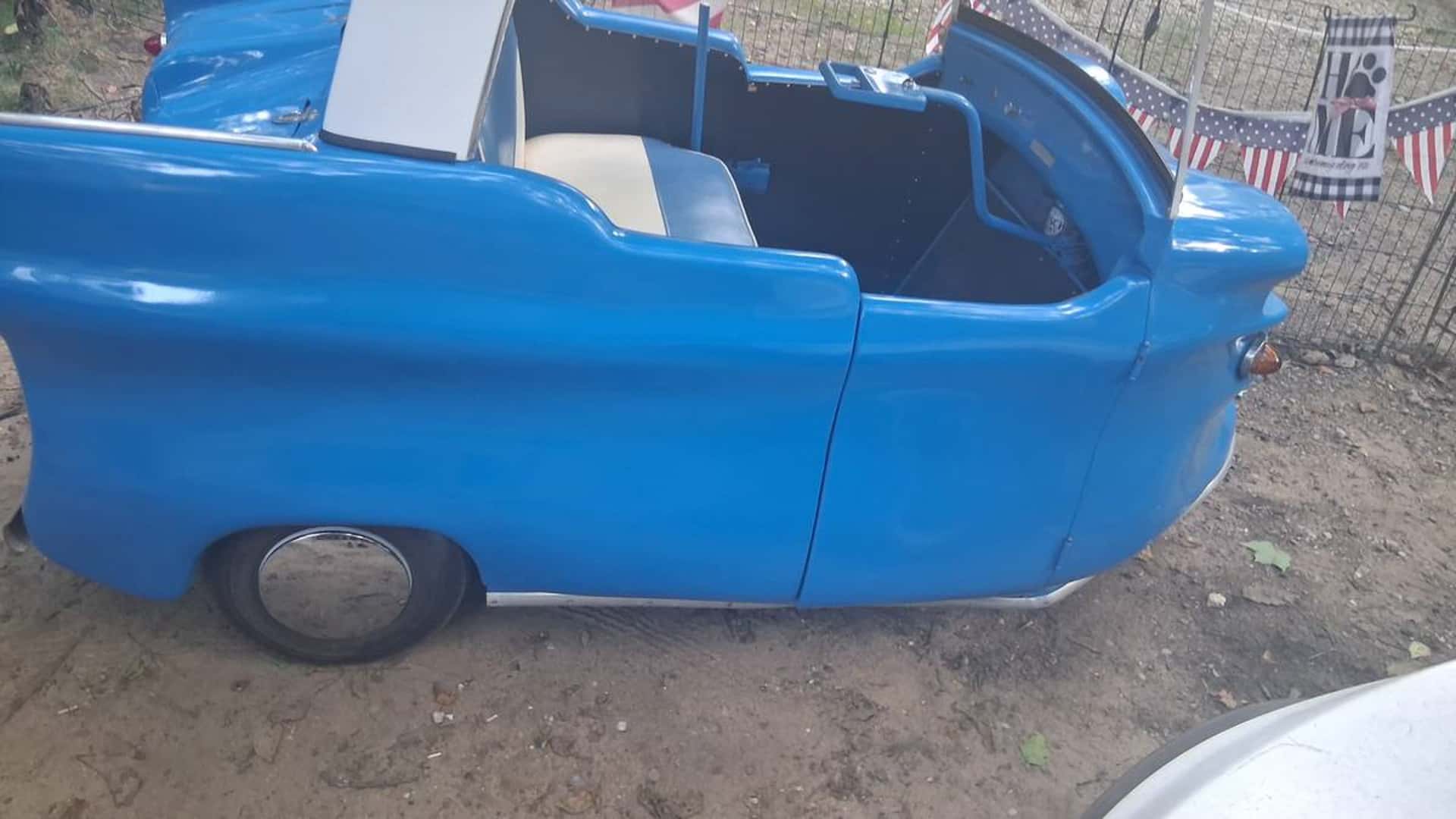
The specific 1961 Electric Shopper currently listed for public sale features a blue exterior paired with a white roof and boasts a reported odometer reading of 129,000 miles—an extraordinary mileage accumulation for a vehicle of this type and era, suggesting it saw active, long-term use rather than mere garage storage.
The asking price for this rolling piece of automotive history is set at $12,500. For casual observers, the valuation may prompt skepticism, as the sum could easily purchase a reliable used conventional automobile or fund a brand-new, factory-fresh low-speed quadricycle like the Fiat Topolino. However, proponents of vintage micro-cars argue that traditional depreciation metrics do not apply to ultra-rare historical artifacts.
According to the vehicle’s current seller, the Electric Shopper is exceptionally scarce, with an estimated total of only 15 examples believed to survive globally. Among that microscopic population, this particular car is claimed to be one of just seven officially documented specimens. The seller notes that institutional interest is already established within the niche, with two known surviving Shoppers residing in recognized automotive museums—including a stint at the Route 66 Electric Vehicle Museum and a temporary exhibition at the Petersen Automotive Museum.
This extreme rarity shifts the vehicle’s value proposition away from practical daily transportation and firmly into the realm of historic preservation and collector appeal. For a specialized collector or automotive historian, owning one of the spiritual ancestors of the modern urban EV carries undeniable weight. Conversely, a pragmatic consumer seeking functional, everyday zero-emission transport would likely find superior utility, safety features, warranty coverage, and aesthetic modernity in a similarly priced contemporary alternative.
The Broader Implications for Urban Mobility and LSEV Evolution
The longevity of the low-speed electric vehicle concept raises profound questions regarding the trajectory of urban automotive engineering. While the broader automotive industry has undergone a monumental shift toward high-capacity battery packs, autonomous driver-assistance systems, high-speed charging infrastructure, and connected digital cockpits, the urban micro-car segment has remained remarkably insulated from these sweeping trends.
The core engineering challenge of the city car has always centered on weight minimization, spatial efficiency, and energy conservation. By stripping away extraneous weight and limiting top speeds, manufacturers in 1960—just as manufacturers in 2024—could achieve viable electric mobility using rudimentary, inexpensive technology. The Electric Shopper proves that the formula for an efficient grocery-getter was well-understood long before the modern lithium-ion revolution.
However, the lack of substantial evolution also highlights regulatory and infrastructure hurdles that have persisted for generations. Low-speed vehicles have historically occupied an awkward regulatory grey area, frequently restricted from arterial roadways due to crash-test standards and speed limitations. While European markets have eagerly embraced quadricycles like the Citroën Ami and Fiat Topolino through progressive vehicle classifications (such as the L6e category), North American adoption has faced greater friction, often relegating vintage curiosities like the Shopper to neighborhood electric vehicle (NEV) status or private property use.
Market Response and Consumer Sentiment
Industry analysts observing the secondary market for micro-EVs note that interest is bifurcated. On one end of the spectrum, younger, design-conscious urban dwellers are gravitating toward vehicles like the Topolino and Ami as fashion accessories and customizable blank canvases, frequently modifying them with aftermarket wraps, unique accessories, and personalized interior touches. On the other end, micro-mobility purists and vintage EV restorers view machines like the Electric Shopper as vital technological touchstones that map the evolutionary lineage of sustainable transport.
The appearance of a road-worthy, highly documented 1961 Electric Shopper on an open classifieds platform serves as a timely reminder that the challenges of urban mobility are cyclical. As cities around the globe continue to densify, streets become more congested, and consumers seek out lightweight alternatives to oversized multi-ton SUVs, the fundamental philosophy embodied by the Electric Shopper more than sixty years ago remains as relevant today as it was at the dawn of the 1960s. Whether the market will ultimately reward a 1960s grocery-getter with a $12,500 sale price remains to be seen, but its enduring existence secures its place in the annals of alternative vehicle history.