StrongVPN Review 2024: A Veteran Service Struggling to Keep Pace in a Modern Privacy Market

Founded in 2005 during the nascent stages of the modern commercial internet, StrongVPN has long maintained a reputation as a stalwart provider in the virtual private network industry. Originally emerging as a reliable option for basic IP masking and foundational digital privacy, the company has survived nearly two decades of rapid technological transformation. However, as the digital landscape has shifted toward high-speed streaming, advanced cryptographic protocols, and rigorous third-party auditing, long-standing providers must continuously evolve to remain competitive. A comprehensive examination of StrongVPN reveals a service that, while offering straightforward functionality and unique bundle extras like StrongDNS and an aloSIM eSIM data allowance, struggles significantly with outdated software architecture, lackluster performance metrics, and a minimal feature set that fails to match the benchmarks established by contemporary market leaders.
Pricing Structure and Subscription Models
Evaluating StrongVPN requires a detailed look at its financial tiers, which position the provider directly against top-tier competitors such as Surfshark, CyberGhost, and Private Internet Access. StrongVPN operates on a relatively simple subscription model, offering customers a choice between a month-to-month commitment and an annual plan.
For users seeking short-term flexibility, the monthly plan is priced at $11.99. Meanwhile, the annual subscription is initially billed at $47.69 for the first year, which breaks down to an effective rate of approximately $3.97 per month. While this introductory rate appears economical, consumers must navigate the common industry practice of automatic subscription renewals. Upon the conclusion of the first year, the annual plan’s cost nearly doubles, jumping to $89.99—equivalent to $7.50 per month. Consequently, privacy-conscious consumers who opt for the service must carefully track their renewal dates or proactively disable auto-renewal features to avoid unexpected charges.
Furthermore, financial protections for consumers are somewhat limited. While StrongVPN does offer a standard 30-day money-back guarantee, this refund policy is restricted exclusively to the annual plan, leaving monthly subscribers without a safety net if the service fails to meet their performance expectations. When measured against competitors in the low-to-medium price bracket that routinely bundle advanced obfuscation, multi-hop capabilities, and ad-blocking suites into comparable pricing tiers, StrongVPN’s value proposition diminishes considerably after the promotional first-year period expires.
Server Infrastructure and Jurisdiction Challenges
At the core of any virtual private network lies its underlying server network, privacy policies, and operational jurisdiction. StrongVPN currently claims a network comprising approximately 950 servers distributed across 30 countries and 46 distinct locations. By contemporary industry standards, this infrastructure footprint is notably modest. Major market competitors routinely operate thousands of servers spanning upward of 100 countries, offering users vastly superior geographic diversity and load distribution. Adding to these concerns, industry analysts have noted that StrongVPN’s published infrastructure metrics have remained largely stagnant on its official website for several years, leaving prospective users unable to definitively verify the current operational scope of the network.

Privacy-sensitive users must also evaluate the implications of the company’s corporate headquarters. Based in New York, United States, StrongVPN operates under a jurisdiction characterized by robust data retention frameworks, active intelligence-sharing alliances (such as the Five Eyes intelligence network), and sweeping legal authorities regarding electronic surveillance. For consumers prioritizing absolute digital anonymity and zero-jurisdiction exposure, a US-based provider inherently presents a higher risk profile compared to competitors situated in privacy-friendly offshore havens like the British Virgin Islands, Panama, or Switzerland.
Regarding data logging policies, StrongVPN maintains a stated zero-logs policy concerning user online activity, web browsing history, and traffic content. However, the service does retain specific connection metadata, including incoming user IP addresses and assigned outgoing VPN IP addresses. Critically, unlike many leading VPN providers that routinely subject their infrastructure and no-logs claims to rigorous, independent third-party security audits, StrongVPN has not published comprehensive, verifiable third-party audit reports to scientifically confirm its data handling practices.
Performance, Speed, and Protocol Implementation
In the realm of digital connectivity, speed is a defining metric for user experience, whether engaged in high-definition media consumption, competitive online gaming, or large-file peer-to-peer torrenting. In recent performance evaluations, StrongVPN’s download speeds consistently placed at the lower end of industry performance benchmarks.
Testing protocols utilizing standard OpenVPN configurations yielded download speeds hovering around 128Mbps. When utilizing the faster WireGuard protocol, speeds ranged between 234Mbps and 353Mbps. While these figures may suffice for basic web browsing and standard-definition video streaming, they pale significantly in comparison to modern competitors operating on the same financial tier. For context, independent benchmarks for providers like Surfshark and Windscribe frequently record speeds exceeding 2,000Mbps under identical network conditions.
Industry experts attribute these performance bottlenecks to StrongVPN’s utilization of older, less optimized implementations of both OpenVPN and WireGuard. While modern VPN architecture relies on regularly updated codebases to maximize packet throughput and cryptographic efficiency, StrongVPN’s lack of continuous software maintenance results in legacy components that fail to maximize hardware capabilities.
Streaming Compatibility and Torrenting Capabilities
The modern consumer market increasingly utilizes virtual private networks to bypass geographic content restrictions imposed by major streaming platforms. StrongVPN approaches this sector with mixed efficacy. Officially, the service permits streaming and peer-to-peer torrenting across all of its available server locations, omitting the need to navigate specialized P2P server directories.

During practical testing, StrongVPN demonstrated the ability to successfully unblock several major international platforms, including Netflix, Disney+, DAZN, alongside regional public broadcasting services such as the United Kingdom’s BBC iPlayer and Australia’s 9Now. However, consistency remains an issue. The service proved entirely incapable of unblocking content from YouTube Premium and Amazon Prime Video, regardless of the server geographic location selected by the user. Consequently, users seeking a reliable, all-encompassing solution for global media consumption will likely find better performance elsewhere.
For torrenting enthusiasts, the platform fares adequately. While promotional materials rarely emphasize peer-to-peer file sharing, testing confirmed that users can execute torrent downloads without systemic throttling or protocol blockages while connected to the VPN network.
App Usability, Features, and Accessibility
StrongVPN provides client applications across a standard array of operating systems, including Windows, macOS, Android, iOS, and Fire TV devices, alongside dedicated browser extensions for Google Chrome and manual setup documentation for Linux distributions.
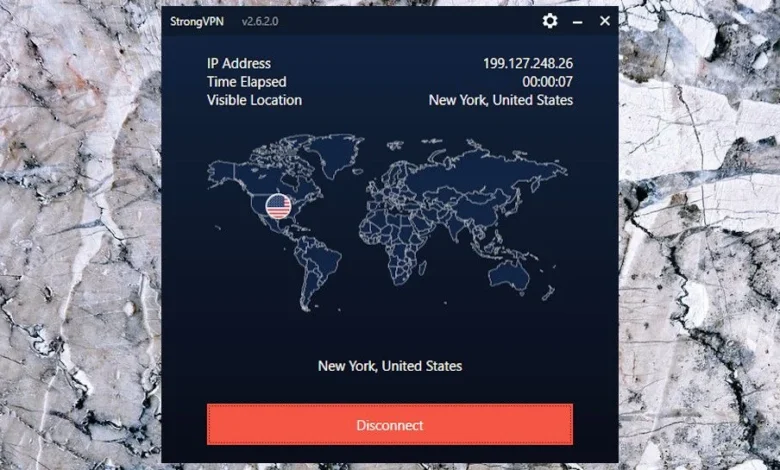
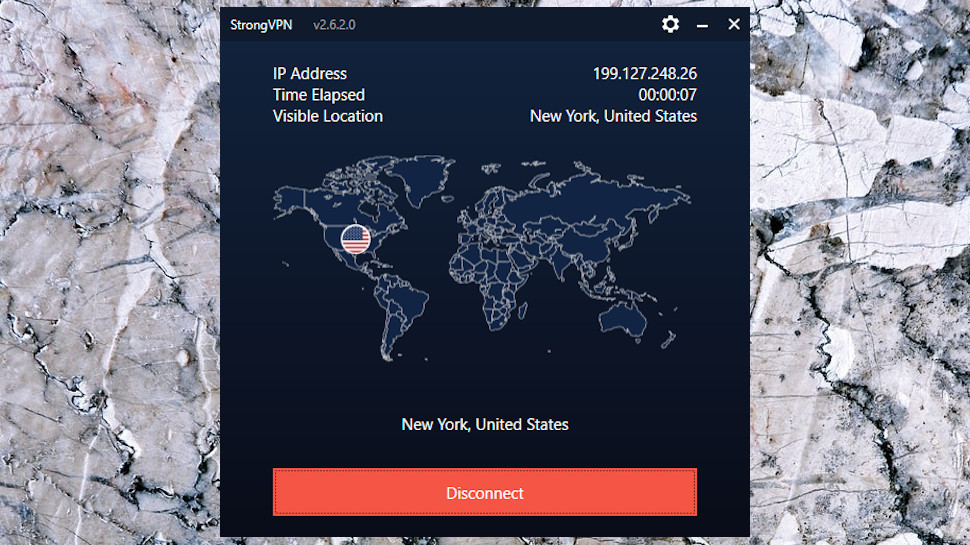
Despite this broad platform availability, the user interfaces are notably Spartan, bordering on basic. The Windows client, for instance, features a static world map devoid of interactive capabilities, accompanied by standard connection status indicators, a primary connect/disconnect toggle, and a settings menu. While locations are conveniently sorted alphabetically with an integrated search box for rapid navigation, the app lacks crucial usability features standard in contemporary software, such as a "Favorites" tab for frequently accessed servers, a "Recently Used" history list, or real-time latency indicators to guide users toward the fastest available connection. Furthermore, users frequently report frustrating operational delays, including login screens that stall for upwards of 30 seconds during background initialization phases.
Security features within the applications also exhibit notable inconsistencies across platforms:
- Kill Switch Implementation: While Windows and macOS applications feature a kill switch designed to sever internet traffic if the encrypted tunnel drops, the macOS variant restricts this safety measure exclusively to OpenVPN connections, omitting protection for WireGuard. Additionally, StrongVPN’s kill switch enforces an all-or-nothing approach by blocking all internet traffic unless an active VPN connection is established. While secure, this design creates operational friction due to the absence of split-tunneling on desktop platforms.
- Split Tunneling Limitations: Windows users are entirely deprived of split-tunneling capabilities. If a specific local application or website refuses to function over a VPN connection, users cannot designate exceptions; they must manually disable the entire VPN service. Split-tunneling is restricted solely to the Android application environment.
- Accessibility Deficits: Software audits reveal notable accessibility shortcomings, particularly concerning keyboard navigation. Standard interface shortcuts—such as utilizing directional arrow keys to navigate location lists and the Enter key to confirm a selection—fail to function correctly, frequently cycling through lists unintentionally and hindering users with accessibility needs.
Customer Support and Auxiliary Add-ons
Customer assistance is channeled through a web-based support portal, an automated support chatbot, and electronic mail ticketing. Notably, telephone support is obscured, accessible only after a user successfully logs into their customer dashboard. The automated chatbot has faced criticism for its rigid programming, lacking both advanced Natural Language Processing capabilities and any seamless escalation pathway to human technical representatives, frequently leaving complex queries unresolved.
To bolster its market appeal, StrongVPN includes secondary digital tools with its core subscriptions. Subscribers receive access to StrongDNS, a proprietary private DNS service intended to assist in circumventing basic geo-blocks, alongside a complimentary eSIM data package from aloSIM providing 3 gigabytes of mobile data. While these extras offer utility for international travelers, they serve to mask a core product that has received minimal structural innovation in recent years.
Market Implications and Final Verdict
StrongVPN occupies a peculiar niche in the contemporary cybersecurity market. As a veteran service with nearly two decades of operational history, it maintains a loyal user base seeking straightforward, no-frills IP masking. The service is fundamentally capable of delivering baseline encryption adequate for casual browsing, basic file downloads, and occasional media streaming.
However, the broader market implications of StrongVPN’s current developmental trajectory point toward stagnation. In an era defined by lightning-fast proprietary protocols, audited zero-logs claims, advanced ad-blocking suites, multi-hop obfuscation, and highly polished user interfaces, StrongVPN’s aging infrastructure, slow download speeds, inconsistent streaming compatibility, and rigid application design place it at a distinct disadvantage.
When measured against aggressive competitors in the low-to-medium price tier—such as Surfshark, CyberGhost, Windscribe, and VyprVPN—which deliver exponentially faster speeds, superior privacy jurisdictions, and comprehensive feature sets for comparable financial outlays, StrongVPN struggles to justify a primary recommendation for modern, security-conscious digital consumers.