Tesla gives the Roadster an official Go for launch demonstration date

Tesla has officially confirmed an October 1, 2026, demonstration event for its next-generation Roadster, marking a critical milestone in a development saga that has spanned nearly a decade. The announcement, delivered via a cryptic "Go for launch" teaser on the social media platform X, signals the company’s intent to finally showcase the long-awaited integration of SpaceX-derived thruster technology. For reservation holders who have waited since the vehicle’s initial 2017 unveiling, the October 1 date represents the most concrete step toward production to date.
The event is scheduled to take place in Waco, Texas, a strategic choice given its proximity to the SpaceX propulsion development facility in nearby McGregor. Invitations distributed to reservation holders indicate a high-security, invitation-only format, with strict age requirements and non-transferable entry credentials. This localized, exclusive approach suggests a controlled demonstration environment, likely designed to showcase the vehicle’s controversial and highly anticipated "SpaceX Package."
A Chronology of Delays and High Expectations
The path to the 2026 Roadster reveal has been defined by a series of aggressive performance targets and repeated scheduling adjustments. When Elon Musk first pulled the wraps off the second-generation Roadster at the conclusion of the Tesla Semi launch event in November 2017, the specifications provided were, at the time, unprecedented for a production vehicle. Tesla promised a 0-to-60 mph acceleration time of 1.9 seconds, a top speed exceeding 250 mph, and a staggering 620-mile range powered by a 200 kWh battery pack.
Initial production was slated for 2020, but that target proved overly ambitious as Tesla pivoted its engineering resources toward scaling the Model 3, Model Y, and the development of the Cybertruck. Over the intervening years, Musk has frequently revisited the project, each time escalating the performance claims. By 2023 and into 2024, the narrative shifted from a standard electric supercar to a vehicle that would incorporate aerospace engineering.
The timeline remained fluid throughout 2025 and 2026. During the November 2025 shareholder meeting, Musk famously proposed an April 2026 demonstration date, acknowledging the history of delays with a touch of humor by claiming the date provided "deniability" should the project miss its mark. That target eventually slid through August, finally landing on the October 1 window, which now appears to be the definitive moment for the platform’s public debut.
The SpaceX Package: Engineering for the Track
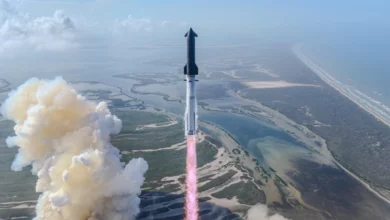
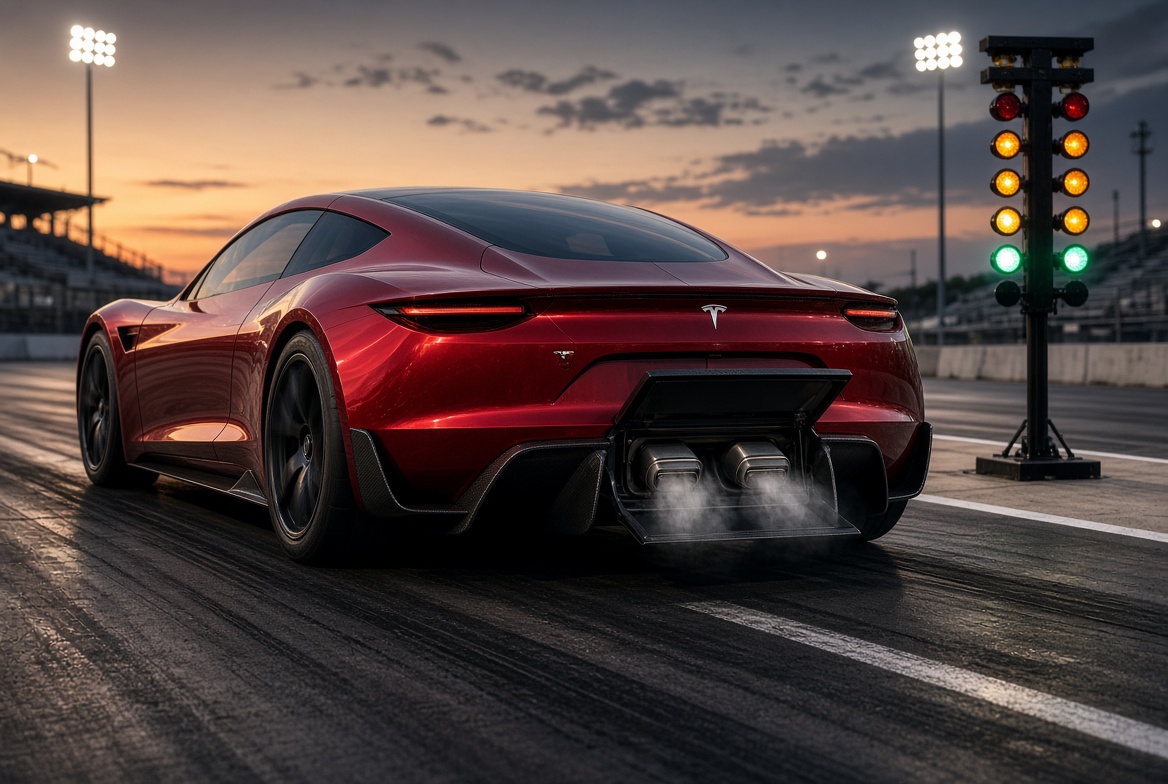
At the core of the October 1 event is the so-called "SpaceX Package," an internal development project codenamed A71—a direct reference to the Lockheed SR-71 Blackbird reconnaissance aircraft. Unlike traditional performance vehicles that rely solely on mechanical grip and tire friction, the thruster-equipped Roadster is expected to utilize cold gas thrusters fed by a composite overwrapped pressure vessel (COPV), utilizing the same materials science and tank architecture found in the SpaceX Falcon 9 rocket.
The technical implications of this system are significant. Musk has publicly floated the possibility that a thruster-equipped Roadster could achieve a 0-to-60 mph time of approximately 1.1 seconds. To achieve this, the vehicle would need to exert roughly 2.75 g of force during launch—a figure that pushes the boundaries of human tolerance and tire technology. Due to the extreme nature of this acceleration and the weight of the hardware required to sustain it, industry analysts expect this version of the Roadster to be restricted to track-only use, exempt from the regulatory requirements of road-legal passenger vehicles.

Manufacturing and Strategic Context
While the performance-focused SpaceX variant captures headlines, the standard Roadster remains a vital, albeit low-volume, part of Tesla’s long-term product roadmap. Tesla VP of Vehicle Engineering Lars Moravy has confirmed that production will be centered at Gigafactory Texas. Current estimates from the company suggest that full-scale production may not begin until 2027 or 2028, positioning the vehicle as a halo product that arrives roughly 12 to 18 months after the initial demonstrations are refined and validated.
Pricing remains tethered to the 2017 figures, with a $200,000 base price and a $250,000 "Founders Series" tier. These prices were set when reservations were originally opened, requiring deposits of $50,000 and $250,000, respectively. Whether these prices remain sustainable in a post-inflationary manufacturing environment remains a point of speculation among financial analysts.
Broader Corporate Tensions: Media and Autonomy
The excitement surrounding the Roadster launch coincides with a volatile period for Tesla’s public relations department. Elon Musk has recently engaged in aggressive public disputes with legacy media organizations, most notably ABC News, regarding the framing of a fatal vehicle crash in Manhattan.
The incident, which occurred in early September 2026, involved a Model Y that struck several stationary objects in Midtown. While initial reports and social media discourse often conflate such accidents with the vehicle’s driver-assistance systems, police investigations have consistently pointed toward driver impairment and human error. Musk has utilized his platform on X to push back against what he characterizes as biased media coverage, asserting that the vehicle’s Autopilot and Full Self-Driving (FSD) software were not factors in the collision.
This pattern of friction between Tesla’s leadership and mainstream media outlets is not new. In previous instances, such as a high-profile crash in Katy, Texas, internal telemetry data provided by Tesla’s AI team—led by Ashok Elluswamy—was used to refute claims that the vehicle’s automation was at fault. In that instance, data showed the driver had manually depressed the accelerator to 100% capacity in a residential zone. These events highlight the ongoing tension between the rapid adoption of automated driving features and the public’s perception of safety, as well as the legal challenges of defining liability in a tech-driven automotive landscape.
Connectivity and the Future of the Fleet
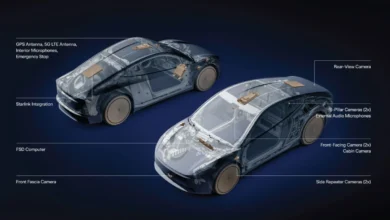
While the Roadster represents the pinnacle of performance, Tesla’s fleet is simultaneously undergoing a significant connectivity upgrade. Recent drone observations at Gigafactory Texas confirm that the new Cybercabs are now shipping with Starlink hardware integrated into the rear hatch as standard equipment.
This transition marks a shift from experimental, one-off retrofits to high-volume production. The integration of satellite connectivity is intended to solve a long-standing challenge for autonomous fleets: "Bermuda Triangles" of poor cellular coverage where vehicles may lose the high-bandwidth data connection required for remote monitoring and navigation updates.
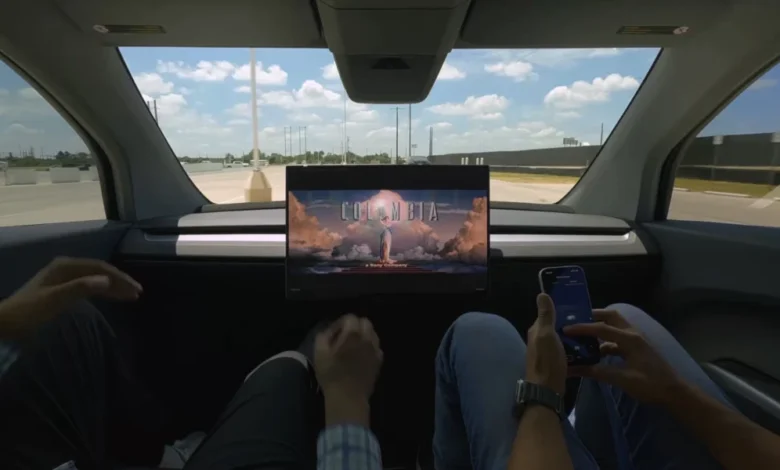
While Ashok Elluswamy has clarified that a direct satellite link is not strictly required for the vehicle to operate its local self-driving logic, Musk has emphasized the consumer-facing benefits. By providing a persistent, high-speed connection, Tesla aims to enable in-cabin experiences such as 4K video streaming and low-latency cloud gaming. As the Cybercab enters service in dense urban environments like Austin and Miami, this high-bandwidth connectivity will be tested for its ability to enhance the passenger experience, though experts note that the most critical utility of the satellite link—coverage in remote or rural areas—has yet to be fully realized for the current urban-centric robotaxi geofences.
Implications for the Road Ahead
The October 1 demonstration will be a litmus test for Tesla’s ability to deliver on long-promised aerospace-inspired automotive technology. If the demonstration successfully showcases the SpaceX Package, it will solidify Tesla’s position as a disruptor in both the automotive and propulsion engineering sectors. However, the event also serves as a reminder of the significant gap that often exists between initial prototype reveals and the realities of mass manufacturing.
As Tesla navigates the legal complexities of its autonomous driving suite, the high-stakes debut of the Roadster, and the rollout of satellite-connected robotaxis, the company remains focused on its dual strategy: pushing the technological envelope with halo products while scaling mass-market solutions for a global audience. The world will be watching in early October to see if the Roadster can finally move from the launch pad into the realm of reality.