The Lifecycle of Production LLMs and the Drift Challenge
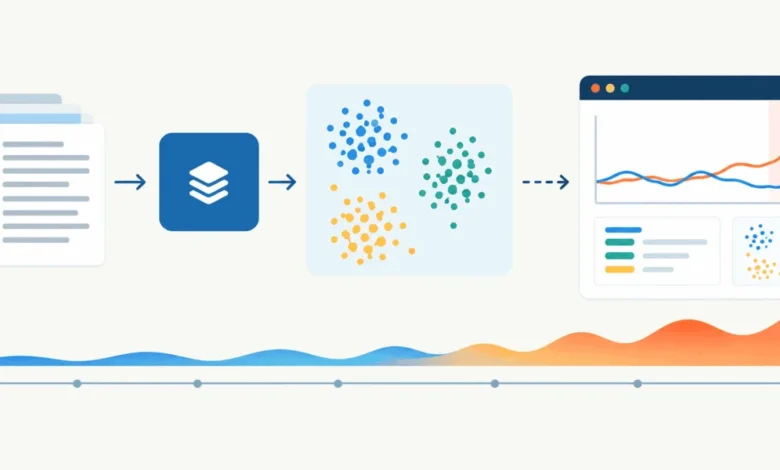
In a standard production LLM architecture, raw text data—whether user queries, customer support tickets, or internal documentation—is converted into high-dimensional numerical vectors known as embeddings. These vectors allow the system to perform semantic searches within a vector database. However, the assumption that production data will remain consistent with the training or baseline data is often flawed.
Real-world user behavior is dynamic. For instance, a chatbot trained on a baseline of technical documentation may suddenly encounter a surge of queries regarding a new, undocumented product feature or a shift in user sentiment during a public crisis. This evolution creates a statistical divergence between the baseline distribution and the current production stream. If the model is not monitored for this drift, the distance between query embeddings and relevant document embeddings can widen, causing the system to retrieve inaccurate information or fail to provide a coherent response. Unlike tabular data, where drift can be identified by monitoring individual feature thresholds, embedding drift is high-dimensional and complex, requiring sophisticated mathematical detection strategies.
The Chronology of Model Decay
The degradation of model performance in production typically follows a predictable trajectory. In the first phase, the model is deployed and operates within the expected performance bounds defined by the training distribution. During the second phase, external factors—such as seasonal trends, market shifts, or changes in user demographics—introduce new patterns into the incoming data.
By the third phase, the "drift" manifests. The embedding space begins to populate with clusters that fall outside the density regions of the original baseline. If left unchecked, the final phase is a systemic failure where the LLM’s output becomes increasingly unreliable, leading to a loss of user trust and potential operational hazards. Monitoring is not merely an optional maintenance step; it is a critical component of the MLOps lifecycle that prevents the silent failure of production intelligence.
Quantitative Approaches to Detection
Detecting this drift requires moving beyond simple descriptive statistics. Industry experts rely on two primary, complementary methodologies: domain classification and centroid-based distance measurement.
The Domain Classifier Method
The domain classifier approach treats the detection task as a supervised binary classification problem. By labeling baseline data as "0" and current production data as "1," engineers train a lightweight classifier, such as a Random Forest, to distinguish between the two distributions. If the classifier achieves a high Receiver Operating Characteristic Area Under the Curve (ROC-AUC) score—typically exceeding 0.65—it indicates that the two datasets are statistically distinct. A high ROC-AUC implies that the model can easily identify the "source" of the data, which serves as a definitive signal that the distribution has shifted enough to warrant intervention, such as fine-tuning the model or updating the vector index.
The Centroid "Center of Mass" Method
For systems requiring lower computational overhead, the centroid distance method provides a faster, albeit less granular, alternative. This technique calculates the mean vector of the baseline embeddings and compares it against the mean vector of the production embeddings using cosine distance. While this method effectively identifies large-scale shifts in data themes, it lacks the ability to detect multi-modal drift or subtle structural changes. It is best used as a real-time "canary" metric to trigger more intensive, resource-heavy analysis.
Implementation Framework with Scikit-LLM
The integration of libraries such as Scikit-LLM and Sentence-Transformers facilitates a streamlined pipeline for these diagnostics. By leveraging tools like all-MiniLM-L6-v2, developers can map textual inputs to 384-dimensional vectors with high efficiency.
In a practical implementation, the following logic is applied:
- Baseline Establishment: A representative sample of the initial production data is encoded and stored.
- Batch Collection: As new requests flow through the production environment, the system batches these inputs and generates corresponding embeddings.
- Statistical Comparison: Using
sklearn.metrics.pairwise.cosine_distances, the system measures the gap between the baseline and production centroids. - Automated Alerting: When the calculated distance exceeds a pre-defined threshold, the monitoring system triggers an alert for data science teams to perform a qualitative review of the incoming queries.
Broader Implications and Strategic Importance
The implications of embedding drift extend far beyond technical performance metrics. In sectors such as fintech, healthcare, and legal services, the reliability of AI-driven responses is paramount. A system that drifts away from its original purpose can inadvertently provide outdated legal advice or misinterpret financial inquiries, leading to significant liability.
From an organizational standpoint, implementing robust drift detection is a reflection of AI maturity. Companies that treat LLMs as static assets are significantly more vulnerable to "silent decay" than those that integrate continuous monitoring into their MLOps workflows. Furthermore, these detection methods provide a feedback loop that informs the RAG strategy. When drift is detected, it does not always require retraining the underlying LLM; often, it signals that the knowledge base (the vector database) needs to be refreshed or augmented with new documents that reflect the current reality of the user queries.
Expert Perspectives on Future-Proofing
Industry practitioners argue that the future of LLM reliability lies in "observability-first" architectures. As the ecosystem matures, the integration of automated retuning loops—where the system detects drift and automatically suggests document re-indexing—is expected to become standard practice. While the techniques outlined here represent the current state-of-the-art for open-source stacks, the community is rapidly moving toward more advanced distributional measures, such as Maximum Mean Discrepancy (MMD) and Wasserstein distance, which offer more robust insights into high-dimensional space behavior.
In conclusion, the effective management of LLM production pipelines hinges on the recognition that models are not static. Embedding drift is an inevitable consequence of deploying intelligent systems into an ever-changing world. By adopting proactive detection strategies—ranging from domain classification to centroid monitoring—organizations can ensure that their LLM applications remain accurate, relevant, and reliable throughout their operational lifespan. The combination of Scikit-LLM and standard scikit-learn libraries offers an accessible, scalable, and highly effective path for developers to secure their AI infrastructure against the silent risks of data evolution.