BYD Redefines the Mid-Size EV Market with the Launch of the Second-Generation Seal 07 and Breakthrough Disus-M Suspension Technology

The global automotive landscape is undergoing a monumental shift, marked by rapid advancements in battery chemistry, autonomous driving capabilities, and active chassis control. At the forefront of this transformation is BYD, a dominant force in the New Energy Vehicle (NEV) sector. The company has officially introduced the second-generation Seal 07 to the market, a vehicle that blurs the lines between mainstream affordability and ultra-luxury engineering. While comparable in footprint to traditional internal combustion engine stalwarts like the Toyota Camry, the Seal 07 operates in an entirely different technological tier. Featuring cutting-edge battery architecture, ultra-fast flash charging, and the pioneering Disus-M Intelligent Magnetorheological Body Control System, BYD’s latest offering signals a significant escalation in the ongoing global EV price and technology war.
Main Facts and Launch Overview
The official launch event for the second-generation Seal 07 took place last week, positioning the sedan as a new benchmark for class-leading luxury experiences within an accessible price bracket. Consumers are offered a choice between two distinct powertrain architectures: a Battery Electric Vehicle (BEV) and a Plug-in Hybrid Electric Vehicle (PHEV).
Market pricing for the vehicle is aggressively competitive, designed to capture maximum market share both domestically and internationally. The plug-in hybrid variant starts at 139,900 yuan (approximately $21,000 USD), while the fully electric iteration begins at 149,900 yuan (around $22,500 USD). Furthermore, for a limited promotional window, BYD has introduced a "Super trade-in price" special, lowering the entry barrier further to 135,900 yuan ($20,500) for the PHEV and 145,900 yuan ($22,000) for the base EV.
Despite its accessible price point, the Seal 07 boasts generous physical dimensions. It measures 5,080 millimeters in length, 1,960 millimeters in width, and 1,495 millimeters in height, supported by a substantial wheelbase of 2,960 millimeters. This grants the vehicle a commanding road presence and interior cabin space that comfortably eclipses traditional mid-size sedan competitors.
Chronology and Background of the Seal Lineup
The evolution of BYD’s Ocean series reflects the brand’s rapid iterative cycle in vehicle development. The original Seal lineup was introduced to counter established global EV models, earning praise for its aerodynamic styling and efficient electric architecture. However, consumer demand for higher technological integration, superior ride comfort, and faster replenishment times prompted BYD to fast-track a comprehensive redesign.
Development of the second-generation Seal 07 began over two years ago, focusing heavily on vertical integration—a cornerstone of BYD’s manufacturing philosophy. By producing its own semiconductors, software, body control systems, and battery cells, the automaker was able to bypass supply chain bottlenecks and integrate proprietary technologies like the second-generation Blade Battery and the Disus body control suite. The rollout of the Seal 07 marks the culmination of these engineering efforts, moving from concept validation to mass production within a remarkably tight schedule.
Supporting Data: Battery Innovation and Ultra-Fast Charging

At the technical heart of the fully electric Seal 07 is a 76.7 kWh second-generation BYD Blade LFP (Lithium Iron Phosphate) battery pack. Known for their exceptional thermal stability and safety profiles, the new generation of Blade Batteries elevates energy density and operational efficiency, yielding an impressive CLTC (China Light-Duty Vehicle Test Cycle) driving range of up to 481 miles (775 kilometers) on a single charge.
Perhaps the most disruptive technological leap showcased in the Seal 07 is its compatibility with BYD’s proprietary Flash Charging technology. Historically, high-capacity LFP batteries required longer charging intervals compared to their NMC (Nickel Manganese Cobalt) counterparts. However, the second-generation Blade Battery drastically alters this paradigm.
Testing data indicates that the vehicle can replenish its energy reserves from 10% to 70% state of charge in a mere five minutes. Expanding that cycle to a near-complete charge—from 10% to 97%—requires only nine minutes. This capability effectively neutralizes one of the primary consumer pain points associated with long-distance electric vehicle travel, bridging the gap between the convenience of refueling a gasoline vehicle and charging an EV.
The Disus-M Body Control System and Chassis Dynamics
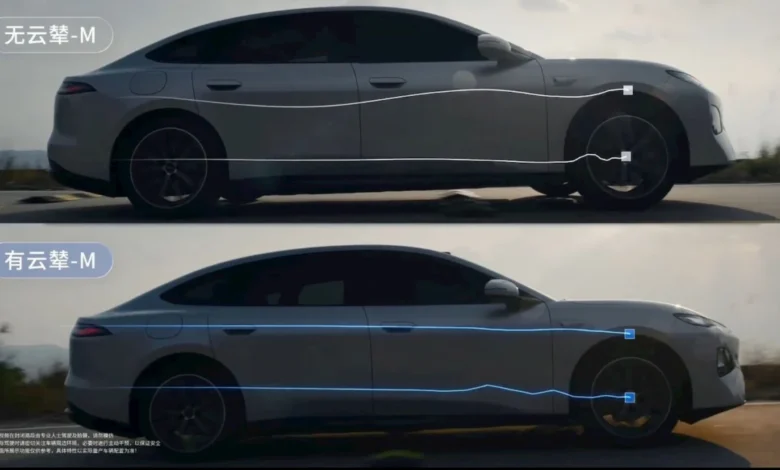
Ride comfort and handling precision are traditionally reserved for high-end luxury vehicles equipped with expensive pneumatic or hydraulic suspension systems. With the Seal 07, BYD is democratizing active chassis technology through the debut of its Disus-M Intelligent Magnetorheological Body Control System.
The vehicle utilizes a sophisticated suspension architecture, pairing a front double-wishbone setup with an enhanced rear five-link suspension. This hardware is interconnected with a network of advanced road-surface sensors—including roof-mounted LiDAR—and BYD’s proprietary iTAC 2.0 (Intelligent Torque Adaptation System).
Zhang Zhuo, General Manager of BYD’s Ocean sales division, demonstrated the real-world capabilities of the Disus-M system during the launch presentation. The system boasts millisecond-level response times, continuously adjusting the damping force across a vast operational range of 100 to 10,000 Nm. This allows the vehicle to dynamically counteract body roll, pitch, and dive, adapting instantly to road imperfections to deliver a cloud-like ride quality.
While the Disus-M system is featured on the premier all-electric Flagship variant—which starts at 172,900 yuan ($26,000)—lower-tier trims are equipped with BYD’s capable Disus-C intelligent body control system, ensuring that advanced ride dynamics remain accessible across the model lineup.
Interior Luxury and the Smart Ecosystem 2.0
Stepping inside the cabin, the Seal 07 reflects a minimalist yet deeply functional design philosophy centered around digital integration and passenger comfort. The dashboard is anchored by a large 15.6-inch floating center infotainment screen, complemented by a 10.25-inch digital instrument cluster for the driver. Rear-seat passengers are also catered to with dual entertainment screens mounted to enhance long-distance travel experiences.

BYD has infused the cabin with executive-tier amenities typically found in vehicles twice its price. These include a built-in 6.8-liter smart refrigerator, ergonomically contoured zero-gravity seats designed to reduce fatigue on extended journeys, and specialized driver headrest audio systems for personalized sound staging and hands-free communication.
Furthermore, the Seal 07 debuts BYD’s Smart Ecosystem 2.0. A standout feature of this software suite is "Diva," a companion smartwatch that allows drivers to interact seamlessly with the vehicle, execute remote commands, and manage climate and security functions away from the physical keys.
For autonomous driving and active safety, higher-priced configurations of the Seal 07 incorporate BYD’s advanced "God’s Eye B" intelligent driving system. Leveraging the vehicle’s external sensor suite, including LiDAR, the system provides comprehensive driver-assistance features such as Navigation on Autopilot (NOA) for both urban environments and highways, alongside full-scenario intelligent automated parking capabilities.
Official Responses and Industry Implications
While formal statements from competing legacy automakers are yet to be fully articulated, industry analysts have been quick to evaluate the disruptive potential of the Seal 07. Market observers note that BYD’s ability to bundle advanced magnetorheological suspension, ultra-fast charging LFP batteries, and sophisticated autonomous driving suites into a mid-size sedan priced under $30,000 places immense pressure on international competitors.
Western and Japanese manufacturers, many of whom are still struggling to achieve cost parity in their EV manufacturing lines, face a daunting challenge as Chinese automakers continue to iterate at a blistering pace. The vertical integration model utilized by BYD insulates the company from external supply chain shocks while preserving healthy profit margins, enabling aggressive pricing strategies like the ones showcased during the Seal 07 launch.
Broader Economic and Global Impact
The launch of the second-generation Seal 07 extends far beyond domestic market sales figures in China. It serves as a clear indicator of where the global automotive industry is heading. As these advanced technologies—particularly ultra-fast charging infrastructure compatibility and intelligent body control systems—inevitably find their way into export markets, consumer expectations regarding value-for-money in the automotive sector will be permanently altered.
By successfully bridging the chasm between luxury-tier technological sophistication and mass-market affordability, BYD is not merely participating in the electric vehicle transition; it is actively dictating its speed and direction. The Seal 07 stands as a testament to the maturation of Chinese automotive engineering, setting a new benchmark that global competitors will be forced to address in the years to come.
Related posts: