The Gymnastics Plank Is the Ultimate Core Exercise for Stability and Longevity


The evolution of core training has shifted significantly over the past decade, moving away from repetitive, spinal-stressing movements like sit-ups toward the implementation of isometric holds. Among the various techniques currently favored by strength and conditioning professionals, the gymnastics-style plank has emerged as a superior method for developing functional stability. Unlike the standard forearm plank, which often defaults to a passive hold, the gymnastics plank requires active, full-body tension, engaging the musculoskeletal system from the wrists to the ankles.
The Mechanics and Chronology of Modern Core Training
For decades, the fitness industry relied on dynamic movements such as crunches and sit-ups to target the rectus abdominis. However, longitudinal research conducted in the early 2000s, most notably by Dr. Stuart McGill, a professor emeritus of spine biomechanics at the University of Waterloo, shifted the paradigm. McGill’s studies demonstrated that repeated spinal flexion under load could lead to disc herniation and chronic back pain. Consequently, the industry pivoted toward "core bracing"—the practice of maintaining a neutral spine while resisting motion.
The gymnastics plank represents the pinnacle of this shift. While the standard plank gained popularity in the 1990s as a way to engage the transverse abdominis, it was often executed with poor form, leading to sagging hips and lumbar strain. The gymnastics variation, derived from the rigorous training protocols of competitive gymnasts, requires a "hollow body" position. This involves a posterior pelvic tilt and a deliberate rounding of the upper back (scapular protraction), which forces the core to work harder to maintain the structural integrity of the torso.

Technical Execution and Biomechanical Requirements
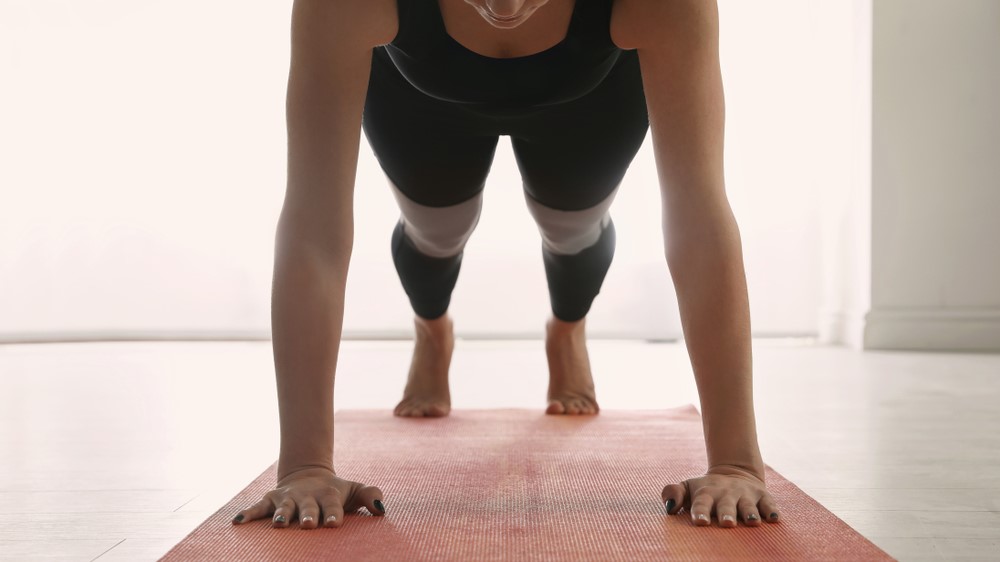
To perform a gymnastics-style plank, an individual must move beyond the basic forearm position. The exercise typically begins in a high-plank (push-up) position. From there, the practitioner must actively push the floor away, creating a dome shape in the upper back between the shoulder blades.
- Setup: Place hands directly under the shoulders, fingers spread wide to increase the surface area for stability.
- Engagement: Actively tuck the tailbone by contracting the glutes and drawing the belly button toward the spine. This posterior pelvic tilt is the "secret sauce" that removes the arch from the lower back.
- The "Hollow" Shift: Lean the body forward so the shoulders move slightly past the wrists. This creates a longer lever arm, significantly increasing the demand on the core and the stabilizing muscles of the wrists and forearms.
- Maintenance: Hold for 20 to 30 seconds. For those accustomed to holding planks for minutes at a time, this will be a humbling experience, as the intensity of the contraction prevents long-duration holds.
Physiological Benefits and Supporting Data
The efficacy of the gymnastics plank lies in the principle of isometric contraction. In an isometric exercise, the muscle fibers are under tension, but the length of the muscle does not change. This is critical for building the type of strength required for daily functional tasks.
According to data from the American Council on Exercise (ACE), a properly executed plank engages more than just the abdominal wall; it recruits the serratus anterior, the external obliques, the rectus abdominis, and the multifidus muscles along the spine. By incorporating the "hollow" posture, the gymnast plank also places a significant load on the upper extremities.
Grip strength, which is heavily challenged by this variation, has become a key biometric marker for longevity. A 2019 study published in The BMJ (British Medical Journal) found a strong correlation between grip strength and mortality rates in older adults. As individuals enter their 50s and beyond, natural muscle atrophy (sarcopenia) accelerates. Exercises that simultaneously challenge the core and the distal extremities, such as the gymnastics plank, serve as a dual-purpose intervention against both core weakness and declining grip strength.

Clinical Perspective on Injury Prevention
Fitness professionals working with clients over the age of 50 report that the gymnastics plank is particularly effective for those suffering from non-specific low back pain. By teaching the body to maintain a posterior pelvic tilt, the exercise reinforces a neutral spine position, which is essential for heavy lifting and everyday movements like picking up groceries or carrying luggage.
The emphasis on scapular protraction—the act of pushing the shoulder blades apart—is also a corrective movement for the "slouched" posture common in office-based workers. By strengthening the serratus anterior, the muscle responsible for stabilizing the scapula against the ribcage, the exercise helps to mitigate shoulder impingement and improves overall thoracic mobility.
Implementation and Progression
Integrating this movement into a routine requires a focus on quality over quantity. Because the intensity is significantly higher than a standard plank, it is recommended to start with short, high-tension intervals.
- Phase 1 (Foundation): Focus on the hollow-body hold while lying on the back to master the pelvic tilt.
- Phase 2 (Integration): Transition to the floor in the push-up position, focusing on the "push" through the hands.
- Phase 3 (Advancement): Incorporate the forward lean, shifting the center of gravity to increase the load on the rectus abdominis.
If an individual experiences pain in the wrists or forearms during the progression, it is advised to revert to a forearm variation while maintaining the same hollow-body cues. It is important to distinguish between the "good" discomfort of muscle fatigue and the "bad" pain of joint impingement.
Broader Implications for Fitness and Wellness
As the global population ages, the emphasis of the fitness industry is shifting from aesthetics to healthspan—the number of years a person lives in good health. The adoption of gymnastics-derived protocols into mainstream fitness is a reflection of this transition. These exercises are not merely about developing a visible "six-pack"; they are about creating a resilient, injury-resistant frame.
The rise of professional coaching platforms and accessible fitness technology has allowed for the democratization of these specialized movements. Where once gymnastics training was reserved for elite athletes in specialized facilities, today, anyone with a yoga mat and an understanding of biomechanical cues can utilize these methods to improve their quality of life.
Summary of Impact
The transition toward gymnastics-style core training is a necessary evolution for both athletes and the general public. By prioritizing isometric tension and structural alignment, the gymnastics plank addresses the limitations of traditional abdominal training. Whether the goal is to improve performance in high-intensity sports, to support the spine during daily activities, or to build the grip strength required for long-term health, this exercise serves as a fundamental building block.
As more trainers and clinicians integrate these techniques into their programming, we are likely to see a decrease in the incidence of common, preventable musculoskeletal issues. The objective for the modern practitioner is not to hold a plank for the longest duration possible, but to hold it with the highest level of neural activation and structural control. By mastering the gymnastics plank, individuals can ensure their core remains a source of strength, stability, and support for decades to come.