Tesla Strengthens European Manufacturing Footprint with Launch of Berlin Engineering Center

Tesla has officially inaugurated its new engineering hub in Berlin, marking a significant strategic shift in how the automaker manages its development cycle for the European market. Located in the Köpenick district, the Berlin Tesla Engineering Center (BTEC) serves as a vital bridge between the drawing board and the production line. By positioning its engineering and testing teams just 30 minutes from the Gigafactory Berlin-Brandenburg in Grünheide, Tesla aims to synchronize design improvements with large-scale manufacturing output, effectively creating a high-velocity feedback loop.
This facility represents the company’s third global engineering hub, joining established centers in Fremont, California, and Shanghai, China. The opening of BTEC underscores Tesla’s commitment to regionalization, ensuring that the vehicles built in Germany are also engineered and validated within the same geographic sphere, thereby reducing logistical friction and accelerating the implementation of design iterations.
Rapid Development and Strategic Consolidation
The transformation of the Köpenick site—a former industrial cable factory—from a permitted project to a fully operational engineering campus in less than a year is a testament to Tesla’s aggressive infrastructure strategy. The new facility consolidates four disparate engineering sites and integrates 30 specialized laboratories under a single roof. This centralization is designed to streamline interdisciplinary collaboration, bringing experts in materials science, powertrain development, vehicle engineering, and safety validation into a shared workspace.
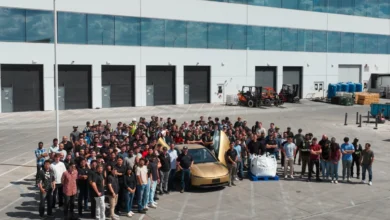
According to Tesla Europe, the facility is already operational with an initial workforce of approximately 250 engineers and technicians. A significant portion of this team consists of personnel relocated from existing Tesla operations, including the company’s facility in Tilburg, the Netherlands. However, this is only the beginning; Tesla has already initiated the approval process for a second phase of expansion, which would double the site’s headcount to roughly 500 employees. The company has disclosed an initial investment of €100 million for the project, signaling a long-term commitment to the region.
Infrastructure for Precision Testing
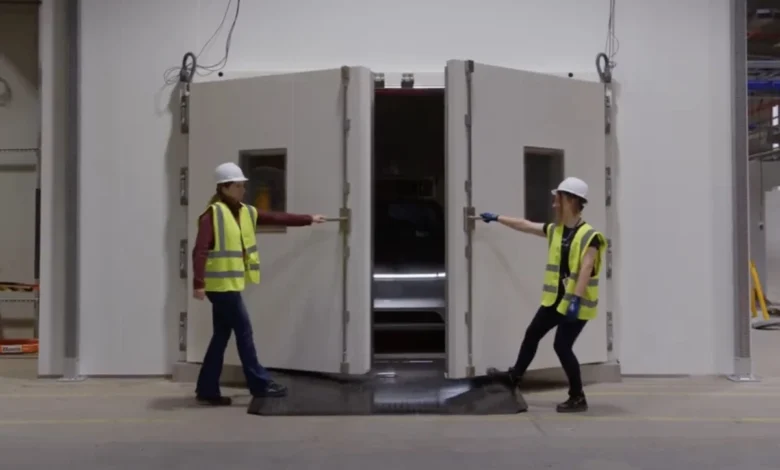
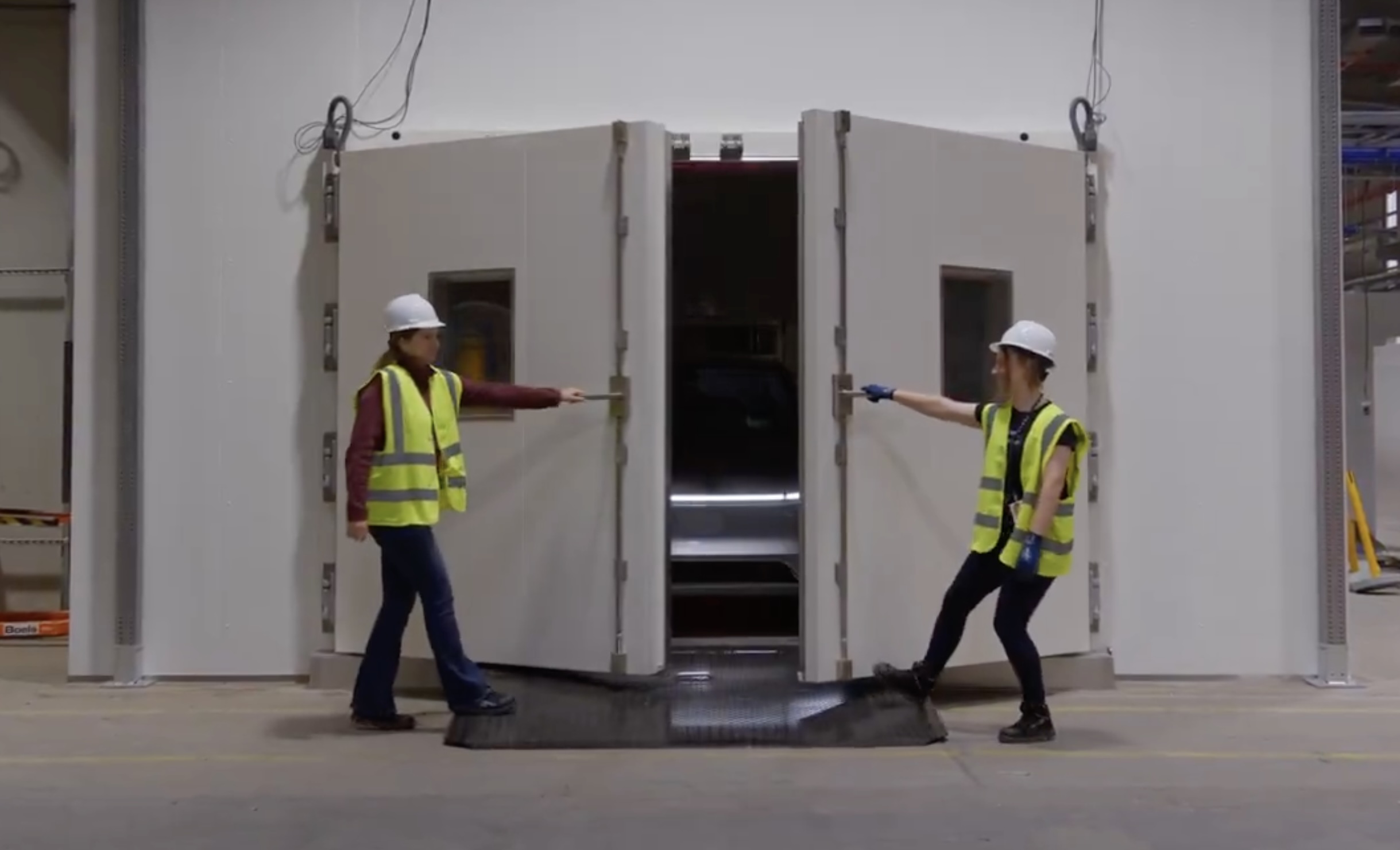
The BTEC facility is equipped to handle the end-to-end lifecycle of vehicle components. Its laboratories are focused on critical areas such as battery cell chemistry, electric motor efficiency, and advanced material durability. One of the most prominent features of the campus is a large-scale hall dedicated to rigorous safety testing. During the center’s opening ceremony, staff demonstrated a pedestrian leg impact test using a sophisticated catapult rig—a visual representation of the facility’s capability to conduct complex safety validations on-site.
The facility’s identity is marked by a unique logo: a cubist-inspired Berlin bear, which staff have affectionately dubbed the "Cybaer." This localized branding reflects the company’s intent to integrate into the German industrial ecosystem, a sentiment echoed by BTEC head Brückner, who stated, "We came here to stay. We serve all of Europe via Gigafactory Berlin-Brandenburg."
A Global Role for a Local Hub
While the immediate priority of BTEC is to solve technical challenges and refine processes for Giga Berlin, the center’s influence will extend far beyond the borders of Germany. Tesla has confirmed that the engineering and design teams based in Berlin have already played a substantial role in the development of the Model Y, the Tesla Semi, and the next-generation Roadster.
Moving forward, BTEC will act as a node in Tesla’s global research and development network. The work performed in Köpenick will not only support local production but will also contribute to the validation and refinement of components intended for vehicles manufactured in the company’s North American and Chinese facilities. This cross-pollination of engineering expertise is central to Tesla’s ability to maintain a consistent global quality standard while addressing specific regional preferences and regulatory requirements.
Contextualizing Giga Berlin’s Growth
The opening of BTEC coincides with a period of aggressive expansion for Gigafactory Berlin-Brandenburg. As Tesla’s European sales trajectory continues to trend upward, the pressure on the manufacturing facility to maintain high output levels has intensified. In June 2026, Tesla announced plans to elevate Model Y production to 7,500 units per week, following a strong first quarter that saw the factory produce over 61,000 vehicles.
Recent milestones confirm the feasibility of these targets. The factory successfully reached a production cadence of 7,000 Model Ys in a single week for the first time, reflecting a significant increase in operational efficiency. Furthermore, in May, the company announced it would more than double the planned 4680 battery cell production capacity at the site, targeting an output of 18 GWh per year. These developments support the broader, albeit long-term, ambition of eventually scaling the Grünheide site to reach an annual production volume of one million vehicles.
Market Dynamics and Economic Indicators
The necessity for such an engineering investment is supported by robust market data. According to data from the Kraftfahrt-Bundesamt (KBA), Tesla’s momentum in the German market remains strong. In October 2026, Tesla registrations in Germany nearly quadrupled compared to the same month in the previous year, totaling 2,932 units. Cumulatively, for the first ten months of 2026, Tesla registered 47,742 vehicles in Germany, reinforcing its position as a key player in the European electric vehicle transition.

The proximity of the engineering hub to the factory is a critical factor in maintaining this market position. In the automotive industry, the "feedback loop"—the time taken to identify a manufacturing defect or a design improvement and implement it on the assembly line—is a primary determinant of competitive advantage. By cutting the travel time between the lab and the factory floor, Tesla expects to reduce waste, improve vehicle build quality, and shorten the lead time for implementing engineering changes that can range from minor part adjustments to significant structural overhauls.
Implications for the European Automotive Sector
The presence of the Berlin Tesla Engineering Center has broader implications for the European automotive industry. By establishing such a significant R&D footprint, Tesla is deepening its integration into the German labor market, tapping into the country’s dense concentration of automotive engineering talent. This, in turn, creates a competitive dynamic for human capital, as legacy automakers and tech startups alike compete for the specialized skills required for battery management, powertrain optimization, and software-defined vehicle development.
Furthermore, the scale of the investment suggests that Tesla views Europe not merely as a sales destination but as an essential engine for its global R&D efforts. As the company navigates the complexities of the energy transition, the ability to iterate on hardware and software at the speed of software development will be crucial. With BTEC fully operational, Tesla has effectively moved the "brain" of its European operations closer to the "heart" of its manufacturing, a move likely to be viewed by industry analysts as a major operational efficiency gain.
Conclusion
The launch of the Berlin Tesla Engineering Center marks a definitive chapter in the company’s European expansion. By bridging the gap between research and mass production through a centralized, high-tech campus, Tesla is positioning itself to handle the growing demands of its European customer base while simultaneously contributing to its global engineering pipeline. As Giga Berlin moves toward its goal of one million vehicles per year, the role of BTEC in ensuring that these vehicles are designed, tested, and refined with maximum efficiency will become increasingly central to Tesla’s mission to accelerate the world’s transition to sustainable energy.