Microsoft Exposes Sophisticated Dual-Campaign Cyber Offensive Leveraging AI-Driven Impersonation and Passkey Social Engineering

Microsoft has officially disclosed the mechanics of two highly sophisticated, multi-stage cyber campaigns that have targeted global enterprise environments throughout the second half of 2026. The tech giant’s security research division detailed a dual-pronged assault: one focused on large-scale financial fraud through generative AI-assisted executive impersonation, and the second centered on identity-focused social engineering designed to compromise cloud-based infrastructure. These campaigns underscore a significant shift in threat actor methodology, moving away from brute-force tactics toward highly personalized, multi-layered narratives that exploit the inherent trust placed in digital authentication and corporate hierarchies.
The Rise of Generative AI in Financial Fraud
The first campaign, which gained significant momentum between August 3 and August 5, 2026, involved the dispatch of over one million fraudulent emails. This operation targeted accounts payable departments across high-value sectors, including IT services, consumer goods, real estate, and discrete manufacturing, primarily within the United States.
The strategy employed by the threat actors marked a departure from traditional "scatter-gun" phishing attempts. By utilizing generative AI to synthesize context-aware email templates, the attackers were able to craft communications that mirrored the professional cadence and operational nuances of specific organizations. The primary objective was to trick finance personnel into initiating Automated Clearing House (ACH) transfers for non-existent annual subscriptions, often disguised as payments for services like ServiceNow.

The sophistication of this campaign lies in its "unified narrative" approach. Rather than relying on a single malicious link, the attackers engineered a complex trail of fabricated evidence. This included the registration of legitimate-looking impersonation domains, the creation of high-fidelity forged invoices, and the insertion of fake email threads between company executives. By populating these emails with the names and verified contact information of CEOs, CFOs, and other C-suite personnel, the attackers effectively lowered the guard of the target employees, making the requests appear as urgent, approved internal directives.
Chronology of the Cloud Compromise Campaign
While the financial fraud campaign targeted corporate coffers, a second, concurrent operation has been active since at least May 2026. This campaign focuses on the long-term compromise of cloud-based identities. Unlike the high-volume nature of the invoice scam, this operation is characterized by surgical, identity-focused social engineering.
The attack lifecycle for these cloud intrusions typically follows a well-defined, four-stage progression:
- Reconnaissance and Pre-attack Research: Threat actors meticulously harvest information about employees from public social networking and professional profiling platforms. This research allows them to identify key personnel and tailor their approach.
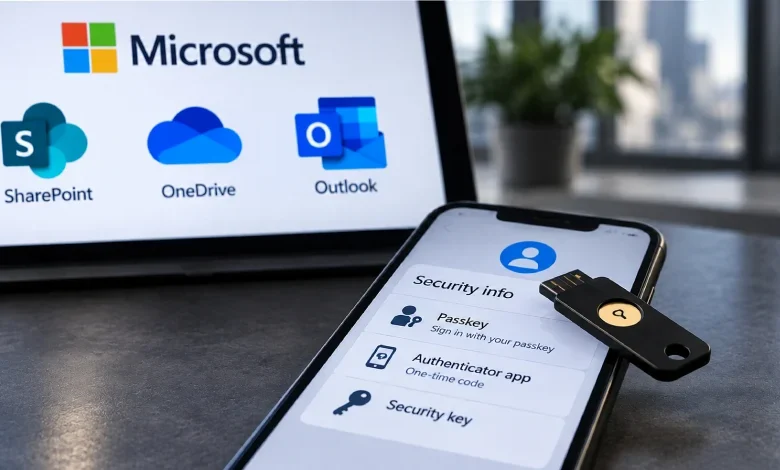
- Voice Phishing (Vishing): Attackers contact the target’s personal phone number, posing as members of the organization’s internal IT help desk. They create a sense of urgency, insisting that the user must immediately update their passkey, multi-factor authentication (MFA), or single sign-on (SSO) configurations to prevent a total loss of access.
- Adversary-in-the-Middle (AitM) Execution: Targets are redirected to counterfeit websites—designed to perfectly mimic Microsoft’s sign-in interface—via SMS. By engaging the victim in device-code authentication flows, the attackers bypass traditional security hurdles, capturing the necessary session tokens or credentials.
- Persistence and Data Exfiltration: Once inside, the attackers immediately register their own MFA methods, such as a rogue authenticator app or a controlled phone number. This grants them the ability to sign in at will, even if the victim changes their password. From this foothold, they utilize the Microsoft Graph API to perform high-volume data collection from SharePoint, OneDrive, and corporate mailboxes.
Analysis of the Threat Actors: UNC6671 and the Storm Ecosystem
Microsoft’s security analysts have linked these activities to a web of known threat actors, most notably the collective tracked as UNC6671. This group—also associated with monikers such as Cordial Spider, O-UNC-045, and PREY-0058—functions as a decentralized network of affiliates. These actors share a common playbook and infrastructure, which allows them to pivot between different extortion brands, such as Helix and the infamous ShinyHunters.

The correlation between these groups suggests an industrialization of the cybercrime economy. By sharing "commoditized phishing panels" and voice-phishing scripts, these groups ensure that their campaigns remain effective even as organizations implement more robust security awareness training. The involvement of Storm-3121 and Storm-3032 indicates that these campaigns are not the work of isolated hackers but rather disciplined entities operating with clear financial incentives and a focus on maximizing return on investment.
The Challenge of Detection in Modern Cloud Environments
One of the most alarming aspects of these campaigns is the difficulty of detecting the subsequent data exfiltration. Microsoft noted that the abuse of the Microsoft Graph API often appears benign when examined as a series of individual, isolated requests. It is only when security teams employ holistic, cross-event correlation that the pattern of unauthorized data harvesting becomes visible.
The reliance on "passkey-themed" lures is particularly concerning. As the industry pushes for the adoption of passwordless authentication, threat actors have pivoted to exploiting the confusion and unfamiliarity surrounding these new standards. By framing the phishing request as an "enrollment" or "update" process, the attackers successfully weaponize the user’s desire to maintain secure, uninterrupted access to their digital tools.
Broader Implications and Corporate Responsibility
The fallout from these campaigns has been significant, forcing many enterprises to re-evaluate their reliance on phone-based authentication and standard MFA protocols. The shift toward attackers registering their own MFA devices as a form of persistent access means that organizations must now prioritize the monitoring of identity enrollment events. Any unexpected registration of a new authenticator app or phone number should be treated as a high-severity security incident.

Furthermore, the integration of generative AI into phishing campaigns signals a new era in business email compromise (BEC). As AI tools become more adept at mimicking human communication patterns, the "red flags" traditionally used to identify phishing—such as grammatical errors, awkward phrasing, or inconsistent tone—are rapidly disappearing.
"The modern threat landscape is no longer just about catching a malicious link," says an independent cybersecurity analyst familiar with the Microsoft report. "It is about verifying the intent and the identity behind every interaction. When an attacker can successfully impersonate a CEO and a help desk technician in the same month, the traditional perimeter-based defense model is fundamentally obsolete."
Recommendations for Mitigation
In response to these findings, cybersecurity experts emphasize several critical defensive measures:
- Behavioral Progression Monitoring: Instead of relying on static alerts, security operations centers (SOCs) must implement behavioral analytics that monitor for anomalous sequences of API calls, particularly those related to Microsoft Graph and SharePoint access.
- Strengthening Help Desk Protocols: Organizations should establish a strictly verified, out-of-band communication channel for all IT support requests. Employees should be trained to verify the identity of anyone claiming to be from the IT department through a separate, pre-established internal channel.
- Hardware-Based Authentication: To mitigate the risks of AitM and device-code phishing, organizations are encouraged to move away from SMS and push-based MFA toward hardware-based security keys (FIDO2) that are resistant to interception.
- Cross-Event Correlation: Security teams should focus on "holistic assessment," ensuring that telemetry from identity providers, endpoint devices, and cloud SaaS applications is aggregated to detect the progression of an attack rather than just the initial entry.
As 2026 draws to a close, these campaigns serve as a stark reminder that the digital transformation of the enterprise also creates a broader, more lucrative attack surface for sophisticated criminal collectives. The ability of these groups to adapt, collaborate, and leverage cutting-edge technology ensures that the cat-and-mouse game between defenders and attackers will remain a defining feature of the global digital economy for the foreseeable future. Organizations that fail to evolve their security posture to account for these AI-driven and identity-centric threats risk becoming the next entry in a long line of victims of professionalized, high-stakes cyber fraud.