The Apple Watch currently relies on a limited suite of input methods, primarily centered on touch gestures and basic wrist-flick recognition. While features like the Double Tap gesture have provided a glimpse into hands-free control, the technology has remained largely restricted to a small set of predetermined actions. However, a significant breakthrough from researchers at Northwestern University and Carnegie Mellon University, titled TransfHAR, suggests that the hardware already present in modern smartwatches is capable of far more sophisticated motion recognition than previously utilized. By leveraging the existing accelerometer and gyroscope, this new system allows the wearable to learn, identify, and execute tasks based on the nuanced patterns of human movement without requiring additional sensors or external computing power.
The Evolution of Wearable Motion Sensing
The history of activity tracking in wearables has largely been confined to rudimentary metrics such as step counting, heart rate monitoring, and generalized exercise detection. Early iterations of these devices were limited by processing power and the fidelity of their Inertial Measurement Units (IMUs). As sensors became more precise, the focus shifted toward "Human Activity Recognition" (HAR).
The TransfHAR project represents a departure from traditional, static activity classification models. By utilizing a transformer-based architecture—an evolution of the LSM-2 wearable sensor model originally developed by Google researchers—the system can interpret complex, repetitive movements as distinct data signatures. The involvement of Google research scientists in this project highlights a broader industry interest in moving beyond basic fitness tracking into the realm of "context-aware" computing. This suggests that the underlying methodology is not only applicable to the Apple Watch ecosystem but could eventually be integrated into the wider landscape of Wear OS devices, which rely on the same fundamental sensor architecture.

Technical Breakdown: How TransfHAR Functions
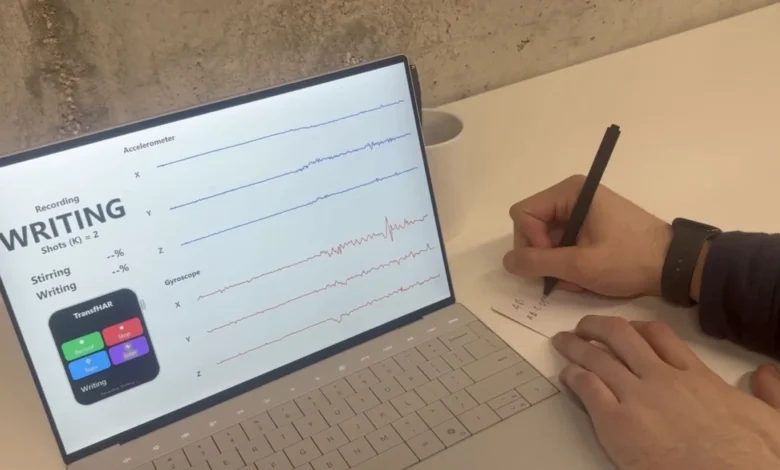
The core of the TransfHAR system lies in its ability to perform "on-device" machine learning. Unlike cloud-based AI models that require high-bandwidth connections and significant latency, TransfHAR processes motion data locally. The system utilizes the 6-axis IMU, which records raw data from the accelerometer and the gyroscope.
In a controlled study involving 10 participants, researchers tested the watch’s ability to recognize a diverse array of mundane, everyday tasks, including the physical motions of stirring a cup of coffee, drawing shapes in the air, using hand sanitizer, and tying shoelaces. The training process for the model is remarkably lean. Participants provided roughly one minute of movement data per activity, allowing the system to achieve a 90% accuracy rate in recognizing those specific motions.
Even with significantly truncated data samples, the system demonstrated high reliability. Data points from the study indicate that a single 2.56-second clip of movement yielded a balanced accuracy of 75.2%. Increasing the sample to 13 seconds of data—or five clips—pushed the accuracy to 86.7%. When expanded to 51 seconds of data, the model reached a peak accuracy of 89.3%. Perhaps most impressive is the computational efficiency: the system requires less than one second to train on a new set of activities and processes predictions in approximately 24 milliseconds, ensuring near-instantaneous response times for the user.
Implications for Human-Computer Interaction
The shift from touch-based interfaces to gesture-based automation represents a paradigm shift in how users interact with smart devices. If implemented by hardware manufacturers, this technology could facilitate a new layer of "ambient" automation.

Consider the potential for smart home integration. If an Apple Watch can accurately identify the motion of stirring coffee, it could serve as a trigger for a series of automated tasks within a connected ecosystem. Upon detecting the gesture, the watch could automatically initiate a smart kitchen appliance, queue a specific morning playlist, or pull up relevant data on a nearby display—all without the user ever touching a screen or issuing a voice command.
Beyond domestic convenience, the medical and professional implications are profound. In clinical settings, the ability for a wearable to monitor tremors or repetitive motor patterns with high fidelity could provide neurologists with objective, longitudinal data on patient health. In industrial environments, the technology could track the completion of assembly steps, providing a digital log of manual labor that ensures compliance and efficiency.
Current Limitations and Future Challenges
Despite the technical promise, the research team identified several hurdles that must be cleared before the technology reaches commercial viability. The primary challenge involves the differentiation of subtle movements. The current iteration of TransfHAR occasionally struggles to distinguish between activities that share similar wrist trajectories but serve different purposes—such as writing, scrolling on a mobile device, or applying lotion. These activities produce similar raw sensor output, making it difficult for the current model to isolate the intent behind the motion.
Furthermore, the system currently faces challenges with "multi-step" routines, such as the sequence required to prepare a complex beverage like a latte. While the model is adept at identifying a single, repetitive action, chaining those actions together remains a hurdle for future iterations.

Additionally, the research was conducted in a controlled environment. Real-world application introduces a host of variables, including varying device fit, individual anatomical differences, and external noise that could potentially degrade the signal quality of the IMU. Finally, the researchers have yet to release comprehensive data regarding the impact of continuous gesture recognition on battery longevity. Given that the Apple Watch is already pushed to its limits by background health monitoring, the power draw of a persistent, high-frequency motion-sensing model will be a critical factor for manufacturers to evaluate.
The Path Toward Implementation
The success of this experiment underscores a growing trend in consumer technology: the "hidden" potential of existing hardware. Often, the limitations of smartwatches are not rooted in a lack of hardware, but in the software’s inability to interpret the vast streams of data the sensors are already collecting.
The integration of such technology would likely require a robust software framework that allows users to "train" their own gestures safely and privately. As the project’s lead researchers suggest, the goal is to make the system accessible enough that a user can define a gesture, assign it a function, and have it working in under a minute.
For developers, the opportunity lies in creating a platform where these gestures can be mapped to custom app shortcuts. If Apple or Google were to integrate an API for this type of on-device gesture learning, it would effectively turn every existing smartwatch into a customizable input device.

As the research matures, the industry will be watching to see how these companies address the privacy concerns inherent in recording detailed movement data. Since the system functions entirely on-device, it offers a significant advantage in terms of data security compared to cloud-reliant models. However, the potential for "accidental triggers"—where a mundane gesture causes an unintended action—will require sophisticated safeguards and user-defined confirmation protocols.
In conclusion, while the technology is still in the experimental phase, the results achieved by the TransfHAR system provide a compelling roadmap for the future of wearable computing. By moving away from rigid, pre-programmed inputs and toward a model of adaptive, user-defined gesture recognition, the next generation of smartwatches may finally achieve the level of intuitive interaction that has been promised for over a decade. Whether this capability will be integrated into the next firmware update or remains a foundational research project for future hardware iterations remains to be seen, but the data clearly indicates that the watch on your wrist is capable of learning much more than just your step count.
Related posts: