The Limitations of Text-Centric Retrieval
For the past several years, the standard approach to document processing has involved converting PDFs into raw text strings and performing semantic search via vector embeddings. While this method is highly effective for prose, it creates significant "blind spots." When a parser encounters a table, the structural integrity of rows and columns is often lost, leading to hallucinated data or incomprehensible outputs. Furthermore, embedded images are typically ignored entirely, resulting in a pipeline that operates with only a fraction of the original document’s intelligence.
The necessity for multi-modal RAG is underscored by the high density of visual data in enterprise environments. Research indicates that upwards of 40% of critical decision-making data in annual reports and technical whitepapers is contained within non-textual elements. Without a system capable of interpreting these visual cues, automated AI assistants remain tethered to incomplete data sets, potentially leading to inaccurate strategic recommendations.
The Technical Architecture: A Four-Stage Workflow
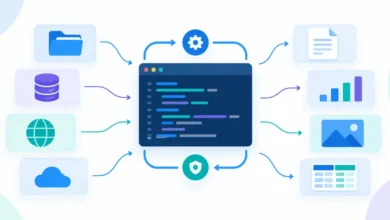
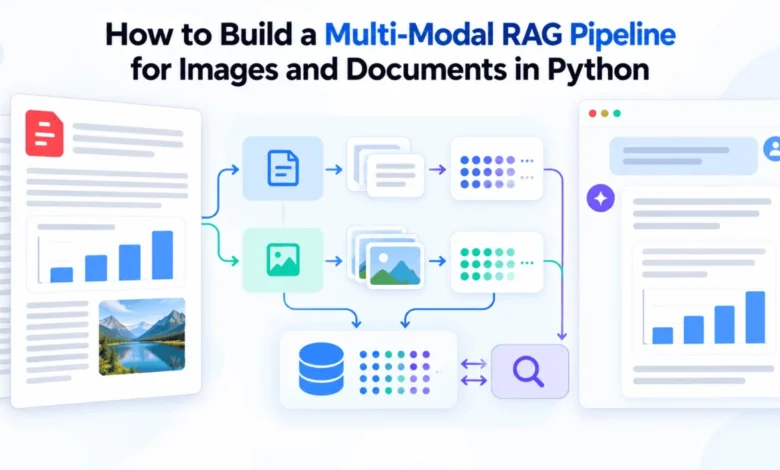
Transitioning from a text-only RAG pipeline to a multi-modal system requires a fundamental shift in how data is ingested, indexed, and queried. The modern, API-driven architecture for this process is structured into four distinct stages: ingestion (parsing), semantic enrichment (summarization), dual-index storage (multi-vector retrieval), and multi-modal synthesis (querying).
The process begins with the parsing stage, utilizing tools like the unstructured library. Unlike traditional PDF scrapers, this library utilizes advanced layout analysis to differentiate between document components. By setting infer_table_structure=True, the system preserves the relationship between data points, while extract_image_block_types ensures that images are isolated as distinct assets. This is not merely a file-saving operation; it is a structural classification process that prepares the document for secondary processing.
The Role of Vision-Language Models in Indexing
The most innovative step in this pipeline is the transition from raw image storage to searchable summaries. Because vector databases cannot natively index the pixels of a chart, the pipeline leverages the vision-language capabilities of models like GPT-4o. By passing extracted images to these models with a prompt designed for objective, detailed description, developers can generate text-based summaries that effectively represent the visual content.
These summaries serve as the bridge between the user’s query and the raw visual file. For instance, if an image contains a complex revenue growth chart for the third quarter, the AI-generated summary will contain keywords such as "revenue," "Q3," "growth trends," and "fiscal analysis." When a user later asks, "What was the revenue performance in Q3?", the vector search engine matches the query against the summary, which is then linked back to the original, high-resolution image file.
Multi-Vector Storage: Linking Context to Visuals
The core of the system’s effectiveness lies in the MultiVectorRetriever architecture. This approach deviates from the standard "one-chunk-one-embedding" model. Instead, it utilizes two concurrent data stores:
- The Vector Store: An optimized database, such as Chroma, that holds the high-dimensional embeddings of text chunks and image summaries.
- The Document Store: An
InMemoryStorethat keeps the actual content—the raw text and the file paths to the original images—indexed by unique, persistent identifiers (UUIDs).
This separation of concerns allows for high-speed similarity searches in the vector store while ensuring that the final output provided to the user is the original source material rather than a degraded representation.
Implementation Requirements and Setup
To deploy this architecture, the following environment configuration is essential. Developers must ensure that system-level dependencies, particularly poppler-utils, are installed to allow the unstructured library to render PDF pages into images.
# Essential installation command
pip install langchain langchain-openai unstructured[pdf] chromadb pillow
apt-get install -y poppler-utils
Once the environment is configured, the initialization of the OpenAI API and the instantiation of the MultiVectorRetriever form the backbone of the system. It is imperative to manage costs during the indexing phase; because each image requires an API call to a vision-language model, developers should implement a filtering mechanism to exclude small, non-informative icons or decorative elements that do not contribute to the document’s analytical value.
Chronology of Retrieval and Synthesis
The final stage—querying—is where the system demonstrates its value. When a query is initiated, the retriever executes a semantic search across both text and image summaries. The resulting documents are then bifurcated by the code logic:
- Text blocks are concatenated for inclusion in the final prompt.
- Image paths are dynamically read, encoded into base64 format, and injected into the multimodal prompt alongside the text.
This creates a comprehensive context window for the Large Language Model (LLM). For example, if a user requests a summary of a document’s technical specifications, the model can synthesize text from the introduction with the visual schematics found in the appendix, providing a unified answer that would have been impossible for a text-only system.
Strategic Implications and Future Directions
The adoption of multi-modal RAG signals a broader trend in enterprise AI: the movement toward "natively multimodal" reasoning. As noted in recent industry guides, systems that can process text, images, and eventually audio or video are becoming the standard for professional-grade document analysis.
The implications for business productivity are substantial. Departments such as legal, finance, and engineering, which are historically bogged down by the manual synthesis of hybrid documents, can automate the extraction of insights from complex layouts. The potential for error is significantly reduced when the AI is capable of "seeing" the document as a human would, rather than treating it as a flat sequence of characters.
Looking ahead, the next iteration of this technology will likely focus on improving retrieval precision through re-ranking models and the adoption of end-to-end vision-language models like ColPali. These emerging tools aim to embed document pages directly as visual patches, potentially eliminating the need for separate parsing steps. Until then, the four-stage RAG pipeline described here remains the most robust, scalable, and practical framework for handling the complexities of modern, document-heavy workflows. By investing in these architectures today, organizations are positioning themselves to leverage their vast, untapped archives of visual and tabular data as a primary engine for intelligent decision-making.