FBI Sting Exposes RansomwareHelp Co-Founder in Multi-Year Extortion and Fraud Scheme

The co-founder and chief technology officer of a Florida-based data recovery firm has been formally charged with wire fraud following an intricate federal sting operation. Federal prosecutors in Rhode Island revealed that Juan Ricardo Palacio Escobar, 52, operated ransomwarehelp.com—a business that publicly positioned itself as an ethical alternative to paying extortionists, yet covertly engaged in the very practices it condemned. Instead of employing proprietary cryptographic tools or advanced forensic engineering to restore locked systems, Palacio allegedly paid ransomware threat actors directly for decryption keys, subsequently billing victim organizations massive, fraudulent markups for unperformed labor.
The indictment unsealed this week highlights a disturbing trend within the cybersecurity landscape: predatory intermediaries exploiting vulnerable, panic-stricken businesses under the guise of specialized remediation. Palacio’s case exposes the mechanics of a lucrative double-dipping scam that preyed on organizations facing catastrophic data loss, adding to a growing wave of Department of Justice (DoJ) prosecutions targeting corrupt cyber defense and negotiation firms.
The Facade of Advanced Cryptography
For six years, ransomwarehelp.com marketed itself as a beacon of hope for enterprises locked out of their own networks. The company’s digital storefront aggressively courted prospective clients with the reassuring slogan, “Do not pay the ransom!” It claimed to possess a 99% success rate backed by a formidable team of 80 experts specializing in cryptography, cybersecurity, forensic analysis, and reverse engineering.
To justify its exorbitant service fees, the platform boasted proprietary algorithms capable of restoring 100 percent of locked servers and data without yielding to extortion demands. “Our cryptography experts use proprietary tools and algorithms to achieve 100% data recovery,” the website proclaimed, explicitly stating that the firm never promoted, intermediated, or paid ransoms on behalf of its clientele.
In reality, these claims were entirely fictitious. According to federal investigators, Palacio operated a pipeline that funneled victim funds directly to criminal syndicates while pocketing the difference. Rather than cracking complex mathematical ciphers, Palacio acted as a covert middleman, negotiating with threat actors for lower payoffs, securing decryption keys, and concealing his actions behind elaborate technical pretexts.

The Federal Sting Operation
The unraveling of RansomwareHelp began when federal law enforcement agencies launched an undercover operation designed to test the firm’s operational integrity. Posing as both a distressed corporate victim of a cyberattack and, separately, as a fictitious ransomware extortion group, FBI investigators set a trap for the Miami and Medellin-based executive.
Disguised as corporate victims, undercover agents contacted RansomwareHelp and provided a copy of a fabricated ransom note, explicitly stating their reluctance to pay attackers. True to form, the firm reiterated its strict policy against negotiating with cybercriminals.
Shortly thereafter, Palacio—acting as the victim’s supposed champion—contacted the fictitious ransomware group operated by the FBI, soliciting the lowest possible price for a decryption key. Undercover agents posing as the threat actors quoted a price of 0.2 bitcoin, valued at approximately $13,000 at the time. Less than 48 hours later, Palacio reported back to the “victim” company, claiming that diagnostic assessments were complete and quoting a decryption fee of $13,260.
In a brazen display of double-dealing, Palacio concurrently messaged the FBI’s fake ransomware cell to negotiate the price down to roughly $4,000, eventually settling on approximately $6,000 in bitcoin. Ultimately, Palacio billed the undercover federal agents $16,010—incorporating an initial $2,750 diagnostic charge alongside the inflated decryption fee—pocketing a substantial illicit profit while contributing nothing to actual technological recovery.
Anatomy of a Scam: The Accounting Firm Incident
The federal indictment aligns closely with independent accounts from security professionals who investigated RansomwareHelp’s activities prior to the FBI intervention. Paul Ihme, co-founder of the cybersecurity firm Soteria, detailed a 2024 case in which a small accounting firm sought help after a devastating Lockbit ransomware infection paralyzed its entire database and client network.
According to Ihme, RansomwareHelp issued an astonishing proposal totaling $438,880. The invoice claimed the fee covered the “professional configuration of forensic servers,” specialized programming hours to build custom decryption algorithms, and eight distinct six-hour processing cycles. The proposal even asserted that recovery involved reverse engineering encryption via “510 preconfigured forensic servers of the maximum quantitative capacity located in different parts of the world,” using brute-force processes to inject randomly extracted codes.

Technical experts quickly recognized these assertions as technological gibberish. Ihme noted that the proposal listed irrelevant password-hashing algorithms, such as SHA-256, in a farcical attempt to explain how the firm supposedly planned to break six distinct encryption standards.
“If it were really true these guys could decrypt any ransomware out there, this guy would be a billionaire,” Ihme remarked. “They were going after people who don’t have any technical knowledge, are desperate, and don’t have anyone advising them about how any of this stuff works.”
Covert Access and Erased Evidence
To execute their scheme, RansomwareHelp representatives routinely insisted on obtaining unrestricted remote access to victim networks using AnyDesk remote desktop software, ostensibly to run diagnostic analyses. However, security audits revealed a more malicious motive: eliminating evidence of direct communication with threat actors.
Standard ransomware attacks leave numerous text files scattered across infected systems containing extortion instructions and darknet chat links. In the accounting firm’s case, investigators discovered that nearly all copies of the Lockbit ransom note had been systematically deleted from the network. Only a single backup snapshot preserved the original text.
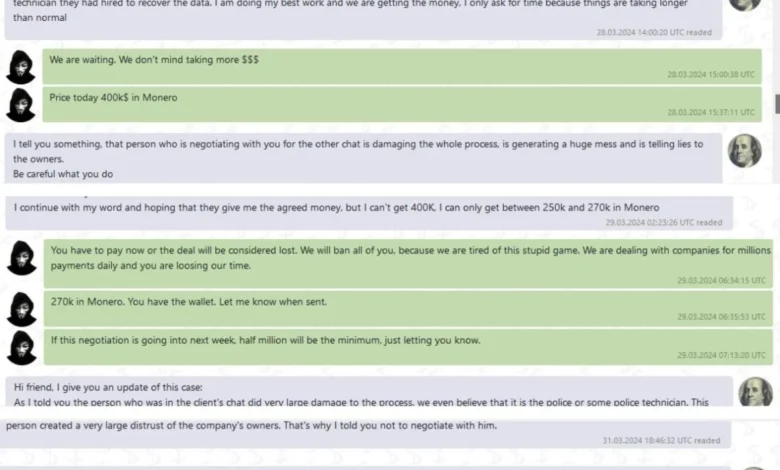
When Soteria connected to the Lockbit chat server using credentials found in the preserved note, they discovered that an external party had already been secretly negotiating with the extortionists for days. Internal chat logs later exposed RansomwareHelp frantically pleading with Lockbit to maintain secrecy, fearing that the victim would discover the double-crossing intermediary.
As negotiations dragged on, the Lockbit representatives grew increasingly impatient, threatening to increase the ransom demand by $100,000 for every day the victims delayed payment. Despite realizing that a legitimate security firm had stepped in on the client’s behalf, RansomwareHelp continued to message the hackers, complaining that competing negotiators were disrupting their arrangement. Ultimately, the accounting firm bypassed RansomwareHelp entirely, engaging an established security provider that successfully negotiated a legitimate settlement for roughly half of Palacio’s proposed fee.

A Broader Crackdown on Corrupt Intermediaries
Palacio’s indictment is not an isolated incident, but rather part of an aggressive, coordinated crackdown by the U.S. Department of Justice against fraudulent remediation and negotiation firms operating within the cybersecurity sector. Federal authorities are increasingly scrutinizing individuals who exploit the regulatory gray areas of ransomware response.
- October 2024: Federal authorities charged Edward Dubrovsky, 54, an executive at Canadian cybersecurity firm Cybersteward, with cyber extortion and conspiracy, though specific case details remain under seal.
- October 2024: MonsterCloud CEO Zohar Pinhasi, 50, was indicted on wire fraud and conspiracy charges. Prosecutors alleged that Pinhasi secretly paid hackers $8 million behind his customers’ backs while billing them $19 million for supposed non-payment remediation.
- July 2024: Angelo Martino, a 41-year-old ransomware negotiator from Land O’Lakes, Florida, was sentenced to 70 months in prison. Martino was convicted of conspiring with the notorious Blackcat/ALPHV ransomware syndicate, providing confidential client negotiation strategies to help hackers maximize payouts from victimized organizations.
Industry Implications and Recommendations
The proliferation of fraudulent recovery operators underscores a critical vulnerability in the modern incident response market. Organizations facing imminent operational collapse are frequently targeted by bad actors who exploit their desperation, technical illiteracy, and fear of public data leaks.
Cybersecurity analysts emphasize that legitimate remediation firms operate with total transparency, providing clear cryptographic validation, realistic recovery timelines, and verifiable communication channels. Experts advise victimized businesses to verify the credentials of response vendors, consult with trusted industry bodies, and coordinate closely with law enforcement agencies rather than relying on unverified third-party intermediaries who promise miraculous technical breakthroughs.
As federal law enforcement continues to dismantle illicit operations like ransomwarehelp.com, the message to predatory operators is unequivocal: exploiting corporate victims under the guise of cyber defense is a federal crime that carries severe legal consequences.
Related posts: