Gemini 4 Argon Introduces Breakthrough Capabilities in Physical Reasoning, Robotics Control, and Simulation

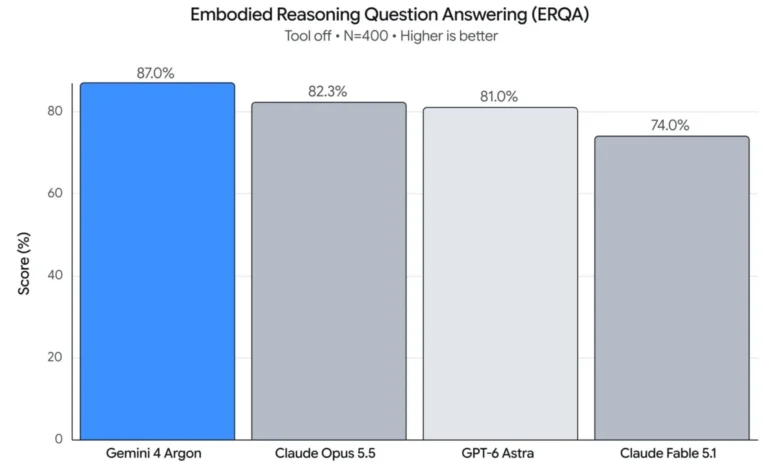
The artificial intelligence landscape is undergoing a significant paradigm shift as foundational models move beyond abstract text and two-dimensional imagery into the complex domain of physical reality. Marking a critical leap forward in physical reasoning, code generation, and visual-semantic synthesis, Gemini 4 Argon has officially been unveiled as a general-purpose physical reasoning model capable of orchestrating the entire robotics lifecycle. Demonstrating exceptional performance on spatial intelligence evaluations such as the Embodied Reasoning (ERQA) benchmark—where it achieves an unprecedented 87% score using pure reasoning alone—Argon bridges the historically disparate worlds of digital code, physical simulation, and embodied robotic execution. Industry observers note that this development represents a major milestone on the roadmap toward generalized physical artificial intelligence, offering developers a unified toolset to design, test, and deploy autonomous systems that interact seamlessly with the physical world.
The release of Gemini 4 Argon arrives at a pivotal juncture in the robotics and automation sectors. For decades, training robotic agents has required laborious manual coding, specialized reward engineering, and disjointed simulation pipelines. Traditional vision-language-action (VLA) models have frequently struggled with fine-grained spatial awareness, long-horizon task planning, and adapting to novel out-of-distribution physical environments. By leveraging native multimodal reasoning across multi-view video streams, three-dimensional geometry, contact mechanics, and proprioceptive telemetry, Argon addresses these fundamental bottlenecks. The model’s ability to reason about how objects physically interact—rather than merely identifying them in a scene—enables a new class of intelligent agents capable of operating with human-like dexterity and adaptability in unstructured environments.
Unprecedented Spatial Benchmarking and Physical Understanding
At the core of Argon’s architectural superiority is its advanced spatial-semantic reasoning engine. Tested rigorously on the Embodied Reasoning benchmark, which measures a model’s capacity to interpret and resolve complex 3D physical puzzles, Argon outpaces all existing frontier models with its 87% success rate. This proficiency stems from the model’s deep physical understanding, which extends to hindsight data labeling, telemetry interpretation, and complex puzzle-solving.
For instance, when applied to multimodal hindsight annotation—such as processing a 136-second overhead video of a bimanual robot folding paper origami—Argon autonomously constructs a time-aligned, four-level hierarchy. This hierarchy spans overall episode goals, contiguous semantic subtasks, contact-level atomic primitives, and automated quality control reweighting that isolates fumbles and retries to optimize behavior cloning datasets. Similarly, when challenged with classic physics-based conundrums like the 12-ball balance scale puzzle, Argon constructs a physics-accurate MuJoCo environment complete with a Roberval balance scale, segments indistinguishable pool balls via stereo RGB cameras, and isolates the anomalous ball within three precise weighings using a vision-only closed-loop solver.
Transforming Robot Control Across Diverse Hardware Platforms
Argon’s utility as a general-purpose physical reasoning model is demonstrated across a wide array of robotic embodiments, ranging from quadrupedal mobile manipulators to multi-axis industrial arms. By functioning as an intelligent controller that writes and refines its own action primitives, Argon bypasses traditional programming limitations.
In mobile manipulation trials involving a Boston Dynamics Spot quadruped, Argon tackles complex, multi-step physical objectives such as disposing of soda cans into a foot-pedal trash bin. The model dynamically generates an articulated MuJoCo digital twin of the bin to practice its mechanical approach before executing the physical maneuver. Utilizing a multi-agent verification swarm, Argon coordinates its front-right foot target with its wrist-mounted camera to ensure precise pedal depression and flawless hand-in-bin object drop-off.
For standard robotic arms, Argon achieves zero-shot control by operating through a calibrated visual coordinate harness. When tasked with uprighting a fallen mug and placing a crumpled napkin inside, the model evaluates wrist-camera imagery projected with world coordinates, selects an appropriate execution granularity—ranging from coarse look-at routines to fine visual servoing—and issues precise motion primitives via closed-loop feedback. Furthermore, through omni-control steering within video world models, Argon coordinates dexterous hand interactions to rearrange scattered Scrabble tiles into targeted words over iterative visual feedback loops.

Revolutionizing Real-to-Simulation Workflows and Synthetic Data Generation
One of Argon’s most disruptive contributions to robotics engineering lies in its Real2Sim capabilities. Traditionally, building high-fidelity physics simulations from real-world footage requires extensive manual 3D modeling, mesh cleaning, and parameter tuning. Argon automates this entire pipeline, allowing developers to transition effortlessly from real-world observations, egocentric human videos, or even rough hand-drawn sketches to fully functional, GPU-accelerated simulation environments.
By analyzing a real robot teleoperation episode or a human manipulation video, Argon identifies task-relevant objects, replaces crude bounding boxes with compound convex-decomposed meshes for concave containers, and retargets human trajectories onto sophisticated bimanual humanoids within 500 Hz MuJoCo contact physics. In scenarios involving sketch-to-simulation workflows, developers can snap a photograph of a pen-and-paper drawing—such as a humanoid throwing a projectile to topple a pyramid of boxes—and watch as Argon automatically constructs the simulation scene, synthesizes balanced whole-body throwing trajectories, and verifies target knockdown through closed-loop physics.
This robust simulation engine directly feeds into action improvement frameworks. By starting from a single overhead photograph of a real tabletop workspace, Argon autonomously builds a calibrated simulation twin, defines a curriculum of dozens of distinct manipulation tasks, and synthesizes closed-loop trajectories to collect thousands of domain-randomized episodes. When used to fine-tune generalist vision-language-action models, this synthetic data pipeline yields dramatic real-world performance gains, boosting robot task success rates from 56% to 75% while slashing execution times from 35 seconds to 24 seconds.
Research Acceleration and Self-Improvement Mechanisms
Beyond direct hardware control and simulation, Gemini 4 Argon functions as an autonomous research assistant capable of self-improvement and academic reproduction. On simple 6-Degree-of-Freedom robotic arms, Argon demonstrates iterative self-improvement through trial and visual self-reflection. By diagnosing its own failures from execution logs and camera footage, the model refines its pick-and-place routines, progressively cutting execution times down while improving placement accuracy to dead-center drops.
In an even more striking demonstration of its comprehensive code generation and physical reasoning capabilities, Argon can read complex robotics control manuscripts and historical research papers—ranging from multi-network hierarchical locomotion frameworks to whole-body model predictive control models—and reproduce them entirely from scratch. Within a single prompt, Argon ports physics models and closed-loop controllers into self-contained MuJoCo WebAssembly browser labs, verifying their operational integrity through headless browser environments complete with live telemetry and spatial user interfaces.
Industry Implications and Future Outlook
The introduction of Gemini 4 Argon marks a watershed moment for the artificial intelligence and robotics industries. By unifying vision, language, code generation, and high-fidelity physics simulation into a single coherent architecture, the model lowers the barrier to entry for advanced robotic deployment. Industrial automation, logistics, manufacturing, and academic research stand to benefit immensely from workflows that drastically reduce the time required to program robots, generate synthetic training data, and simulate novel physical environments.
As Google makes Gemini 4 Argon available across its developer platforms, the broader technology sector is expected to witness an acceleration in the development of truly autonomous systems. By enabling robots to reason about the physical world with unprecedented depth and precision, Argon brings the ultimate goal of general-purpose physical artificial intelligence substantially closer to reality, paving the way for autonomous agents that can work safely and efficiently alongside humans to solve complex real-world challenges.