Tesla Expands AI Infrastructure with New Megapod Trademark for Modular Data Center Systems

Tesla, Inc. has officially filed a trademark application for the term "MEGAPOD" with the United States Patent and Trademark Office (USPTO), signaling a significant expansion of the company’s efforts to build out a physical infrastructure capable of supporting large-scale artificial intelligence workloads. The application, filed under serial number 99893717, identifies the applicant as Tesla’s corporate headquarters in Austin, Texas. This move suggests that the electric vehicle manufacturer and energy storage giant is preparing to commercialize or deploy a new class of integrated, modular hardware designed specifically for the rapidly evolving AI sector.
The filing, which remains in a "live pending" status as of late June 2026, describes a comprehensive suite of hardware and software solutions. According to the official goods and services description, the MEGAPOD is defined as modular data center hardware systems for artificial intelligence computing. These systems are comprised of computer servers, specialized AI processing hardware, networking equipment, electrical power distribution units, and integrated cooling systems. Critically, the filing specifies that these components are intended to be "sold as a unit," emphasizing a turnkey, self-contained approach to AI infrastructure.
Technical Specifications and Modular Design
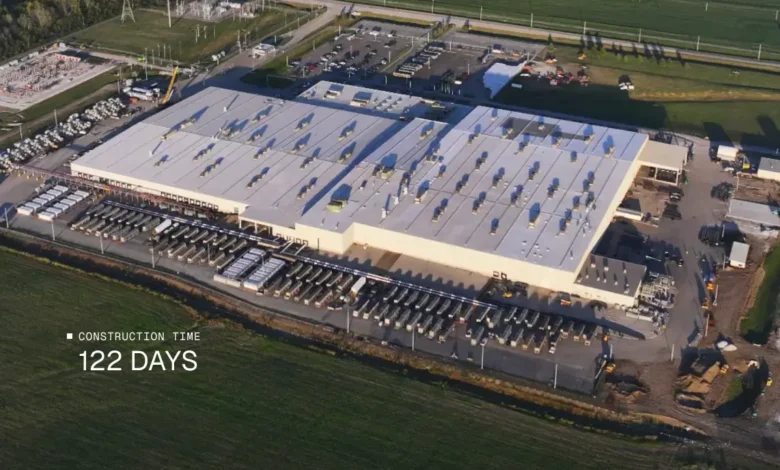
The MEGAPOD trademark description provides a detailed look into Tesla’s engineering philosophy regarding compute infrastructure. By packaging servers, power distribution, and cooling into a single enclosure, Tesla appears to be applying the same modular logic it used for the Megapack—its utility-scale battery energy storage system (BESS). The Megapack revolutionized grid-scale storage by allowing for rapid deployment and scalability; a single unit could be shipped on a flatbed trailer and connected to the grid with minimal on-site assembly.
The MEGAPOD aims to do for AI compute what the Megapack did for energy. The inclusion of "cooling systems" within the unit is particularly noteworthy. High-performance AI chips, such as those used in Tesla’s Dojo supercomputer or NVIDIA’s H100 and H200 clusters, generate immense amounts of heat. Traditional data centers require complex, facility-wide HVAC and liquid cooling architectures. A "self-contained modular computing hardware system" suggests that Tesla has engineered an localized thermal management solution, likely leveraging its expertise in heat pump technology and liquid cooling developed for its vehicle powertrains and the Dojo cabinets.
Furthermore, the trademark covers "downloadable software for monitoring, managing, optimizing, and regulating modular artificial intelligence computing hardware systems." This indicates that MEGAPOD is not just a hardware shell but a vertically integrated platform. This software layer would likely handle workload orchestration, thermal regulation, and power management, ensuring that the hardware operates at peak efficiency regardless of its physical location.
A Strategic Timeline of Tesla’s AI Infrastructure
The move to trademark MEGAPOD follows a multi-year trajectory in which Tesla has pivoted from being a traditional automaker to an AI and robotics powerhouse. To understand the significance of the MEGAPOD, one must look at the chronology of Tesla’s infrastructure development:
- 2019–2021: Development of Dojo: Tesla unveiled its custom AI training chip, the D1, and the Dojo supercomputer architecture. This marked the company’s first major foray into building its own data center hardware to train the neural networks powering Full Self-Driving (FSD).
- 2023: Massive Compute Acquisition: While developing Dojo, Tesla also began acquiring tens of thousands of NVIDIA GPUs to accelerate its AI training capabilities, building some of the world’s largest liquid-cooled compute clusters at its Texas and New York facilities.
- March 2026: The "Digital Optimus" Announcement: Elon Musk outlined a vision for a joint project between Tesla and xAI, often referred to as "Digital Optimus" or "Macrohard." This project aims to deploy AI agents capable of complex digital tasks. Musk suggested that these agents could run on "idle" compute power within parked Tesla vehicles and on dedicated hardware installed at Supercharger stations.
- June 2026: The MEGAPOD Filing: The trademark application for MEGAPOD serves as the physical realization of the "Digital Optimus" infrastructure, providing a name and a legal framework for the modular units that will house these distributed compute resources.
The Role of MEGAPOD in the Tesla-xAI Ecosystem
The relationship between Tesla and xAI (Elon Musk’s artificial intelligence startup) has become increasingly symbiotic. While Tesla provides the massive datasets generated by its fleet of millions of vehicles, xAI provides the expertise in large language models (LLMs) and generative AI. The MEGAPOD is expected to be the bridge between these two entities.
Industry analysts suggest that MEGAPODs could be deployed at Tesla Supercharger stations globally. Tesla’s Supercharger network is already the largest fast-charging network in the world, equipped with high-capacity electrical connections and existing real estate. By placing MEGAPOD units at these sites, Tesla can utilize the massive "headroom" in power capacity that exists when chargers are not at peak utilization.
This strategy would effectively turn Supercharger stations into edge data centers. Instead of sending all AI requests to a centralized facility in Texas or California, inference tasks—such as processing voice commands for the Digital Optimus agents or handling localized robotics navigation—could be handled on-site. This reduces latency, lowers bandwidth costs, and increases the overall resilience of the AI network.
Broader Implications for the Data Center Market
The introduction of the MEGAPOD could disrupt the traditional data center industry. Currently, companies like Amazon Web Services (AWS), Microsoft Azure, and Google Cloud dominate the market by building massive, centralized campuses. However, the rise of AI and autonomous systems is driving a need for "edge compute"—data processing that happens closer to the end-user.
Tesla’s modular approach offers several competitive advantages:
- Speed of Deployment: Traditional data centers take years to permit and build. A MEGAPOD, like a Megapack, could potentially be manufactured in a factory and deployed in a matter of weeks.
- Scalability: Customers (or Tesla itself) can start with one unit and add more as compute needs grow, without needing to redesign the entire facility’s cooling or power architecture.
- Power Integration: Tesla’s ability to pair MEGAPODs with its own solar and battery storage solutions (Powerwalls and Megapacks) allows for "off-grid" or "grid-stabilizing" compute clusters that can operate during peak energy prices or power outages.
While Tesla has not yet released official pricing or a commercial roadmap for MEGAPOD, the "sold as a unit" language in the USPTO filing suggests that Tesla may eventually offer these systems to third-party enterprises, much like it sells energy storage to utility companies.
Lessons from the "Cybercab" Naming Oversight
The proactive filing of the MEGAPOD trademark may also reflect a lesson learned from Tesla’s recent branding challenges. During the unveiling of its autonomous ride-hailing vehicle, frequently referred to as the "Cybercab," it was revealed that Tesla did not hold the trademark rights to that specific name in several jurisdictions. This led to potential legal hurdles and branding confusion.
By securing the MEGAPOD name early in the development cycle, Tesla is ensuring that its brand identity for AI hardware remains protected as it begins to compete more directly with hardware manufacturers like Dell, Supermicro, and NVIDIA. The name itself—MEGAPOD—fits perfectly within Tesla’s existing nomenclature, sitting alongside the Powerwall, Megapack, and the upcoming "Giga-scale" projects.
Conclusion and Future Outlook
The MEGAPOD trademark marks a pivotal moment in Tesla’s evolution. It signifies that the company is no longer content with just building the "brains" of AI (the chips) and the "bodies" of AI (the cars and robots); it is now building the "homes" for AI.
As Tesla continues to ramp up its Dojo 3 supercomputer and expands its partnership with xAI, the MEGAPOD will likely serve as the foundational building block for a distributed AI cloud. If successful, this could transform Tesla’s thousands of Supercharger locations into a global network of high-performance compute hubs, further entrenching the company’s lead in the AI race. The USPTO’s eventual approval of the mark will be the first of many steps in what appears to be a major new product category for the Austin-based firm.