Pentax 645 vs. Mamiya M645 1000S: A Comparative Deep Dive into Medium Format Portrait and Landscape Photography

The choice between the original Pentax 645 and the Mamiya M645 1000S for photographers, particularly those focused on portraiture and landscape, transcends mere feature comparison. It delves into the fundamental question of which system will best translate a photographer’s artistic vision into tangible results. This exploration is not simply about technical specifications, but about the user experience, the inherent workflow each camera encourages, and ultimately, which camera fosters a photographer’s unique creative voice.
The author’s personal journey with these two iconic 645 format SLRs provides a compelling narrative. The acquisition of the Pentax 645 as a first foray into medium format yielded technically proficient images, but was also accompanied by a significant learning curve and moments of frustration. In contrast, the Mamiya M645 1000S, despite appearing simpler and slower on paper, consistently delivered landscape photographs that felt more intentional and aligned with the author’s aesthetic preferences. This experience highlights a crucial aspect of camera selection: the intangible relationship between the photographer and their tool, and how that relationship shapes the creative output.
Both cameras operate within the 6×4.5 cm medium format realm, offering a significant leap in image quality over their 35mm counterparts. They are both Single Lens Reflex (SLR) systems, boasting extensive lens ecosystems and are considered relatively "affordable" within the premium medium format market. However, "affordable" in medium format terms is a relative concept, often requiring a substantial financial commitment, particularly when assembling a comprehensive kit of bodies, lenses, and accessories.
Two 645 Workhorses, Two Very Different Philosophies of Confidence
The Pentax 645 is engineered to bridge the gap between traditional 35mm SLRs and the more demanding medium format experience. Its design prioritizes user comfort and operational familiarity. Features like an integrated grip and a modern (for its era) control layout, coupled with a built-in light meter, aim to streamline the shooting process. The philosophy behind the Pentax 645 is to allow photographers to leverage the larger negative size of medium format without introducing undue operational complexity. It represents a practical approach to medium format, where the goal is to retain the advantages of a larger sensor while maintaining a workflow akin to familiar 35mm systems.
Conversely, the Mamiya M645 1000S embodies a different ethos. It is a predominantly mechanical camera, demanding a higher level of user engagement and presence. Its modular design and straightforward operation underscore a commitment to reliability and direct control. The Mamiya M645 1000S is often described as a "tank" not for its luxurious feel, but for its robust construction and honest, no-nonsense approach to photography. It’s a system that implicitly communicates a demand for precision and intentionality from the photographer.
The author’s eventual preference for the Mamiya stems from its consistent ability to produce the desired landscape imagery, a success attributed not to inherently superior image quality, but to the camera’s influence on the shooting process. The Pentax, while capable, remained tethered to the initial challenges of adapting to medium format, whereas the Mamiya facilitated a more intuitive and ultimately rewarding creative flow for landscape work.
The Reality of Budget: What $850 Secures in the Medium Format Market
A budget of $850 in the used medium format market can indeed assemble a functional starter kit, moving beyond the acquisition of a bare body. Historically, the Pentax 645 has often presented a more accessible entry point into the 645 format due to its generally lower market price. This makes it an attractive option for photographers seeking to experience medium format without an exorbitant initial investment. The Mamiya M645 1000S, while also a viable option within this budget, may require a slightly more targeted search, particularly when factoring in the cost of desirable lenses. However, the long-term value and consistency offered by the Mamiya system are often cited as justifications for its potentially higher acquisition cost.
The Inevitable Learning Curve of Medium Format
It is essential to acknowledge that the initial learning curve associated with medium format photography can be significant, and these challenges do not necessarily reflect a deficiency in the camera itself. The Pentax 645, despite its user-friendly design, still demands adherence to the fundamental principles of medium format capture.
Medium format photography is unforgiving of imprecision, particularly concerning edge sharpness and exposure accuracy, with highlights being especially susceptible to overexposure. On 35mm film, minor framing inaccuracies or slight overexposure in the sky can often be compensated for by the viewer’s perception or digital manipulation. However, the larger negative of medium format amplifies these imperfections, making them glaringly apparent in scans. Sloppy framing at the edges becomes a prominent distraction, and blown-out skies transform into blank, unappealing expanses.
In essence, medium format does not inherently make one a better photographer; rather, it magnifies existing photographic habits and techniques. The disciplined approach cultivated during the author’s time with the Pentax 645—meticulous edge inspection, deliberate metering, and a heightened awareness of highlight management—proved invaluable for subsequent work. This period of learning, though challenging, instilled a foundational discipline that proved beneficial across different camera systems.
Pentax 645 and the 45mm Lens: Capturing Expansive Landscapes with Discipline
The Pentax 645’s 45mm f/2.8 SMC Pentax-A lens is a highly regarded wide-angle option for landscape photography. Its focal length provides a broad field of view, suitable for constructing layered compositions that include foreground detail, midground elements, and dramatic skies. When employed effectively, it delivers that characteristic medium format separation between planes, imbuing landscapes with a tangible sense of depth and immersion.
However, the wide-angle nature of the 45mm lens necessitates careful composition. Its expansive view captures everything within its frame, including potentially distracting elements such as stray branches, bright patches of terrain, or lines that lead the viewer’s eye out of the image. This is not a fault of the lens itself, but an inherent characteristic of wide-angle perspectives that demands a proactive approach to framing, akin to an editorial editing process.
Furthermore, the Pentax 645 system, particularly with this wide lens, underscored the importance of highlight control. Beginners in medium format often struggle with managing bright skies, where overexposure can quickly lead to a loss of detail. The Pentax negatives served as a consistent reminder of the need to prioritize exposure for highlights, subsequently determining the desired rendering of the shadow areas. This meticulous approach to exposure is fundamental for achieving balanced and detailed medium format images.
Pentax 645 Portraits with the 55mm: Directness and Emotional Resonance
The 55mm f/2.8 SMC Pentax-A lens for the Pentax 645 offers a natural portrait perspective on the 645 format. It provides an intimate framing that avoids the geometric distortions sometimes associated with wider lenses, while remaining sufficiently distanced to maintain a flattering perspective. This focal length is characterized by its honesty; it captures subjects with clarity and calm, eschewing artificial flattery for a more genuine portrayal.
The strength of portraits captured with the Pentax 645 and the 55mm lens lies in their authenticity. Images of family moments, such as a father and child, demonstrate that impactful medium format portraits do not necessitate elaborate studio setups. Instead, they rely on the presence of the subject, their expressions, and the photographer’s ability to slow down and capture the essence of the moment.
Any critique of these portraits often circles back to the common beginner’s pitfall in medium format: compositions that are close to perfect but lack complete commitment. Minor issues, such as being slightly too tight on one edge or a highlight that could be marginally softer, become more pronounced on a medium format negative where overall image quality is exceptionally high. These subtle imperfections, while minor in absolute terms, are amplified by the superior detail and clarity of the medium format capture.
The Fox Theater Example: Translating the "Interesting" into the "Graphic"
Architectural subjects and signage, with their emphasis on lines, shapes, and textures, are particularly well-suited to the larger negative size of medium format. The Pentax 645 excels in this domain, allowing photographers to work quickly and efficiently, much like with a 35mm SLR. This speed is crucial when shooting in dynamic urban environments with fluctuating light conditions and the presence of moving subjects like vehicles and pedestrians. The Fox Theater image serves as a clear demonstration of the Pentax 645’s capabilities as a reliable workhorse for such assignments, offering a robust and efficient shooting experience.
Mamiya M645 1000S and the 75mm Lens: Landscape Photography Through Simplification
The author’s realization that his most compelling landscape images were achieved through simplification, rather than expansive wide-angle views, became evident with the Mamiya M645 1000S and its 75mm lens. This focal length occupies a sweet spot for landscape photography on the 645 format. It is not a telephoto lens that confines the photographer to distant vistas, but rather a "normal-plus" lens that acts as a natural editor. It helps to pare away extraneous detail, transforming a scene into a deliberate composition and encouraging the photographer to focus on a singular photographic idea.
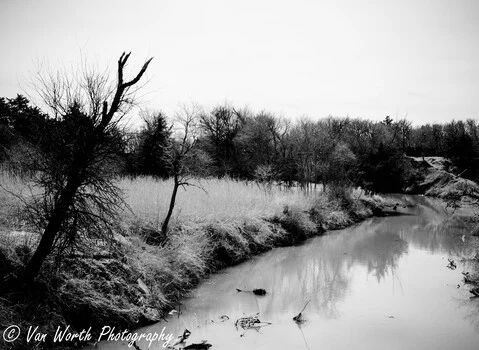
The creek series exemplifies this principle. The water’s flow is reduced to a linear element, the banks define the frame, and the textural details become supporting players rather than the primary focus. The photographer is not merely documenting a picturesque location, but rather exploring the interplay of shape, movement, and tonal gradation. This deliberate simplification is where the Mamiya system began to feel like a natural extension of the author’s instincts, aligning with a preference for landscapes that appear designed and composed, rather than simply recorded. The Mamiya facilitated the creation of images that rendered the world with a sense of quietude and intentionality.
The Significance of Consistency in Medium Format Series
The ability to produce a cohesive series of images, rather than relying on isolated successful frames, is a hallmark of a well-developed photographic practice and a well-matched camera system. The Mamiya creek series demonstrates this cohesion through consistent tonality, perspective, and an overarching sense of intention. This consistency is paramount when evaluating camera systems, as they are tools intended for repeated use over extended periods.
Addressing the challenges of black and white landscape photography, particularly with bright skies, is a perennial concern. Exposing for the foreground can result in blown-out skies, while prioritizing the sky can lead to overly dark foregrounds. However, a moodier foreground often yields more aesthetically pleasing results. Furthermore, the strategic use of a yellow or orange filter can add texture and depth to the sky without resorting to overt special effects. Despite these considerations, the compositions achieved with the Mamiya system consistently felt more robust and deliberate.
The Mamiya Portrait Ladder: From 75mm to 150mm
The Mamiya system transforms into a formidable portrait setup with the addition of the 150mm lens. While the 75mm lens serves as an excellent all-around portrait lens, offering a natural perspective and effective background separation, the 150mm lens elevates the portraiture capabilities significantly. This longer focal length not only compresses the background, softening busy environments into pleasing fields of tone, but also renders facial features with a calming effect, characteristic of classic medium format editorial portraiture.
For portrait photographers, the 150mm lens alone can be a compelling reason to opt for the Mamiya system. It has the power to elevate "nice" portraits into images that feel polished and complete.
Practical considerations for using the 150mm lens include the need for ample working space, as its focal length necessitates a greater distance from the subject. Indoors, it can quickly become too long for comfortable use. Additionally, precise focusing becomes even more critical with a longer telephoto lens on a medium format camera, as a missed focus can result in an expensive reshoot. However, when focus is accurately achieved, the resulting portraits possess a deliberate and planned aesthetic.
The Waterfall Slide Frame: Range and the Unsung Aspect of Film Photography
The inclusion of a waterfall image, shot on slide film, serves a dual purpose. It illustrates the enjoyable and sometimes "cheating" aspect of long exposures on positive film, which can create a sense of timelessness. More practically, this frame demonstrates the versatility of the Mamiya kit. It highlights the ability to transition seamlessly from portraiture to landscape with the same camera body, a crucial factor when selecting a system for long-term use. The decision to invest in a camera system is not about a single photograph, but about its capacity to serve a photographer’s evolving needs over years.
Conclusion: Which Camera Should You Buy?
While a definitive universal winner is elusive, a nuanced comparison can guide photographers. The Pentax 645 serves as an excellent "on-ramp" into medium format for many. Its familiarity, operational speed, and compatibility with a 35mm SLR workflow make it an accessible choice. The 45mm lens, when used with disciplined composition, can indeed yield expansive and layered landscapes.
The Mamiya M645 1000S, however, proved to be a superior "match" for the author’s landscape aesthetic. Its mechanical nature encourages a slower, more deliberate approach, fostering simplification and commitment. Coupled with the 75mm lens, it transforms the act of landscape photography into a process of intentional curation. The addition of the 150mm lens then unlocks its potential as a highly capable portrait machine, rewarding patience and precision.
Choose the Original Pentax 645 if:
- You are new to medium format and desire a familiar, user-friendly interface that closely resembles your 35mm SLR experience.
- Operational speed and convenience are primary concerns for your photography.
- You prioritize a built-in light meter and a more automated shooting process.
- Your budget is a significant factor, and you seek the most accessible entry point into 645 photography.
- You intend to focus heavily on wide-angle landscapes where careful edge management is paramount.
Choose the Mamiya M645 1000S if:
- You value a more mechanical and tactile shooting experience that demands presence and deliberate action.
- You are drawn to a minimalist, robust, and reliable camera system.
- Your photographic style leans towards simplification, intentional composition, and a refined aesthetic, particularly in landscapes.
- You are invested in achieving classic portraiture with beautiful background compression and subject separation, especially with longer focal lengths like the 150mm.
- You are willing to invest more time in understanding and mastering a camera that offers direct control and rewards precision.
Personal Reflection: A Journey of Discipline and Reward
Both the Pentax 645 and the Mamiya M645 1000S are capable of producing exceptional photographic work. The ultimate decision often hinges on which camera system most effectively facilitates a photographer’s decision-making process and aligns most closely with their innate creative instincts.
The Pentax 645 instilled the essential discipline required for medium format photography. The Mamiya M645 1000S, in turn, rewarded that discipline by consistently delivering images that resonated with the photographer’s vision.
For those who have experience with either system, sharing insights on specific lens choices that fostered a connection, and potential $850 budget kit recommendations for today’s market, would be invaluable. For aspiring medium format photographers, the advice to refrain from judging the format on the first roll is critical. The initial roll is an exercise in self-awareness, revealing existing habits. Subsequent rolls offer an opportunity to learn the format’s capabilities, and by the third roll, photographers begin to shoot authentically, armed with the technical understanding to translate their vision onto a medium format negative.
Lead image: Photo by Steven Van Worth. Shot with the Mamiya m645 1000s on Ilford FP4+ film.