The gaming peripheral market has long been defined by the pursuit of the "ultralight" standard, a trend that saw manufacturers strip away features, battery capacity, and structural integrity in a race to shave every milligram from their devices. However, the release of the Wallhack M-001 represents a significant pivot in industrial design philosophy. By prioritizing structural rigidity through a magnesium alloy chassis and reintroducing the long-abandoned concept of hot-swappable batteries, Wallhack is challenging the industry’s status quo. While the device occupies a premium price tier, it offers a compelling look at how high-end engineering can prioritize user agency and long-term durability over the transient nature of standard plastic peripherals.
The Evolution of Peripheral Design and Materials
For years, the industry standard for lightweight gaming mice has been ABS or PBT plastic, often featuring "honeycomb" cutouts to achieve weight reduction. These designs, while effective at keeping mass low, are prone to structural flexing and the accumulation of debris. The Wallhack M-001 eschews these cutouts entirely, opting for a high-grade magnesium shell.

Magnesium is increasingly being utilized by peripheral manufacturers due to its superior strength-to-weight ratio compared to aluminum or plastic. The M-001 weighs in at approximately 53.6 grams. While this is heavier than some extreme-lightweight plastic mice, which can dip into the mid-30-gram range, the structural benefits are immediate. The rigidity of the M-001 provides a consistent surface feel that does not deform under the high-pressure grip of competitive gamers. This shift toward metal alloys reflects a broader trend in enthusiast-grade hardware, where manufacturers are increasingly catering to a demographic that values premium material science alongside raw performance.
A Return to User-Replaceable Power
The most distinct feature of the M-001 is its hot-swappable battery system. In the current market, the vast majority of wireless gaming mice rely on integrated lithium-ion batteries that are soldered to the internal PCB. Once these batteries degrade—typically after 500 to 800 charge cycles—the entire mouse essentially reaches its end-of-life.
Wallhack’s implementation utilizes a spring-loaded ejection mechanism, reminiscent of SD card slots, which allows the user to swap a depleted battery for a fresh one in seconds. By shipping the device with a proprietary external charging dongle, Wallhack has effectively created a system that provides infinite wireless uptime. This design choice addresses the "battery anxiety" often associated with wireless gaming, where users must manage cable clutter or pause gameplay to charge.

From an environmental and sustainability perspective, this design is a significant departure from the "disposable" nature of modern electronics. By allowing users to replace only the power cell, the lifespan of the M-001 is theoretically extended by years, potentially offsetting the high initial cost of the device.
Engineering the "Stressed-Member" Architecture
The internal architecture of the M-001 is arguably its most ambitious engineering feat. In standard mouse design, the internal components (PCB, sensor, and battery) are mounted inside a protective plastic shell. The M-001, however, utilizes a "stressed-member" design, where the circuit board itself acts as a structural component.
This technique, borrowed from automotive engineering—specifically the chassis designs of mid-1990s Formula 1 cars and the Ferrari F50—integrates the electronic components into the load-bearing path of the device. By eliminating the need for an internal plastic frame, the engineers were able to maintain structural integrity while keeping the overall profile of the mouse exceptionally slim. This "chasm-like" bottom design, which leaves the PCB visible, serves both a functional purpose in weight reduction and an aesthetic purpose in transparency, showcasing the device’s internal components.

The Dongle as a Command Center
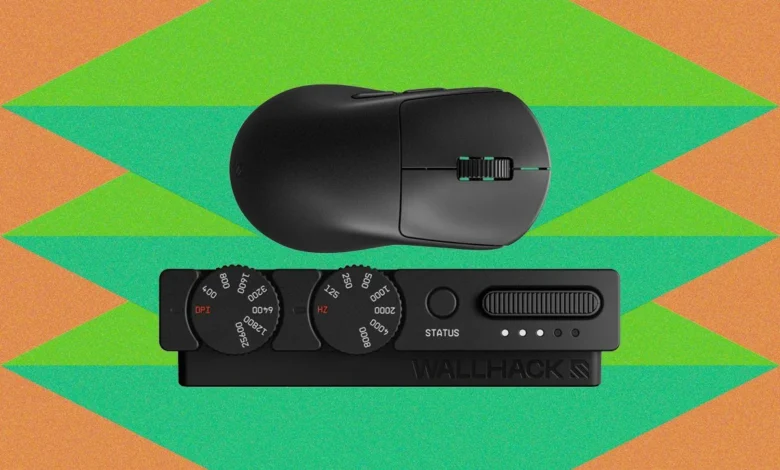
Historically, the USB receiver (dongle) for a wireless gaming mouse has been a passive, hidden component. Wallhack has re-imagined this interface as a physical command center. The M-001’s dongle is a substantial, metal-encased unit featuring two physical rotary dials.
These dials allow for tactile, on-the-fly adjustment of both DPI (dots per inch) and polling rate (Hz). This removes the reliance on cumbersome, often resource-heavy software drivers that users must otherwise keep running in the background. The ability to switch polling rates—for instance, dropping from 8,000 Hz to 1,000 Hz to improve stability in legacy titles—directly from the desk via a physical dial is a level of user control rarely seen in consumer electronics. This tactile integration shifts the mouse from being a peripheral that requires digital hand-holding to a tool that offers immediate, physical feedback.
Performance Specifications and Sensor Consistency
The M-001 is powered by the Pixart PAW3950 sensor. While industry critics may note that this sensor architecture is an iteration of the technology debuted in 2022, its inclusion here is a calculated choice. The PAW3950 remains one of the most reliable and consistent optical sensors in the industry, capable of tracking at extremely high speeds and accelerations.

In controlled testing, the sensor exhibits negligible deviation, making it suitable for even the most demanding competitive environments. The polling rate, which can reach 8,000 Hz, ensures that the latency between the mouse and the PC is significantly lower than that of standard 1,000 Hz mice. While the practical benefits of polling rates above 4,000 Hz are often debated, the M-001 provides the headroom for users who prioritize the absolute lowest click-to-pixel latency.
Market Implications and Future Outlook
The release of the M-001 serves as a barometer for the gaming peripheral market. It signals that there is a growing segment of consumers who are willing to pay a premium for hardware that emphasizes modularity, high-quality materials, and physical customization.
However, the M-001 is not without its limitations. The absence of a secondary connectivity option, such as USB-C wired mode, creates a "single point of failure" scenario: if the battery system or the dongle were to fail, the device would be rendered useless. Furthermore, the high price point puts the M-001 in direct competition with established brands like Logitech and Razer, which offer more software support and ecosystem integration.

Despite these hurdles, the M-001 is a testament to the benefits of "over-engineering." By focusing on the tactile experience of the user—from the weight of the magnesium shell to the satisfying click of the battery ejection system—Wallhack has successfully differentiated itself in a saturated market.
Conclusion: The Value of User-Centric Design
The Wallhack M-001 is a departure from the industry-wide trend of mass-produced, software-dependent gaming gear. It represents a synthesis of high-end materials, innovative mechanical design, and a return to user-serviceability. While it remains a niche product due to its price and specific feature set, the design philosophy behind the M-001 provides a roadmap for how future gaming peripherals can balance performance with long-term reliability. For users who prioritize the physical interaction with their hardware and are tired of the planned obsolescence inherent in modern consumer tech, the M-001 offers a refreshing and highly functional alternative that proves that, in the world of gaming, the hardware should be as engaging as the game itself.
Related posts: