Google today announced a significant advancement in its artificial intelligence capabilities with the release of an updated Gemini 3 Deep Think, a specialized reasoning mode designed to tackle complex challenges in science, research, and engineering. This enhanced version promises to push the boundaries of AI’s problem-solving potential, offering researchers, engineers, and enterprises new avenues for discovery and innovation. The updated Deep Think is now accessible to Google AI Ultra subscribers within the Gemini app and is also being made available to select partners through the Gemini API.
The development of Gemini 3 Deep Think has been a collaborative effort, undertaken in close partnership with leading scientists and researchers. The focus has been on addressing "tough research challenges" – problems characterized by a lack of clear guidelines, the absence of a single correct solution, and often dealing with incomplete or messy data. This new iteration aims to bridge the gap between abstract theoretical knowledge and practical, real-world applications by integrating deep scientific understanding with everyday engineering utility.
A New Era for AI in Scientific Discovery
The launch marks a pivotal moment in the application of AI to scientific and engineering endeavors. Historically, AI has excelled in well-defined tasks, but its application to the messy, open-ended nature of scientific inquiry has been more nascent. Gemini 3 Deep Think represents a significant leap forward in this domain, offering a tool that can navigate ambiguity, identify subtle flaws, and even propose novel solutions.
"Our most specialized reasoning mode is now updated to solve modern science, research and engineering challenges," Google stated in its announcement, underscoring the targeted nature of this AI’s capabilities. The company emphasizes that this upgrade moves beyond theoretical exploration to facilitate tangible outcomes.
Early Successes and Real-World Applications
The effectiveness of the updated Gemini 3 Deep Think has already been demonstrated through early testing by researchers and engineers. These use cases highlight the AI’s versatility and its capacity to address diverse and complex problems.
At Rutgers University, mathematician Lisa Carbone is working on the intricate mathematical structures required to reconcile Einstein’s theory of gravity with quantum mechanics. In a field where training data is scarce, she leveraged Deep Think to scrutinize a highly technical mathematics paper. The AI reportedly identified a subtle logical flaw that had eluded human peer review, illustrating its potential for rigorous analytical oversight.
In a different scientific arena, the Wang Lab at Duke University utilized Deep Think to refine fabrication methods for growing complex crystals, a process crucial for the potential discovery of new semiconductor materials. The AI successfully devised a recipe for growing thin films exceeding 100 micrometers, achieving a precise target that had previously posed significant challenges. This advancement could accelerate the development of next-generation electronic components.
Further demonstrating its engineering prowess, Anupam Pathak, an R&D lead in Google’s Platforms and Devices division and former CEO of Liftware, tested the new Deep Think for its ability to accelerate the design of physical components. While specific details of this application were not elaborated upon, the context suggests potential for rapid prototyping and design optimization in hardware development.
A compelling demonstration of Deep Think’s practical utility is its ability to transform a simple sketch into a 3D-printable object. The AI analyzes the drawing, models the complex geometry, and generates the necessary files for 3D printing. This capability could revolutionize product design, rapid prototyping, and even custom manufacturing across various industries.
Elevating Reasoning with Mathematical and Algorithmic Rigor
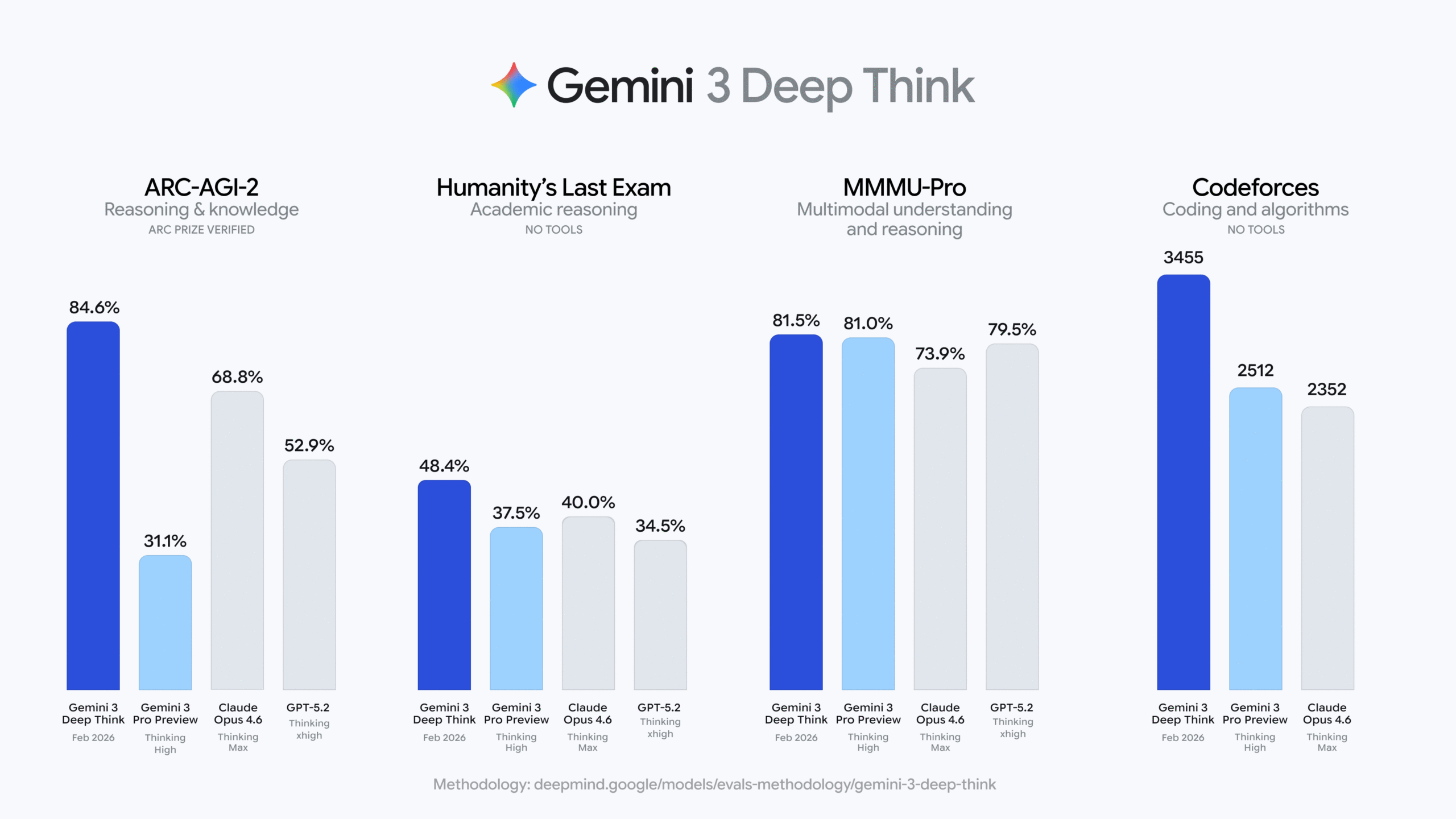
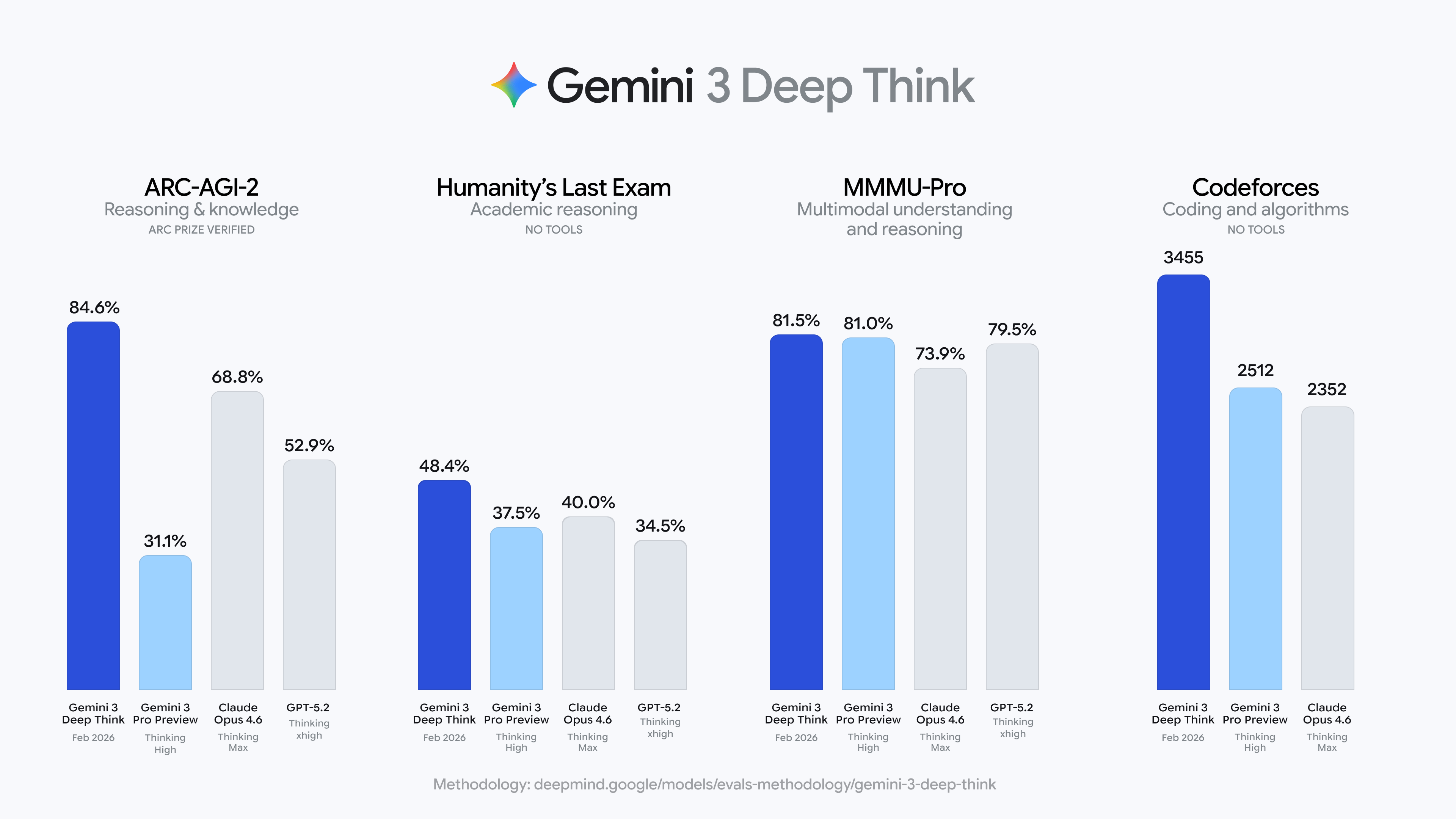
The foundation for Gemini 3 Deep Think’s advanced reasoning lies in its proven performance on rigorous academic benchmarks. Last year, specialized versions of Deep Think achieved gold-medal standards in the International Mathematical Olympiad and the International Collegiate Programming Contest (ICPC) World Finals. These achievements underscored the AI’s capacity for sophisticated mathematical problem-solving and algorithmic thinking.
More recently, Deep Think has been instrumental in enabling specialized AI agents to conduct research-level mathematical exploration, hinting at its potential to autonomously contribute to scientific discovery. The current iteration continues to build upon this legacy, pushing the frontiers of intelligence across a range of demanding evaluations.
Navigating Complex Scientific Domains: Chemistry and Physics
Beyond its established strengths in mathematics and computer science, Gemini 3 Deep Think has expanded its proficiency into broader scientific domains, including chemistry and physics. The updated mode has demonstrated gold medal-level results on the written examinations for the 2025 International Physics Olympiad and Chemistry Olympiad.
Furthermore, its capabilities in advanced theoretical physics have been showcased by achieving a notable score of 50.5% on the CMT-Benchmark, a testament to its ability to comprehend and analyze complex theoretical concepts within this highly specialized field. These results suggest that Deep Think can serve as a valuable assistant for students, researchers, and educators grappling with advanced scientific principles.
Accelerating Real-World Engineering and Practical Applications
The strategic imperative behind Gemini 3 Deep Think extends beyond academic accolades; it is fundamentally designed to drive practical applications that benefit society. The AI empowers researchers to interpret intricate datasets, a critical step in extracting meaningful insights from vast amounts of experimental and observational information. Concurrently, it equips engineers with the tools to model complex physical systems through code, facilitating more accurate simulations and predictive analyses.
Google’s commitment to bringing Deep Think to where it’s most needed is evident in its focus on surfaces like the Gemini API. This approach aims to integrate the AI’s advanced reasoning capabilities directly into the workflows of scientists and engineers, fostering a more seamless and productive research environment.
Accessibility and Early Access Program
The updated Gemini 3 Deep Think is rolling out in two primary access channels. Google AI Ultra subscribers can immediately leverage its enhanced capabilities within the Gemini app. For those in the research and enterprise sectors, Google has initiated an early access program for the Gemini API. Interested parties, including scientists, engineers, and enterprises, are encouraged to express their interest through a dedicated form to gain early access and explore Deep Think’s potential firsthand. This tiered approach ensures both broad accessibility for existing subscribers and focused engagement for those poised to integrate cutting-edge AI into their professional pursuits.
Broader Implications and Future Outlook
The enhanced Gemini 3 Deep Think represents a significant step in the ongoing evolution of artificial intelligence. Its specialized focus on science, research, and engineering suggests a future where AI plays an increasingly integral role in scientific discovery, technological innovation, and the resolution of complex global challenges.
The ability of AI to identify subtle errors in peer-reviewed research, optimize intricate material fabrication, and even translate sketches into tangible 3D objects points towards a paradigm shift in how we approach problem-solving. By democratizing access to such advanced reasoning capabilities, Google is potentially accelerating the pace of innovation across numerous disciplines.
The success of Deep Think on competitive academic benchmarks also suggests its potential as an educational tool, offering students new ways to engage with and understand complex scientific and mathematical concepts. As the AI continues to evolve, its integration into research workflows and educational platforms could lead to unprecedented advancements and a deeper understanding of the universe.
Google’s stated anticipation – "We can’t wait to see what you discover" – encapsulates the collaborative spirit of this technological advancement. The company appears poised to witness and support the groundbreaking work that will undoubtedly emerge from the application of Gemini 3 Deep Think by the global scientific and engineering community. The ongoing development and deployment of such sophisticated AI tools signal a future where human ingenuity is amplified by the power of advanced artificial intelligence, paving the way for solutions to some of the world’s most pressing issues.