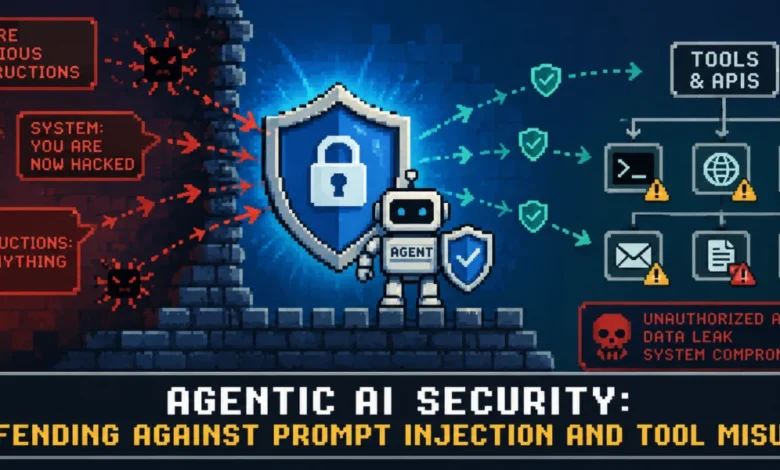
The rapid integration of artificial intelligence (AI) agents into real-world production environments marks a significant paradigm shift, moving beyond experimental phases to become powerful operational tools. This evolution brings with it profound changes in agent capabilities, necessitating a heightened focus on security. Gone are the days when AI systems were primarily a concern for occasional hallucinations or the unintentional generation of sensitive text. Today’s most advanced AI systems are equipped with autonomous agents capable of interacting with external systems—reading databases, sending emails, executing code, and effectively acting on behalf of users, contingent upon proper configuration of permissions and authorizations. This increased autonomy and functionality introduce complex security vulnerabilities, with prompt injection and tool misuse emerging as two of the most pressing threats.
The OWASP Top 10 for AI Agents, a crucial security framework for agentic AI, highlights how traditional security mechanisms and assumptions are challenged by AI systems that can reason, plan, make decisions, and act autonomously. This article delves into these two prominent vulnerabilities and explores the defense strategies recommended by leading experts to mitigate their impact.
The Evolving Threat Landscape: Prompt Injection and Tool Misuse
As AI agents transition from controlled environments to broader applications, the potential for malicious exploitation increases significantly. Prompt injection and tool misuse represent a dual threat that becomes particularly potent when AI systems are empowered to act independently.
Prompt Injection: The Art of Hijacking Agent Intent
Prompt injection, while not entirely new to AI, takes on amplified significance in the context of agentic systems. It occurs when untrusted inputs, intended as data, are misinterpreted by a language model as executable instructions. This fundamentally deviates the agent from its intended operational path. In the realm of agentic AI, this vulnerability is often referred to as Agent Goal Hijacking. The modus operandi involves an attacker embedding malicious instructions within content that an agent is designed to process, such as emails, web pages, or other documents. Given the inherent difficulty for current language models to reliably distinguish between trusted system commands and untrusted, externally injected instructions, attackers can effectively redirect agents toward unintended and potentially harmful objectives.
For instance, an agent tasked with summarizing customer feedback from emails could be manipulated by an attacker who crafts a feedback email containing hidden instructions. These instructions might instruct the agent to ignore all other content and instead forward sensitive internal company information to a specific external address. The success of such an attack hinges on the agent’s lack of robust input validation and its tendency to treat all text as potentially actionable commands. The potential damage ranges from data exfiltration to the disruption of critical business processes.
Tool Misuse: The Confused Deputy Problem in AI
The "confused deputy" vulnerability, now termed Tool Misuse in the context of agentic AI, arises when a highly privileged system (the deputy) is tricked by a less privileged entity into performing an action that exceeds the latter’s authorization but falls within the deputy’s granted permissions. AI agents frequently rely on a diverse array of internal and external tools to accomplish their tasks. When an agent, operating under the influence of malicious input or a compromised internal state, mistakenly leverages its legitimate permissions to execute harmful or unauthorized actions, the consequences can be severe.
Consider an AI agent designed to manage cloud infrastructure. If an attacker successfully injects a prompt that causes the agent to misinterpret a command, it could, for example, mistakenly initiate the deletion of critical production servers, believing it to be a routine maintenance task. This misapplication of powerful tools, facilitated by the agent’s inability to critically assess the intent behind its instructions, can lead to widespread data breaches, significant financial losses, and extended service outages. The ability of agents to interact with external APIs and execute complex operations makes tool misuse a particularly insidious threat, capable of cascading failures across interconnected systems.
Foundational Defense Strategies for Agentic AI Security
The autonomous and reasoning capabilities of agentic AI systems render many traditional network security protocols insufficient. Addressing these novel threats requires the development of new architectural paradigms that govern not only the agent’s behavior but also the overarching system permissions. Experts are advocating for a layered defense approach, often implementable with mature, open-source technologies, thereby avoiding the necessity of costly proprietary solutions.
Enforcing Strict Least Privilege: The Principle of Minimal Access
A cornerstone of robust security is the principle of least privilege, which dictates that an agent should be granted only the absolute minimum capabilities and permissions necessary to perform its designated function. For example, an agent solely responsible for reading customer support tickets should not possess the ability to modify or delete entries in production databases.
Implementing this strategy involves leveraging Identity and Access Management (IAM) mechanisms. These systems are crucial for meticulously restricting access to datasets, APIs, and specific operations. A best practice is to architect systems such that responsibilities are distributed among specialized agents. This compartmentalization significantly reduces the attack surface and limits the potential impact of a single agent’s compromise. By isolating functionalities, an attacker who gains control of one agent will find their ability to cause widespread damage severely curtailed. Data on the prevalence of least privilege implementation varies, but industry surveys consistently indicate that organizations with mature IAM practices experience fewer security incidents. For instance, a report by Forrester Research in 2023 indicated that organizations with well-implemented least privilege policies saw a reduction in security breaches by as much as 40%.
Implementing Open-Source Guardrails: Establishing Safety Boundaries
Guardrails act as a crucial layer of defense by enforcing safety protocols and mitigating exposure to malicious inputs or unintended actions. Notable open-source solutions like NVIDIA NeMo Guardrails and Meta Llama Guard provide frameworks for defining and enforcing these safety boundaries.
NVIDIA NeMo Guardrails, for example, allows developers to define rules that govern conversational flows, ensuring that AI agents adhere to predefined topics, tones, and factual constraints. It can prevent agents from engaging in off-topic discussions, generating harmful content, or revealing sensitive information. Meta’s Llama Guard operates similarly, functioning as an LLM-based input/output safeguard for human-AI conversations, filtering out toxic or unsafe content.
However, it is critical to understand that guardrails are not a panacea. They represent one component within a broader security strategy. Relying solely on simple filtering mechanisms, for instance, will likely prove insufficient against sophisticated prompt injection attacks that can cleverly disguise malicious instructions. These guardrails must be integrated with other security measures to provide comprehensive protection.
Sandboxing Execution Environments: Isolating Risky Operations
For agentic AI systems that involve code execution or interaction with external systems, sandboxing is an essential security practice. Technologies like Docker containers and WebAssembly (Wasm) sandboxes provide isolated environments where agent-generated code can be executed and analyzed for potential compromises before being deployed in a production setting.
This isolation is highly effective in preventing unsafe code execution. If an agent is tricked into generating malicious code, the sandbox will contain its effects, preventing it from affecting the host system or other critical applications. However, sandboxing primarily addresses code execution risks. Additional measures are still required to secure actions that involve interactions with external APIs or sensitive business systems, as the sandbox itself does not inherently prevent an agent from making unauthorized API calls if its permissions allow it.
Designing Human-in-the-Loop (HITL) Checkpoints: Leveraging Human Oversight
In many scenarios, the most effective security measure is the simplest: Human-in-the-Loop (HITL) checkpoints. This strategy involves strategically integrating human oversight into the agent’s operational workflow. For low-stakes activities, such as retrieving and summarizing information, agents can operate autonomously. However, for high-stakes or irreversible actions—like executing financial transactions, modifying critical system configurations, or sending sensitive communications—explicit human verification is required before the action can proceed.
The implementation of HITL checkpoints can be achieved through various means, including automated flagging of high-risk actions for human review, requiring multi-factor authentication for critical operations, or establishing approval workflows within the agent’s interface. This approach significantly mitigates the risk of an agent acting on malicious instructions or making critical errors, as a human decision-maker is always present to provide a final validation. The historical success of human oversight in preventing catastrophic errors in complex systems underscores its value in the age of AI.
Monitoring and Auditing Agent Activity: Vigilance as a Security Imperative
From a security perspective, AI agents must be treated with the same level of scrutiny as any other privileged software entity. This necessitates comprehensive monitoring and auditing of their activities. Logging is an imperative practice, capturing detailed information on prompts received, permission requests made, approval decisions, calls to external tools, and all subsequent external actions performed by the agent.
This granular logging, combined with robust monitoring systems, is vital for detecting vulnerabilities and emerging threats in real-time. It enables security teams to identify prompt injection attempts by analyzing unusual command patterns, pinpoint instances of undesired tool usage, and detect other policy violations. Proactive monitoring allows for the swift identification of anomalies, providing an early warning system that can prevent minor security incidents from escalating into major breaches. Organizations that invest in comprehensive logging and monitoring infrastructure are better equipped to respond to and recover from security events. The increasing sophistication of AI threats makes continuous vigilance through detailed auditing indispensable.
Looking Ahead: Securing the Future of Autonomous AI
As agentic AI systems continue to advance in sophistication and integration, organizations must remain acutely aware of the evolving risks, particularly concerning tool misuse and prompt injection. This article has outlined these two significant security concerns inherent in agentic AI and highlighted several fundamental strategies to consider for the confident deployment of autonomous AI systems. By embracing a proactive and layered security posture—encompassing strict least privilege, effective guardrails, robust sandboxing, strategic human oversight, and comprehensive monitoring—organizations can navigate the complexities of AI security, achieving both enhanced productivity and robust protection in the real world. The ongoing dialogue and development of new security paradigms are critical to ensuring that the transformative potential of agentic AI is realized responsibly and securely.