Ollama brings real-time text-to-speech capabilities to macOS using Phonon models

Ollama, the widely adopted open-source platform for local large language model (LLM) execution, has officially integrated text-to-speech (TTS) functionality into its macOS application. This expansion marks a significant evolution for the tool, which has primarily focused on text-based generative AI tasks since its inception. By leveraging the Phonon model family developed by Gradium, Ollama now allows users to convert text outputs into spoken word in real time directly on their Apple Silicon hardware. While currently exclusive to macOS, the project maintainers have confirmed that support for Windows and Linux environments is currently in development and expected to roll out in the near future.
The Evolution of Local AI Execution
To understand the magnitude of this update, one must first look at the trajectory of Ollama. Since its emergence as a GitHub repository, the project has garnered nearly 185,000 stars and over 18,600 forks, positioning it as a cornerstone of the "Local AI" movement. The primary value proposition of Ollama has always been privacy and accessibility; by enabling users to download and execute models locally, the platform eliminates the need for data to be transmitted to third-party cloud servers. This is particularly vital for developers, researchers, and enterprises concerned with data sovereignty and the security of sensitive information.
For macOS users, the platform’s performance is largely owed to its utilization of Apple’s MLX framework. MLX is a specialized machine learning framework designed by Apple researchers to maximize the efficiency of Apple Silicon’s unified memory architecture. Unlike traditional setups that rely on discrete GPUs with separate VRAM, Apple Silicon allows the CPU and GPU to share a single, high-bandwidth memory pool. This architectural advantage allows Ollama to load and run larger models with lower latency than would be possible on many traditional hardware configurations.
Chronology of the Phonon Integration
The path to this integration began with the growing demand for multimodal AI interactions. While LLMs excel at reasoning and synthesis, the lack of native voice output often created a "friction point" in human-computer interaction.
- Foundational Development: The team behind Gradium developed the Phonon model family, a suite of small, highly efficient TTS models. Unlike legacy TTS engines that often sound robotic, Phonon utilizes transformer-based architectures to achieve natural inflection and rhythm.
- Optimization Phase: Engineers at Ollama began testing the Phonon architecture specifically for the macOS environment, focusing on the integration with the MLX framework.
- Performance Benchmarking: Extensive testing was conducted on high-end hardware, specifically the MacBook Pro equipped with the M5 Max chip. The objective was to determine if the local execution could keep pace with or exceed the performance of standard cloud-based APIs.
- Public Deployment: On October 2026, version 0.40.11 of Ollama was released, marking the official public debut of the Phonon integration.
Technical Analysis and Performance Benchmarks
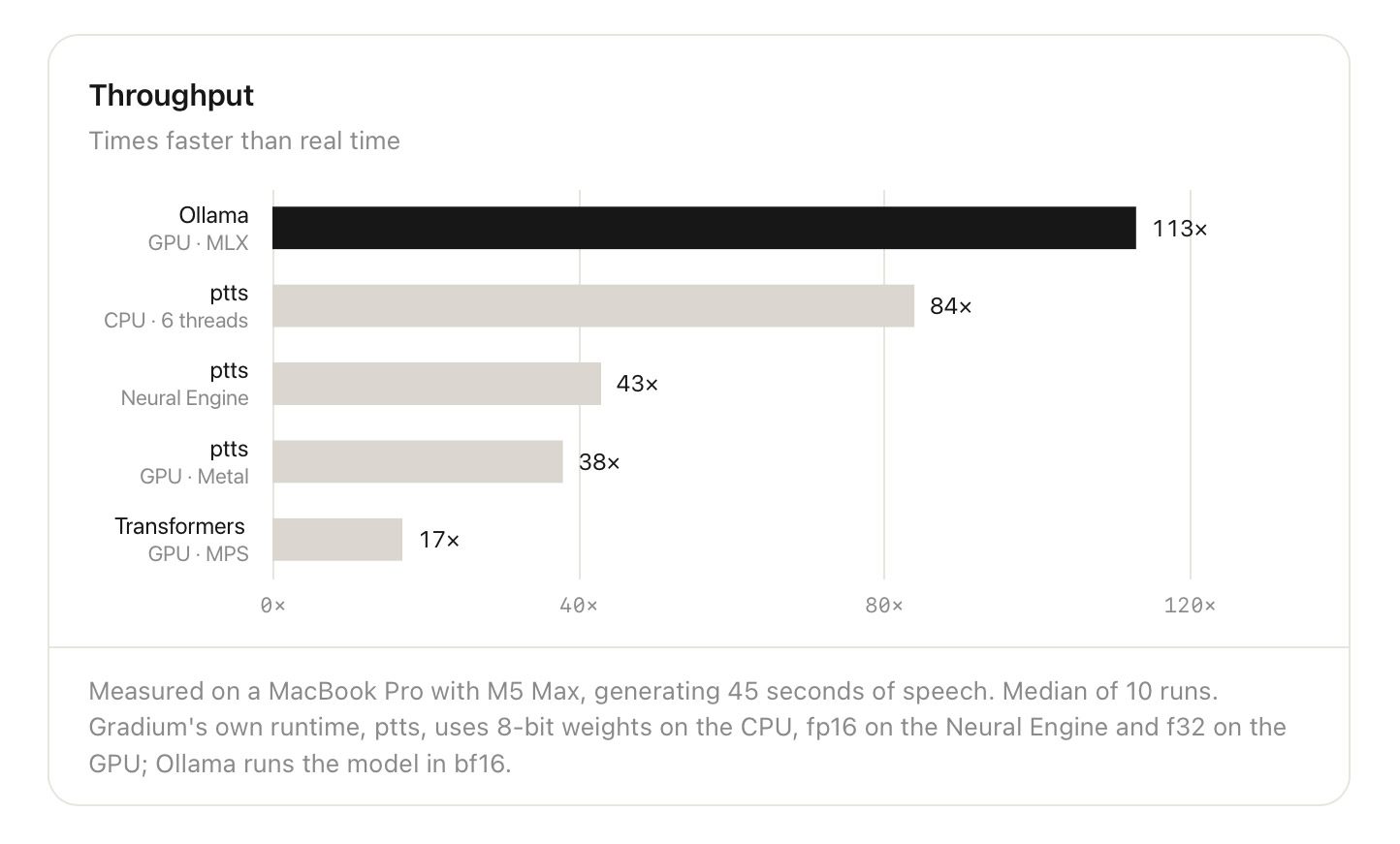
The integration of Phonon into the Ollama ecosystem is not merely a feature addition; it represents a significant engineering achievement in performance optimization. According to internal benchmarks provided by the development team, the implementation on Apple Silicon is approximately 35% faster than Gradium’s reference implementation.
This speed is critical for "streaming" speech. In a traditional TTS pipeline, the system waits for a complete text block to be generated before converting it to audio. In the new Ollama implementation, the speech is synthesized as the tokens are produced. This near-zero-latency experience creates a conversational flow that mimics human dialogue.
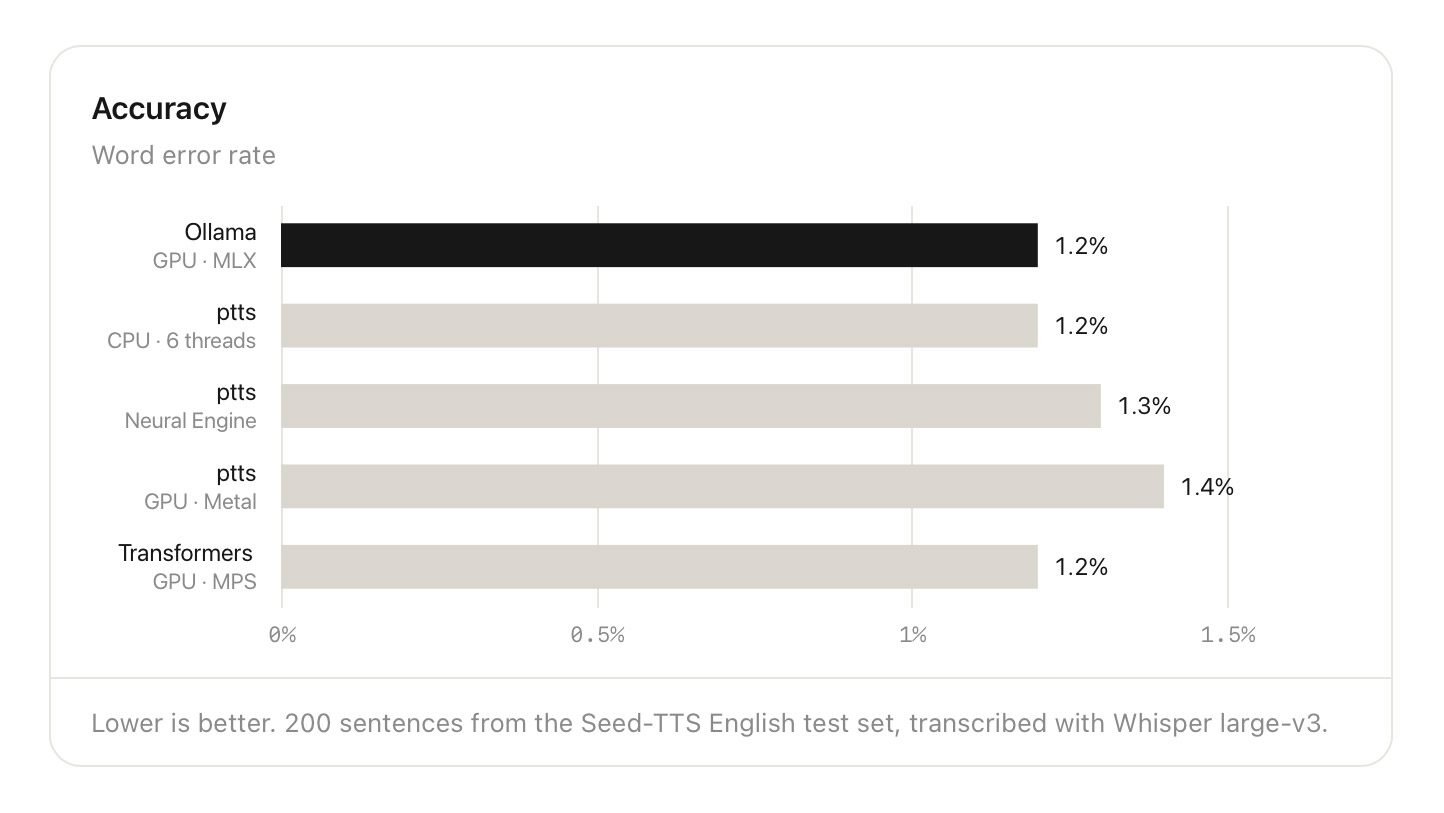
Furthermore, the accuracy of these models is noteworthy. When compared to the industry-standard Hugging Face Transformers implementation, the Ollama-MLX version achieved an identical word error rate (WER). This indicates that the performance gains in speed were achieved without sacrificing linguistic precision. The models support five major languages—English, French, German, Spanish, and Portuguese—with both dedicated language-specific models and a comprehensive multilingual model available for users who require cross-lingual versatility.
Strategic Implications for the Local AI Market
The shift toward multimodal local AI has profound implications for software development and user experience. By lowering the barrier to entry for speech synthesis, Ollama is effectively democratizing capabilities that were previously restricted to major tech companies with massive cloud infrastructure.
Privacy-First Voice Applications: Developers can now build sophisticated voice-based assistants that never ping a server. This is a game-changer for the medical, legal, and financial sectors, where voice-to-text and text-to-voice applications are common but fraught with privacy concerns.
Resource Efficiency: The ability to run high-quality TTS locally reduces the cost of infrastructure for companies that would otherwise have to pay per-character or per-minute fees for cloud-based APIs (such as those offered by OpenAI or Google Cloud). As the hardware capabilities of consumer laptops continue to grow, the reliance on cloud-based AI processing is likely to decrease for all but the most complex models.
The Standardization of Open-Source AI: The success of projects like Ollama and the Phonon model family suggests a trend toward "standardized local AI." As more models from Hugging Face become "Ollama-ready," the platform is increasingly serving as the primary distribution layer for open-source AI, much like Docker did for containerized applications.
Official Stance and Future Roadmap
The developers have been clear about their vision: the goal is to make local AI indistinguishable in performance from cloud-hosted solutions. In their official communication regarding the update, the Ollama team emphasized that this is only the beginning of their multimodal journey.
"Speech models are now available for macOS, with Windows and Linux support coming soon," the team stated in their latest release blog. This indicates that while the Apple ecosystem is currently the "lead" platform due to the efficiency of the MLX framework, the team is actively working on backends that will allow similar performance on other operating systems.
For users, the process of implementation is straightforward. By updating to version 0.40.11 or later, users can pull the Phonon models directly through the Ollama command-line interface. The API, which has become the standard for many local AI developers, has also been updated to handle audio streams, allowing third-party developers to integrate this voice capability into their own software applications immediately.
Conclusion
The release of Phonon support within the Ollama ecosystem is a milestone that highlights the rapid maturation of local machine learning. By successfully merging high-fidelity text-to-speech generation with the local, private, and efficient framework of the Ollama platform, the developers have provided a glimpse into the future of computing. As the industry continues to move away from centralized cloud reliance, tools that enable high-performance, private, and offline AI will become increasingly essential. Whether for accessibility tools, educational software, or personal productivity, the ability to synthesize human-like speech locally on a laptop is a testament to how far open-source hardware and software optimization have come in such a short period. As Windows and Linux support arrives, the footprint of this technology is expected to expand, further cementing Ollama’s role as the de facto platform for the local AI revolution.
Related posts: