Court-Ordered Seizure of Radaris.com Exposes the Shifting Underbelly of the Consumer Data Broker Industry


The consumer data broker Radaris.com, long notorious for ignoring removal requests and hiding behind shifting corporate veils, has finally run aground. In a landmark legal development, a New Jersey court ordered the transfer of radaris.com—alongside more than a dozen other domains associated with the people-search empire—directly to plaintiffs represented by Atlas Data Privacy Corp. This decisive action stems from ongoing litigation alleging that Radaris violated New Jersey’s Daniel’s Law, a strict privacy statute designed to protect law enforcement personnel, judges, and government officials from targeted harassment and safety threats by scrubbing their personal information from commercial databases.
For years, Radaris operated with impunity, leveraging legal stonewalling, jurisdictional shell games, and fictitious executive identities to dodge accountability. However, mounting pressure from privacy advocates, investigative journalism, and aggressive enforcement of state-level privacy statutes has culminated in a severe blow to the multi-million-dollar people-search network. Today, typing radaris.com into a web browser no longer yields detailed dossiers on millions of American citizens; instead, visitors are met with a court-mandated notice detailing the seizure of the domain.
Anatomy of a Shell Game: The Chronology of Radaris and the Lubarsky Brothers
The roots of the Radaris empire trace back to its co-founders, Igor and Dmitry Lubarsky, Russian-born brothers residing in Massachusetts. Operating a sprawling web of people-search engines, affiliate programs, and foreign-registered entities, the brothers engineered an operational structure specifically designed to frustrate regulators and plaintiffs alike.
The timeline of evasion is extensive and well-documented:
- 2017: Radaris temporarily lost a class-action lawsuit (Huebner v. Radaris, LLC) after failing to contest claims in court. When plaintiffs attempted to collect a $7.5 million default judgment, a judge ordered the transfer of the radaris.com domain via Verisign. Radaris appealed, arguing due process violations because the true owner was a Cyprus-based firm called Bitseller Expert Limited. The court halted the transfer, and the plaintiffs ultimately dropped the complaint.
- October 2020: Operational control shifted from Bitseller Expert Limited to Andtop Company, a newly minted entity registered in the Marshall Islands.
- February 2024: Atlas Data Privacy Corp filed a lawsuit against Radaris under New Jersey’s Daniel’s Law, citing illegal publication of protected public officials’ data and seeking statutory fines of $1,000 per violation.
- March 2024: Investigative reports published by KrebsOnSecurity exposed the Lubarsky brothers’ involvement, detailing how they operated the business using a fictitious CEO named "Gary Norden." Radaris’s legal counsel, Val Gurvits of the Boston Law Group, initially threatened defamation lawsuits and claimed the company was owned by Ukrainians in Ukraine, before later admitting the CEO pseudonym was fabricated.
- June 2025: Having faced procedural delays and jurisdictional arguments that the original entities had been dissolved or replaced, Atlas re-filed its lawsuit. This expanded complaint targeted a vastly broader network of Radaris-affiliated corporations and documented an "island-hopping" strategy that continuously shifted legal liability to entities in the British Virgin Islands, Seychelles, and the Marshall Islands.
- August 26, 2025: Following repeated failures by the defendants to mount a valid defense after being given multiple opportunities, the New Jersey court issued a default judgment resulting in the forfeiture and transfer of 14 domains associated with the Radaris network.
Uncovering the Corporate Architecture Through Internal Documents
The scope and scale of the Radaris operation were laid bare through discovery. According to Atlas, litigation yielded more than 10,000 internal emails, financial records, and operational documents. These files categorically dismantle the defense’s previous claims of decentralized, independent ownership.
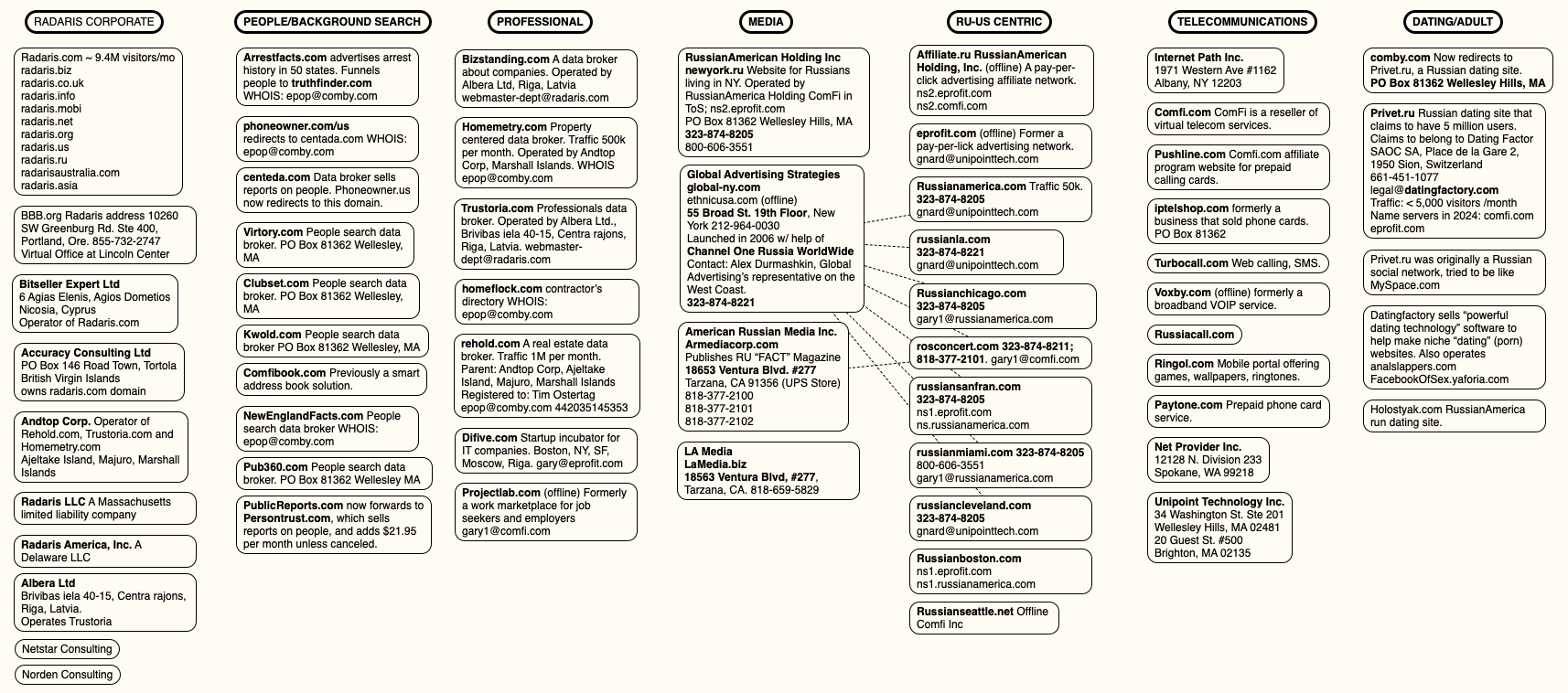
The records demonstrate that nominal legal entities—including Radaris America, Inc., Bitseller Expert Limited, Digital Orbit Corp, Core Solutions Group Inc., Lucky Solutions Inc., Virtura Corp, Veripages Inc., Nuform Solutions Inc., Growth Data Advisors Inc., and Property Experts, Inc.—were in fact administered by the same core group of three or four individuals. These shell companies shared financial accounts, payment card processing setups, and a centralized virtual office managed from the Boston area. Technical and administrative infrastructure relied on shared mail domains such as difive.com, centerex.com, and pub360.com.
Financial disclosures within the cache revealed substantial revenue generation. Radaris.com reportedly pulled in approximately $42,000 per month, while its sister site, Veripages.com, generated roughly $45,000 monthly via marketing partnerships with the Lifetime Value Company—the parent organization behind brands like PeopleLooker, PeopleSmart, NumberGuru, and Bumper. Furthermore, documents indicated the Radaris network collected up to $25,000 monthly from partnerships with Onerep, a privacy-removal service whose own foundational ties to people-search creation have previously drawn intense scrutiny.

Legal Pushback and the Constitutional Battle Over Daniel’s Law
Despite the immediate success of the domain seizures, the legal battle is far from over. Attorneys representing the defendants have mobilized to overturn the judgments. Victor Worms, stepping in as counsel, argued that the default judgment is legally void because "Radaris.com" is a domain name rather than a formal legal entity with the capacity to be sued. Worms confirmed plans to pursue full appeals, asserting that the domain forfeiture violates constitutional principles of due process.
At a broader level, Daniel’s Law itself faces an existential threat. Rather than complying quietly, the consumer data broker industry has launched a coordinated counter-offensive. Approximately 70 separate lawsuits filed by Atlas have been removed to federal court, with data brokers challenging the constitutionality of Daniel’s Law on First Amendment grounds, arguing that the restriction of publicly accessible records is overly broad.
While the U.S. Court of Appeals for the Third Circuit weighs the New Jersey statute, federal district courts have shown mixed receptivity; notably, a federal court ruled West Virginia’s variant of Daniel’s Law facially unconstitutional in August 2025. Legal experts anticipate that the ultimate fate of these state-level privacy statutes will be decided by the U.S. Supreme Court.
Broader Implications: The Void in Federal Privacy Legislation
The seizure of radaris.com marks a watershed moment for state-level enforcement, but privacy experts emphasize that it treats the symptom rather than the disease. Justin Sherman, a privacy researcher and author of the forthcoming book The Middlemen, notes that people-search engines will continue to proliferate as long as state and federal laws exempt vast categories of "public records" from privacy protections. Voter registries, property filings, marriage certificates, motor vehicle logs, and court documents remain freely scrapable across the United States.
Furthermore, legislative efforts to curb data brokerage and commercial surveillance continue to stall amid intense lobbying from major technology firms, social media giants, cryptocurrency enterprises, and artificial intelligence developers. Critics argue that relying on fragmented, occupation-specific statutes like Daniel’s Law leaves the average citizen entirely unprotected against commercial data harvesting, identity theft, and corporate exploitation.
As the legal saga surrounding Radaris and Daniel’s Law heads toward appellate review, the enforcement action serves as a stark warning to the data broker industry: the era of hiding behind offshore shell corporations and unresponsive legal strategies may finally be drawing to a close. Yet, without comprehensive federal data protection standards, the underlying market for consumer data remains fully operational, leaving individuals to fight a decentralized war for their digital privacy.