Hyundai Expands Its Electric Fleet as Staria Electric Van Opens for Global Orders Alongside the Launch of the IONIQ 3

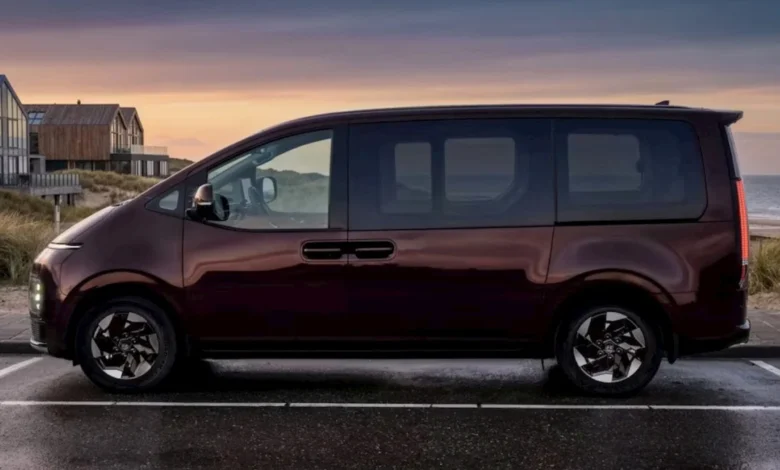
The global automotive landscape is shifting decisively toward electrification, and South Korean manufacturing giant Hyundai Motor Group is at the forefront of this transition. Following an initial reveal earlier this year at the Brussels Motor Show, Hyundai has officially opened order books for the Hyundai Staria Electric across European markets, starting in Germany, alongside the commercial Staria Load variant in Australia. Significantly larger than competitors like the Kia PV5 and the Volkswagen ID. Buzz, the Staria Electric aims to redefine spaciousness and versatility in the multi-purpose vehicle (MPV) and commercial van sectors.
Simultaneously, Hyundai is bolstering its passenger car portfolio with the concurrent rollout of the IONIQ 3, a compact electric vehicle tailored specifically for European consumers. Together, these vehicle launches demonstrate Hyundai’s aggressive strategy to capture market share across multiple segments, ranging from commercial cargo transport and large-family transit to affordable urban mobility. However, despite the excitement surrounding these new releases, automotive analysts note that geographic availability will remain restricted, with neither the Staria Electric nor the IONIQ 3 currently slated for release in the United States market.
Chronology and Evolution of the Staria Electric Program
The journey of the Staria nameplate reflects Hyundai’s agile platform strategy. Originally introduced as a futuristic, combustion-engine MPV designed to replace the aging H-1 (or iLoad/iMax) in various global markets including South Korea, Europe, and Australia, the Staria immediately captured attention due to its aerodynamic, spaceship-like exterior styling.
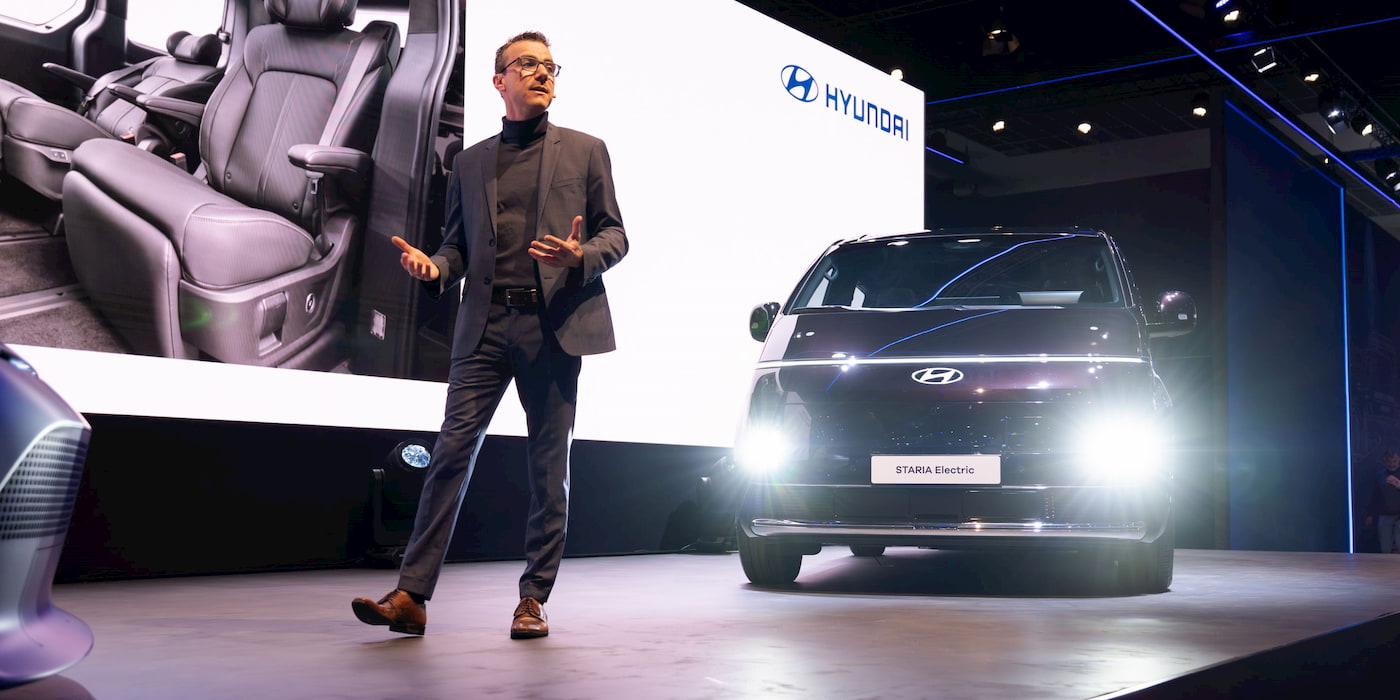
In January, Hyundai shifted its product strategy by pulling back the curtain on the battery-electric iteration—the Staria Electric—at the Brussels Motor Show. Industry observers praised the brand for retaining the distinctive, futuristic silhouette of the gas-powered model while integrating modern electric vehicle design cues.
Following a successful domestic launch in South Korea earlier this year, Hyundai has systematically moved to international markets. The opening of order banks in Germany and Australia marks a critical milestone in the vehicle’s global deployment. By scaling production across its manufacturing facilities, Hyundai is positioning the Staria Electric as a viable, zero-emission alternative for both large families and corporate fleet operators who require heavy-duty passenger or cargo capabilities without the emissions associated with internal combustion engines.
Dimensions, Design, and Interior Architecture
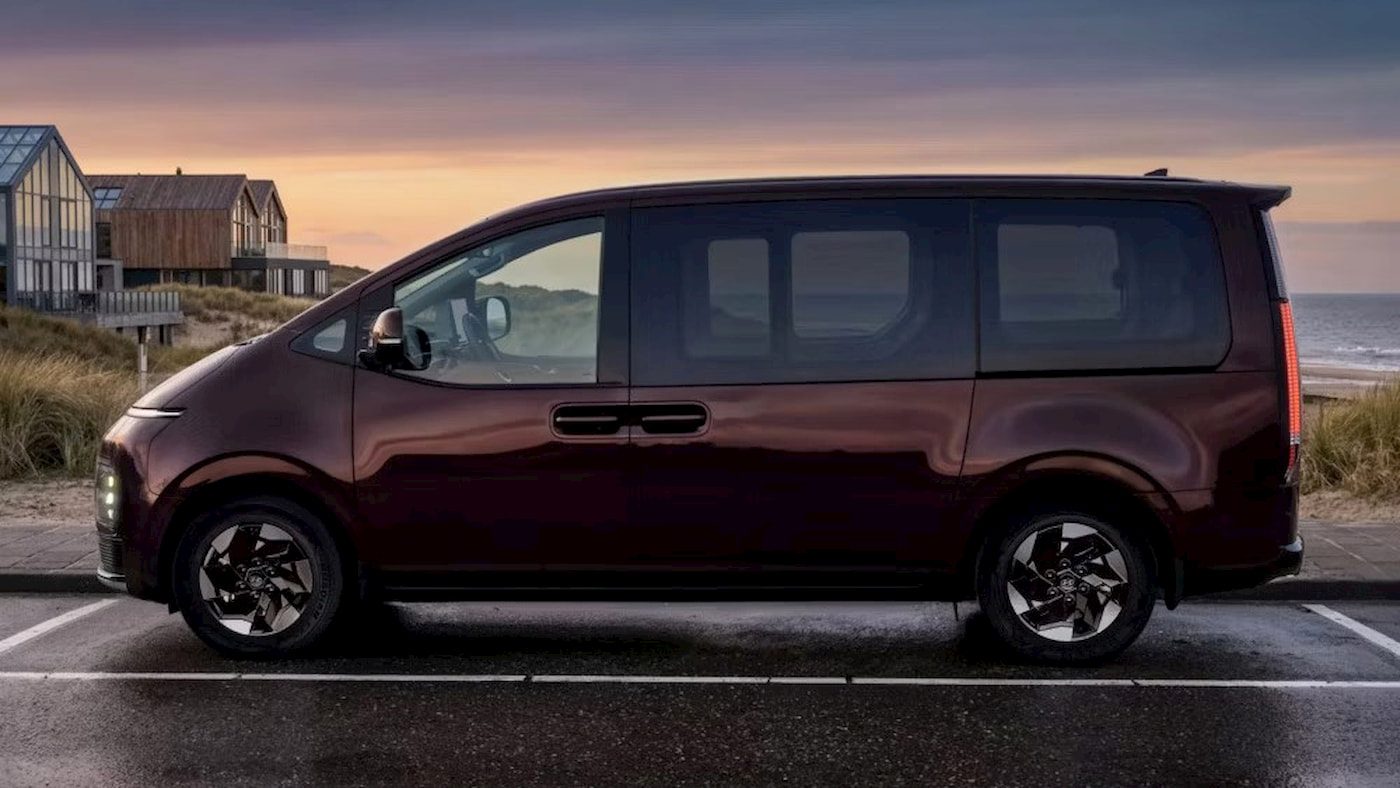
The Hyundai Staria Electric distinguishes itself immediately through its sheer physical presence. Measuring 5,253 mm (206.8 inches) in length, 1,997 mm (78.6 inches) in width, and 1,990 mm (78.3 inches) in height, with a substantial wheelbase of 3,273 mm (128.8 inches), the van is approximately 200 mm (7.8 inches) longer than Hyundai’s flagship three-row IONIQ 9 SUV.
Externally, while retaining the foundational architecture of its internal combustion predecessor, the Staria Electric incorporates several bespoke EV styling elements. Most notable are the closed-off front grille—optimized for aerodynamic efficiency—and a full-length LED light bar that spans the width of the front fascia, aligning it visually with Hyundai’s broader IONIQ family of electric vehicles.
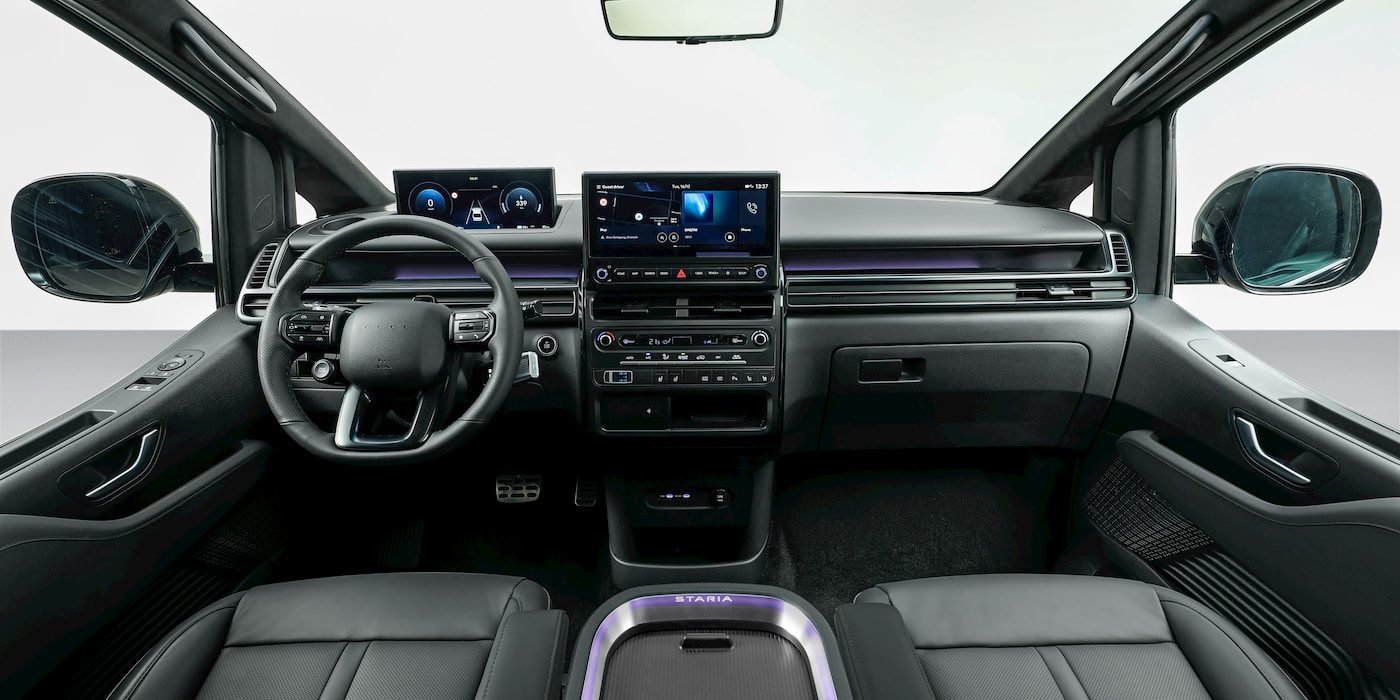
Inside, the vehicle utilizes Hyundai’s signature "Inside-Out" design philosophy, which prioritizes interior space and passenger visibility. The adoption of a completely flat floor transforms the cabin into an open-plan environment available in both seven- and nine-seat configurations. For the nine-passenger variant, Hyundai has engineered a flexible layout that retains up to 1,303 liters of dedicated luggage capacity, supplemented by an additional 24-liter front trunk (frunk) under the hood.
Equipped with sliding side doors and modular, folding seating configurations, the Staria Electric is marketed heavily toward hospitality services, shuttle operators, and large families. The cockpit features Hyundai’s advanced Connected Car Navigation Cockpit (ccNC) system, housed within dual 12.3-inch display screens that manage both instrument data and infotainment, complete with wireless integration for Apple CarPlay and Android Auto.
Powertrain, Range, and Charging Performance
Underneath its spacious exterior, the Staria Electric relies on a robust engineering foundation designed for efficiency and long-distance capability. The vehicle is powered by an 84 kWh battery pack paired with a front-mounted electric motor generating 160 kW (218 horsepower). According to Worldwide Harmonised Light Vehicles Test Procedure (WLTP) testing standards, the Staria Electric delivers a driving range of up to 430 kilometers (267 miles) on a single charge.
Charging performance is a major selling point, facilitated by Hyundai’s high-voltage 800V electrical architecture—a technology shared with the company’s award-winning E-GMP-based vehicles. When plugged into a 350 kW DC fast-charging station, the Staria Electric can replenish its battery from 10% to 80% in approximately 20 minutes, minimizing downtime for commercial fleets and road-tripping families alike.

Furthermore, the van includes Vehicle-to-Load (V2L) technology. This bi-directional charging capability transforms the Staria Electric into a mobile power bank, allowing users to draw electricity directly from the vehicle to power external appliances, camping equipment, professional power tools, or electronic devices while on the go.
Pricing Structures and Trim Level Breakdown in Europe
Hyundai has structured the European rollout of the Staria Electric across three distinct trim levels, catering to varying consumer and commercial requirements.
In Germany, the lineup opens with the entry-level Staria Electric Trend 9-seater, which carries a base price of €57,450 (approximately $66,500). For fleet buyers and retail customers preferring flexible financing, Hyundai Financial Services is offering leasing options starting at €489 ($570) per month.
Stepping up the ladder is the Prime 9-seater variant, priced at €63,350 ($73,500). This mid-tier trim adds significant convenience and safety enhancements, including power-operated sliding doors on both sides, an electric tailgate, second- and third-row sliding windows with integrated sunshades, Highway Driving Assist 1.5, a dedicated blind-spot view monitor display, and a practical 230V interior power socket.
At the pinnacle of the passenger lineup is the Staria Electric Calligraphy 7-seater, starting at €66,950 ($77,800). This flagship trim introduces exclusive exterior design elements, full LED projection headlights, customizable multi-color ambient lighting, a premium BOSE surround-sound audio system, and Hyundai’s "Passenger View and Talk Mode" for enhanced communication throughout the cavernous cabin. Interior comfort is further elevated with Nappa leather upholstery and two individual second-row "relaxation" seats equipped with heating, ventilation, and power-adjustability.
Commercial Adaptations: The Staria Load Electric
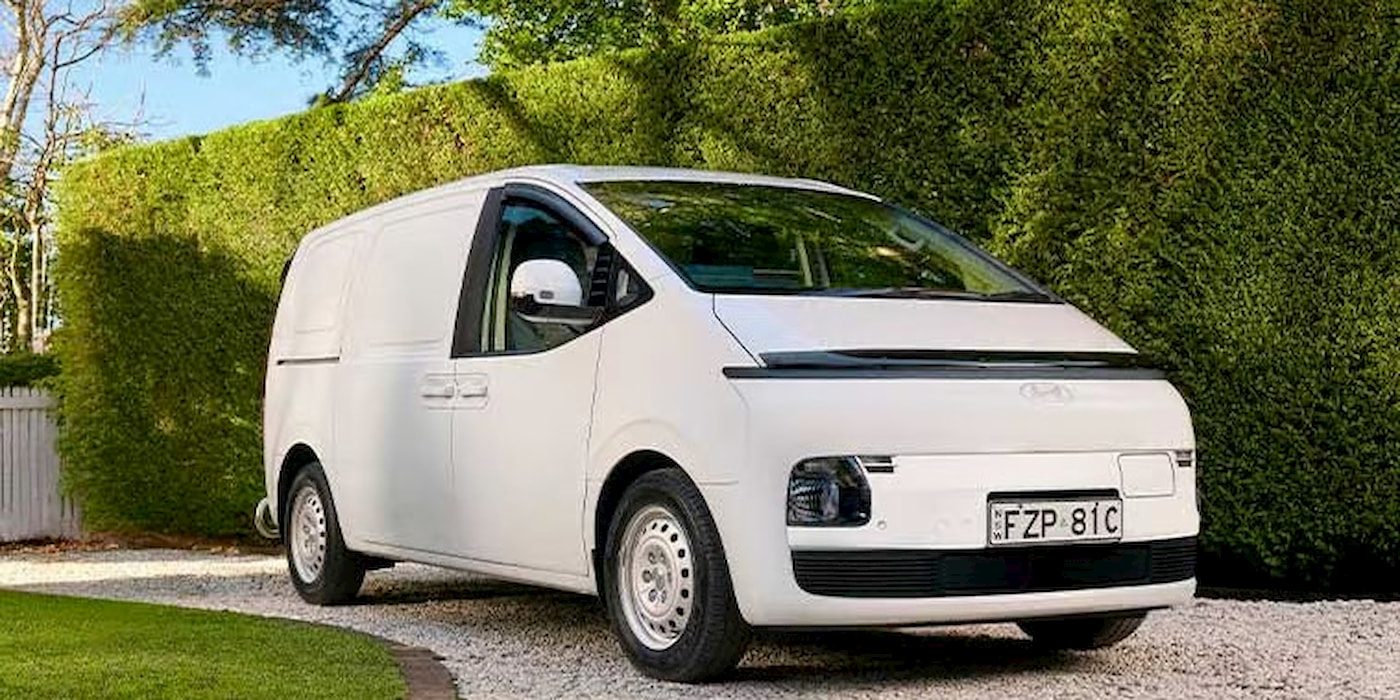
Beyond passenger transport, Hyundai is targeting the lucrative light commercial vehicle sector with the launch of the Staria Load Electric, which has commenced ordering in Australia.

Designed specifically as a work vehicle, the Staria Load Electric provides businesses with a zero-emission cargo hauling solution. In the Australian market, the commercial van is offered in a single, well-equipped configuration starting at 70,990 AUD before local on-road costs. This competitive pricing strategy undercuts key rivals in the region, such as the Ford E-Transit Custom, which starts at 77,890 AUD plus on-road costs, positioning Hyundai favorably to capture commercial fleet contracts as corporations race to meet corporate sustainability goals.
Strategic Context and Market Implications
The simultaneous launch of the Staria Electric and the smaller IONIQ 3—which starts in Europe at €28,950 ($33,000) with leases as low as €209 ($240) per month—highlights Hyundai’s calculated diversification of its electric vehicle ecosystem. While the IONIQ series primarily targets mainstream passenger cars, crossovers, and SUVs (such as the IONIQ 5 and the three-row IONIQ 9), the Staria Electric targets a specialized niche that demands maximum interior volume and multi-passenger utility.
Automotive market analysts suggest that these vehicle rollouts reflect Hyundai’s mastery of flexible manufacturing and platform sharing. By electrifying established internal combustion models like the Staria rather than building entirely bespoke van architectures from scratch, Hyundai can bring high-volume, cost-effective commercial and large-family EVs to market faster than many of its legacy competitors.

Geographic Limitations and Regional Availability
Despite the global enthusiasm surrounding Hyundai’s latest electric offerings, consumers in North America will not have access to these specific models. Industry representatives have confirmed that neither the Staria Electric passenger van nor the European-market IONIQ 3 are planned for introduction in the United States.
The primary reasons cited include differing regional regulatory frameworks, market preferences that heavily favor large SUVs and pickup trucks over traditional MPVs, and localized production incentives such as the North American manufacturing stipulations found within the federal EV tax credit guidelines. Instead, Hyundai will continue to focus its North American electrification strategy on domestically manufactured and imported models, maintaining its existing lineup that features the popular IONIQ 5 and the large, three-row IONIQ 9 SUV.
As order books remain open across Europe and Australia, the performance and market reception of the Staria Electric will serve as a crucial test case for the viability of large-format electric passenger and commercial vans in an increasingly competitive global automotive market.