Critical Security Vulnerability in GitLab Enables Remote Code Execution Through Oj Library Memory Corruption

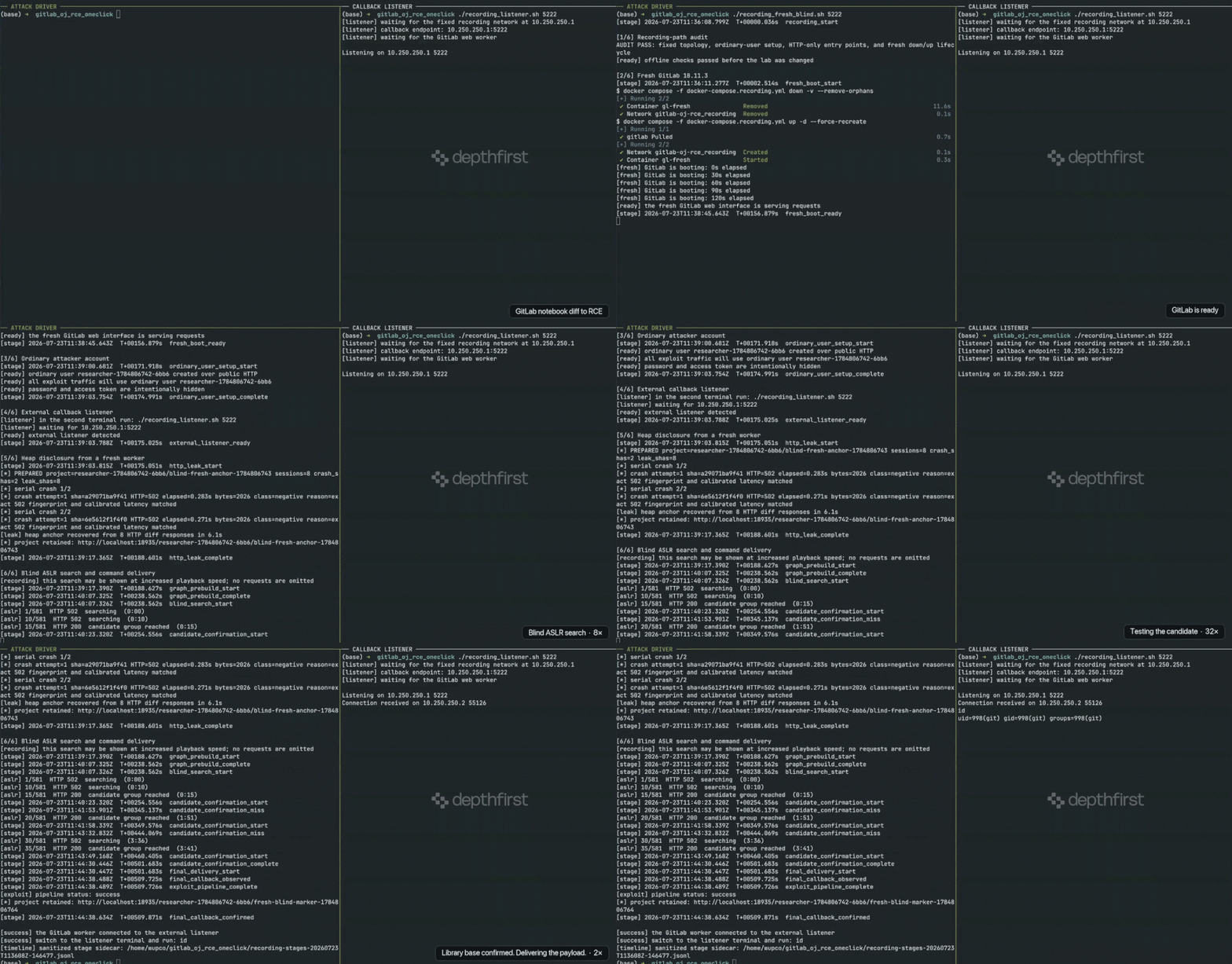
The landscape of enterprise DevSecOps has been jolted by the revelation of a sophisticated Remote Code Execution (RCE) vulnerability within GitLab, a cornerstone platform for version control and collaborative software development. On July 24, 2026, security researchers at the firm Depthfirst published a fully functional exploit demonstration targeting a critical flaw in GitLab’s handling of Jupyter Notebook files. This disclosure comes approximately six weeks after GitLab quietly patched the underlying issue on June 10, 2026. The vulnerability allows an authenticated user with basic project push privileges to execute arbitrary commands as the "git" user on any self-managed GitLab server that has not yet applied the necessary updates. The discovery has ignited a fierce debate within the cybersecurity community regarding the transparency of vendor patch releases and the rising efficacy of automated, AI-driven vulnerability discovery.
The Anatomy of the Exploit Chain
The vulnerability is not found within GitLab’s core Ruby on Rails logic itself, but rather in a third-party dependency known as "Oj" (Optimized JSON), a high-speed JSON parser for Ruby implemented largely in native C code. Because Oj handles memory management manually to achieve its performance benchmarks, it is susceptible to classic memory corruption issues that are typically absent in pure Ruby code.
The exploit chain, as detailed by Depthfirst researchers, utilizes a two-stage attack vector involving the rendering of Jupyter Notebooks (.ipynb files). GitLab employs an internal component called ipynbdiff to generate visual differences between versions of these notebooks. When a user views a "commit diff" containing a specially crafted notebook, GitLab passes the attacker-controlled JSON data to the Oj::Parser.usual.parse method. This process occurs within the context of a long-lived Puma worker—the web server component that powers the GitLab interface.
The first stage of the attack leverages an integer truncation bug. By providing an object key of exactly 65,565 bytes, the attacker triggers a flaw where the length is truncated to a 29-byte value in a signed 16-bit field. This mismatch results in the parser returning a live heap pointer, which is then inadvertently rendered by GitLab into the web interface’s diff view. By repeatedly triggering this leak, an automated probe can map the server’s memory layout, identifying the base addresses of critical system libraries like libc.
The second stage utilizes a buffer overflow in the parser’s nesting stack. The Oj parser maintains a fixed 1,024-byte stack to track nested JSON structures. By exceeding this limit with a deeply nested payload, an attacker can write past the stack boundary and gain control over the parser’s internal start callback. By pointing this callback to the system() function discovered in the first stage, the attacker can execute arbitrary shell commands.

The "Silent Patch" Controversy
A significant point of contention following the disclosure is GitLab’s categorization of the fix. When GitLab released the patch on June 10, the update to Oj version 3.17.3 was listed under the general "bug fixes" category rather than the "security fixes" table. Furthermore, no Common Vulnerabilities and Exposures (CVE) identifier was assigned to the flaw at the time of the release, and no Common Vulnerability Scoring System (CVSS) score was provided to indicate the severity.
This lack of formal security labeling meant that many system administrators and security operations centers (SOCs) may have triaged the June 10 update as a low-priority maintenance task rather than an urgent security necessity. In many enterprise environments, patches are prioritized based on the presence of a high CVSS score. By omitting these markers, the vulnerability remained a "zero-day" in practice for many organizations for several weeks, even after a fix was technically available.
Security analysts argue that this "silent patching" practice puts users at risk, as it provides attackers who monitor library updates with a roadmap for exploitation while keeping defenders in the dark. Depthfirst researchers noted that they were able to develop a working exploit precisely because they monitored the changes in the Oj library and recognized the security implications that the vendor had not publicly acknowledged.
Chronology of Discovery and Remediation
The timeline of the vulnerability’s discovery highlights the rapid pace of modern exploit development:
- May 21, 2026: Depthfirst researchers identify two memory corruption bugs in the Oj Ruby gem and report them to the library’s maintainer.
- May 27, 2026: The maintainer of the Oj gem merges fixes for the reported issues into the project’s main branch.
- June 4, 2026: Oj version 3.17.3 is officially released to the public.
- June 5, 2026: Depthfirst reports the full RCE exploit chain to GitLab, demonstrating how the Oj bugs can be weaponized against the GitLab platform.
- June 8, 2026: GitLab security teams confirm the validity of the RCE chain and reproduce the exploit independently.
- June 10, 2026: GitLab releases patch 19.0.2, 18.11.5, and 18.10.8, which include the updated Oj gem. The fix is listed as a routine bug fix.
- July 24, 2026: Depthfirst publishes a detailed technical write-up and a working exploit demo on GitHub, citing the need for transparency after the silent patch.
- July 25, 2026: The broader cybersecurity community begins widespread analysis of the exploit’s impact on self-managed GitLab instances.
Scope of Impact and Affected Versions
The vulnerability affects both the Community Edition (CE) and Enterprise Edition (EE) of GitLab. Because the flaw resides in the dependency used for rendering notebook diffs, all tiers—from Free to Ultimate—are vulnerable. The affected versions include:
- GitLab 15.2.0 through 18.10.7: Fixed in version 18.10.8.
- GitLab 18.11.0 through 18.11.4: Fixed in version 18.11.5.
- GitLab 19.0.0 through 19.0.1: Fixed in version 19.0.2.
It is important to note that GitLab instances running on versions 15.2 through 18.9 are essentially in a state of permanent vulnerability unless they are upgraded to a supported release line. GitLab’s maintenance policy typically only provides backported patches for the current stable version and the previous two monthly releases.

For organizations using containerized deployments via Helm charts or the GitLab Operator, administrators are cautioned to verify the specific version of the "Webservice" image running the Puma workers. The version of the chart itself may not always clearly reflect the underlying GitLab version, potentially leading to a false sense of security.
Technical Implications of a Successful Breach
If an attacker successfully exploits this RCE, the commands are executed with the permissions of the git user. In a standard GitLab installation, the git user is the primary account responsible for managing the application process. While this is not a "root" or administrative system account, the level of access granted is devastatingly high within the context of the application.
A compromised Puma worker allows an attacker to:
- Access Source Code: The attacker can read any repository hosted on the instance, regardless of private visibility settings.
- Exfiltrate Secrets: Access to
gitlab-secrets.jsonallows an attacker to decrypt sensitive data, including database passwords and integration tokens. - Poison CI/CD Pipelines: By gaining control over the application, an attacker could potentially inject malicious code into build processes or steal CI/CD runner registration tokens to execute code on build agents.
- Pivot to Internal Networks: The GitLab server often has trusted access to internal databases, LDAP servers, and other infrastructure, providing a foothold for lateral movement.
The portability of the current public exploit is somewhat limited, as it was specifically built for GitLab version 18.11.3 on x86-64 architecture. The exploit relies on specific memory offsets and the behavior of the jemalloc memory allocator. However, Depthfirst has warned that porting the exploit to other versions is a straightforward task for a determined adversary, estimated to take only a few hours of analysis.
The Role of AI in Vulnerability Research
A notable aspect of this event is Depthfirst’s claim that its autonomous AI system initially flagged the Oj bugs. The firm stated that its AI agent uncovered 21 zero-day vulnerabilities across various libraries during a wider review, with the Oj memory corruption bugs being among the most critical. While the final exploit chain was constructed by human researchers, the use of AI as a force multiplier for vulnerability discovery marks a significant shift in the threat landscape.
This development suggests that both defenders and attackers are now utilizing machine learning to scan large codebases for subtle patterns of memory corruption that traditional static analysis tools might miss. As AI systems become more adept at identifying "unreachable" or complex logic flaws, the window between a vulnerability’s introduction and its discovery is likely to shrink.

Official Responses and Recommendations
In response to inquiries regarding the classification of the fix, GitLab has not yet issued a formal statement explaining the omission of a CVE or security advisory. Historically, GitLab has been recognized for a robust and transparent security program, making this "silent" approach an anomaly that has caught many observers by surprise.
Depthfirst has defended its decision to publish the exploit code, stating that since a patch was available for over a month, the primary risk shifted from the vulnerability itself to the lack of awareness among administrators. The firm emphasized that it is not aware of any in-the-wild exploitation prior to their disclosure but noted that GitLab was able to reproduce the RCE independently during the disclosure process.
The recommended course of action for all operators of self-managed GitLab instances is an immediate upgrade to versions 18.10.8, 18.11.5, or 19.0.2. There are currently no known workarounds or configuration changes that can mitigate the risk short of disabling the rendering of Jupyter Notebooks, a feature deeply integrated into the GitLab UI. Organizations are also advised to review their internal logs for any suspicious activity involving the ipynbdiff component or unusual Puma worker crashes, which could indicate failed or successful exploitation attempts.
As the software supply chain continues to grow in complexity, the GitLab-Oj incident serves as a stark reminder that the security of a platform is only as strong as its least-scrutinized dependency. The event underscores the necessity for transparent communication between vendors and their users, particularly when the stakes involve the total compromise of the software development lifecycle.