Weight-Only Quantization: A Technical Deep Dive into Efficient Large Language Model Inference


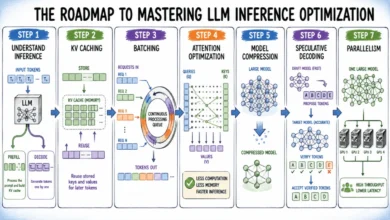
During autoregressive decoding, a transformer model must repeatedly read its massive weight parameters for every single token generated. In scenarios involving small batch sizes—typical of latency-sensitive applications like personal assistants or real-time code completion—the bottleneck is rarely the arithmetic computation itself. Instead, the primary constraint is the memory bandwidth required to move those weights from high-bandwidth memory (HBM) to the processor. Weight-only quantization addresses this by representing model weights with fewer bits, significantly reducing the memory footprint and the time spent on data transfer.
For instance, converting a weight matrix from standard FP16 or BF16 format to INT8 effectively halves the raw storage requirement. Furthermore, many modern AI-accelerated GPUs are architected to perform low-precision integer matrix multiplications at a much higher throughput than their floating-point counterparts. While the theoretical speedup is significant, the realized performance gains remain heavily dependent on the interplay between the underlying hardware architecture, the specific kernels employed, and the geometry of the model layers.
The Mechanism of Asymmetric Affine Quantization
At the heart of weight-only quantization lies the mathematical mapping of real-valued floating-point weights into a finite set of discrete integer codes. This is typically achieved through asymmetric affine quantization, a process defined by a scale factor $s$ and a zero point $z$. The quantization formula, $q = operatornameclampbig(operatornameround(fracxs) + z, qmin, qmaxbig)$, ensures that floating-point values are mapped efficiently into an integer range, such as 0 to 255 for an 8-bit unsigned integer.
The dequantization process—the act of reconstructing the approximate floating-point value for computation—is defined by $hatx = s(q-z)$. A critical advantage of this asymmetric approach is its ability to map the real value of zero exactly to an integer code. This ensures that padding or sparsity, common in neural network activations, can be handled without introducing bias. While simple tensor-level quantization uses a single scale and zero point for the entire matrix, advanced implementations often utilize per-channel or per-group quantization. By assigning distinct parameters to smaller subsets of weights, researchers can significantly preserve the integrity of the model’s original decision-making capabilities, which is vital when reducing precision to 4 bits or lower.
Post-Training Quantization (PTQ) and the Rise of TorchAO
Post-training quantization (PTQ) has emerged as the industry standard for deploying Large Language Models (LLMs) without the prohibitive cost of full-parameter fine-tuning. Libraries such as TorchAO have streamlined this process by allowing developers to replace standard torch.nn.Linear layers with quantized counterparts in-place. This enables practitioners to take a pre-trained, high-precision model and convert it for production use in a matter of minutes, rather than days of retraining.
In a typical workflow, a developer might apply asymmetric, per-channel INT8 quantization while keeping activations in their native BF16 format. This hybrid approach is particularly effective because activations, which are dynamic and data-dependent, often require the broader dynamic range of floating-point numbers to avoid accuracy degradation. By contrast, static model weights are far more resilient to the rounding errors introduced by quantization, making them the ideal candidates for aggressive bit-width reduction.
Calibration and Advanced Optimization: GPTQ and AWQ
While simple "round-to-nearest" quantization provides a baseline for efficiency, it often ignores the nuanced impact that specific weights have on the final model output. To mitigate this, more sophisticated methods—notably GPTQ (Generalized Post-Training Quantization) and AWQ (Activation-aware Weight Quantization)—have been developed.
GPTQ operates on a layer-by-layer basis, utilizing second-order information to adjust the remaining weights as it quantizes, effectively compensating for the errors introduced during the process. This method, now widely accessible through the GPTQModel backend in the transformers ecosystem, allows for significant compression with minimal impact on perplexity.
AWQ takes a different, human-centric approach to the same problem. It identifies "salient" weights—those that are disproportionately important to the model’s accuracy—and applies a scaling factor to protect them before the quantization process occurs. By using representative calibration datasets (such as a subset of the C4 dataset), AWQ ensures that the model retains its intelligence even when squashed into 4-bit representations. This technique has become a staple for developers aiming to run models like TinyLlama or larger parameter-count models on consumer-grade hardware like the NVIDIA RTX 4090.
The GGUF Ecosystem and Deployment Realities
Beyond the native PyTorch environment, the GGUF (GPT-Generated Unified Format) container format has revolutionized local model deployment. Developed by the community surrounding llama.cpp, GGUF is designed to store metadata, tensors, and quantization information in a single, portable file.
The GGUF workflow is distinct: it involves converting an existing model to a high-precision intermediate format and subsequently applying a quantization pass. The resulting "mixed" quantization types—such as Q4_K_M—employ varying encodings across different tensors, balancing performance and memory consumption in a way that is highly optimized for CPU and Apple Silicon execution.
However, a word of caution is necessary for developers. Not all quantization formats are created equal. Re-quantizing a model that has already been compressed often leads to a compounding of approximation errors, resulting in "model collapse" where the AI loses its coherence. Furthermore, while the transformers library now supports loading many GGUF files, it does not always maintain the compressed state in memory; in many instances, tensors are dequantized upon loading, leading to higher-than-expected memory usage. For the most robust, high-performance deployment, utilizing dedicated inference engines like llama.cpp remains the gold standard for those who require direct execution of packed, quantized weights.
Implications and Future Outlook
The democratization of quantization technology has profound implications for the AI landscape. By lowering the hardware barrier to entry, developers can now host sophisticated 7B or 14B parameter models on devices that were previously restricted to much smaller architectures. This shift effectively decentralizes AI, moving computational power from massive, centralized server farms to edge devices, laptops, and local servers.
However, the trade-offs are non-trivial. As models are squeezed into lower bit-widths, the need for rigorous evaluation increases. Standard metrics like perplexity are no longer sufficient; developers must implement application-specific benchmarks to ensure that the quantization process has not introduced subtle biases or logical failures.
As we look toward the future, the industry is trending toward even tighter integration of quantization into the training process itself, known as Quantization-Aware Training (QAT). Yet, for the foreseeable future, PTQ methods like GPTQ and AWQ will remain the primary tools for the enterprise. As hardware vendors continue to introduce new data formats—such as FP8 and sub-4-bit integer support—the software ecosystem will continue to evolve, making weight-only quantization an increasingly vital skill for any machine learning engineer.
Ultimately, successful quantization is an exercise in balance: managing the delicate trade-off between the model’s numerical precision and the practical constraints of the deployment environment. By carefully selecting the quantization algorithm, the calibration set, and the inference backend, developers can unlock the full potential of LLMs while ensuring that they remain fast, efficient, and reliable for the end-user.