Kia Expands UK Commercial Lineup by Opening Orders for New PV5 Electric Van Variants

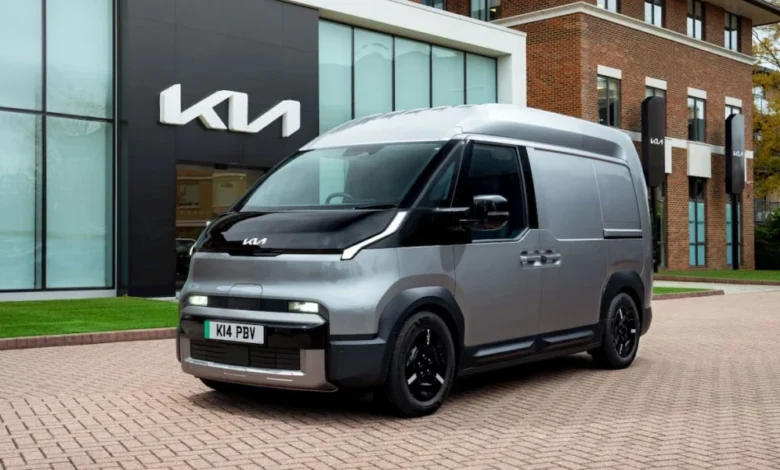
Kia has officially opened order books in the United Kingdom for two highly anticipated additions to its commercial electric vehicle lineup: the PV5 Chassis and the high-roof PV5 Cargo L2/H2. Representing a significant milestone in the South Korean automaker’s transition toward comprehensive commercial mobility solutions, these new variants expand the practical applications of Kia’s dedicated Platform Beyond Vehicle (PBV) ecosystem. Built upon Hyundai Motor Group’s specialized modular skateboard architecture—known as the E-GMP.S platform—the PV5 series is engineered from the ground up to challenge traditional internal combustion engine (ICE) light commercial vehicles (LCVs) by offering unprecedented structural flexibility, zero-tailpipe-emission operations, and advanced digital connectivity tailored specifically for modern fleet operators, small businesses, and municipal logistics providers.
The introduction of these models marks another crucial step in Kia’s broader corporate transformation strategy, which seeks to establish the brand as a dominant global provider of sustainable purpose-built vehicles. As urban centers across Europe continue to enforce stricter Low Emission Zones (LEZs) and Zero Emission Zones (ZEZs), commercial fleet managers face mounting regulatory pressure to electrify their operations without compromising utility, payload capacity, or vehicle versatility. By bringing the modular PV5 platform to the UK market with specialized body configurations, Kia aims to directly address the diverse, demanding requirements of tradespeople, delivery services, and specialist conversion industries.
Strategic Evolution and Background of Kia’s PBV Business
The genesis of Kia’s Platform Beyond Vehicle initiative can be traced back to the company’s broader long-term business strategy, known internally as "Plan S." First detailed in outline at major global automotive exhibitions, Kia’s PBV division was conceptualized not merely as a manufacturer of vans, but as a holistic provider of total mobility ecosystems. Recognizing that traditional commercial vehicle architectures often limit operational efficiency due to rigid, factory-welded bodies, Kia designed the E-GMP.S skateboard platform to support "limitless possibilities" through interchangeable upper body structures. This modularity allows a single skateboard chassis to serve as a passenger shuttle, an urban delivery van, an open-bed work truck, or a customized mobile workspace.

The journey toward the commercialization of the PV5 family has seen steady momentum over recent years. Following initial concept revelations and structural durability testing in various global climates, Kia formally introduced the PV5 Passenger and initial Cargo variants to international automotive audiences. Industry analysts immediately recognized the platform’s disruptive potential, largely because the skateboard architecture centralizes the battery pack and electric drive units beneath the floor, maximizing interior volume while maintaining a low center of gravity.
The latest rollout in the UK builds directly upon this foundational engineering. By partnering with established regional specialists such as TGS Automotive Group, Kia has ensured that the PV5 Chassis can seamlessly transition from an "incomplete vehicle" straight out of the factory into fully certified, specialized work vehicles tailored for the British construction, utility, and maintenance sectors. This collaborative approach highlights Kia’s acute understanding of the European LCV market, where third-party conversions traditionally represent a substantial portion of total commercial vehicle registrations.
Detailed Breakdown of the PV5 Chassis and Tailored Conversions
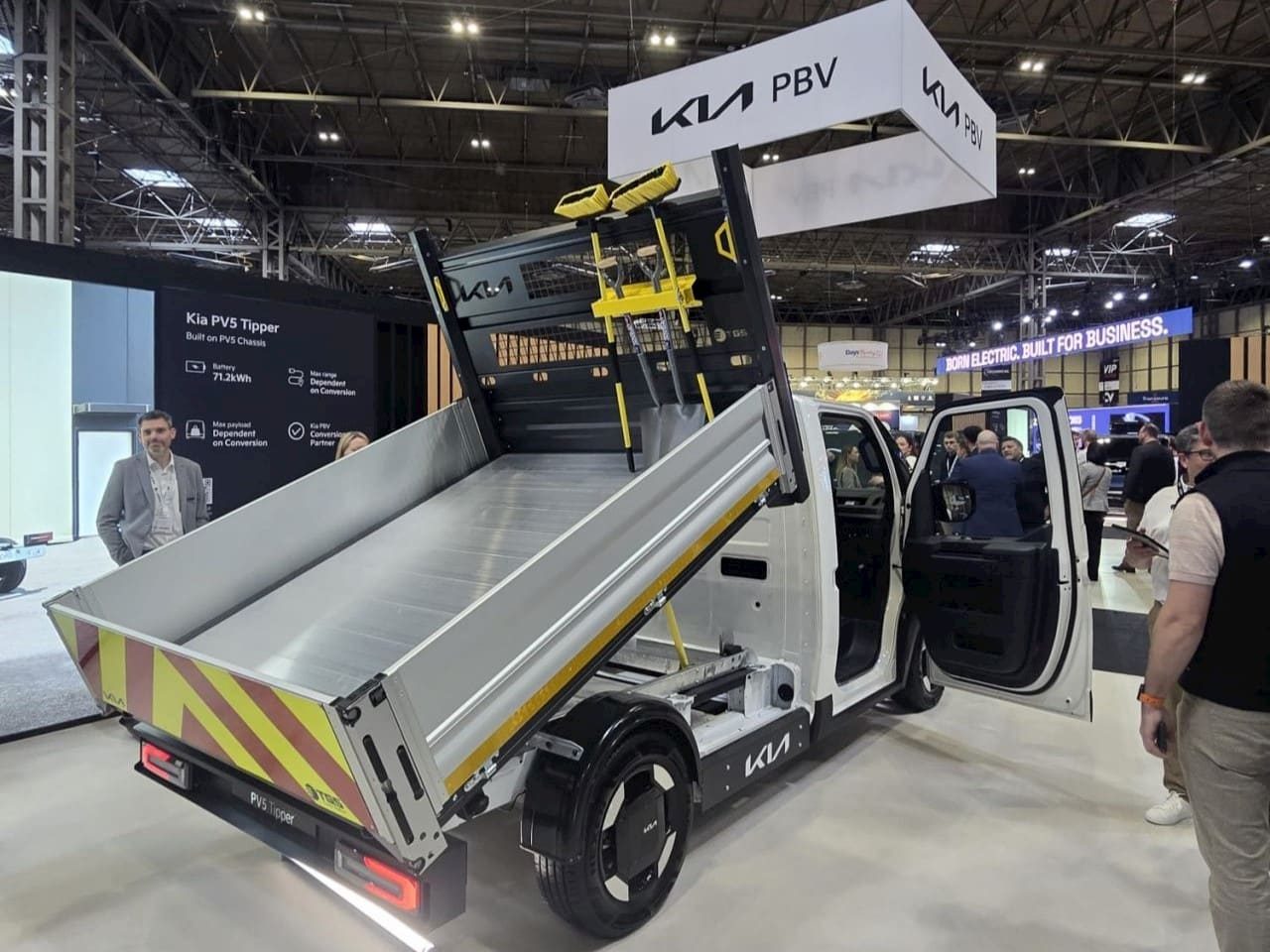
At the forefront of the new order intake is the PV5 Chassis, an open-bed variant designed explicitly to serve as a blank canvas for specialized upfitting. Engineered to accommodate a wide variety of industrial bodies, the Chassis model provides commercial operators with the mechanical and digital foundation required for demanding vocational applications. In the UK market, Kia has streamlined the conversion process by establishing an official partnership with TGS Automotive Group, offering factory-supported solutions that include lightweight tippers, Dropside configurations, and secure Box bodies.
From a structural perspective, the PV5 Chassis measures 4,610 millimeters in length, 1,895 millimeters in width, and 1,935 millimeters in height, riding on a generous 2,995-millimeter wheelbase. Despite its robust commercial capabilities, the vehicle has been meticulously optimized for urban navigation. Kia engineers managed to achieve a tight 5.5-meter turning radius, ensuring that drivers can easily maneuver through congested city streets, narrow residential alleys, and restricted construction sites without sacrificing workspace.
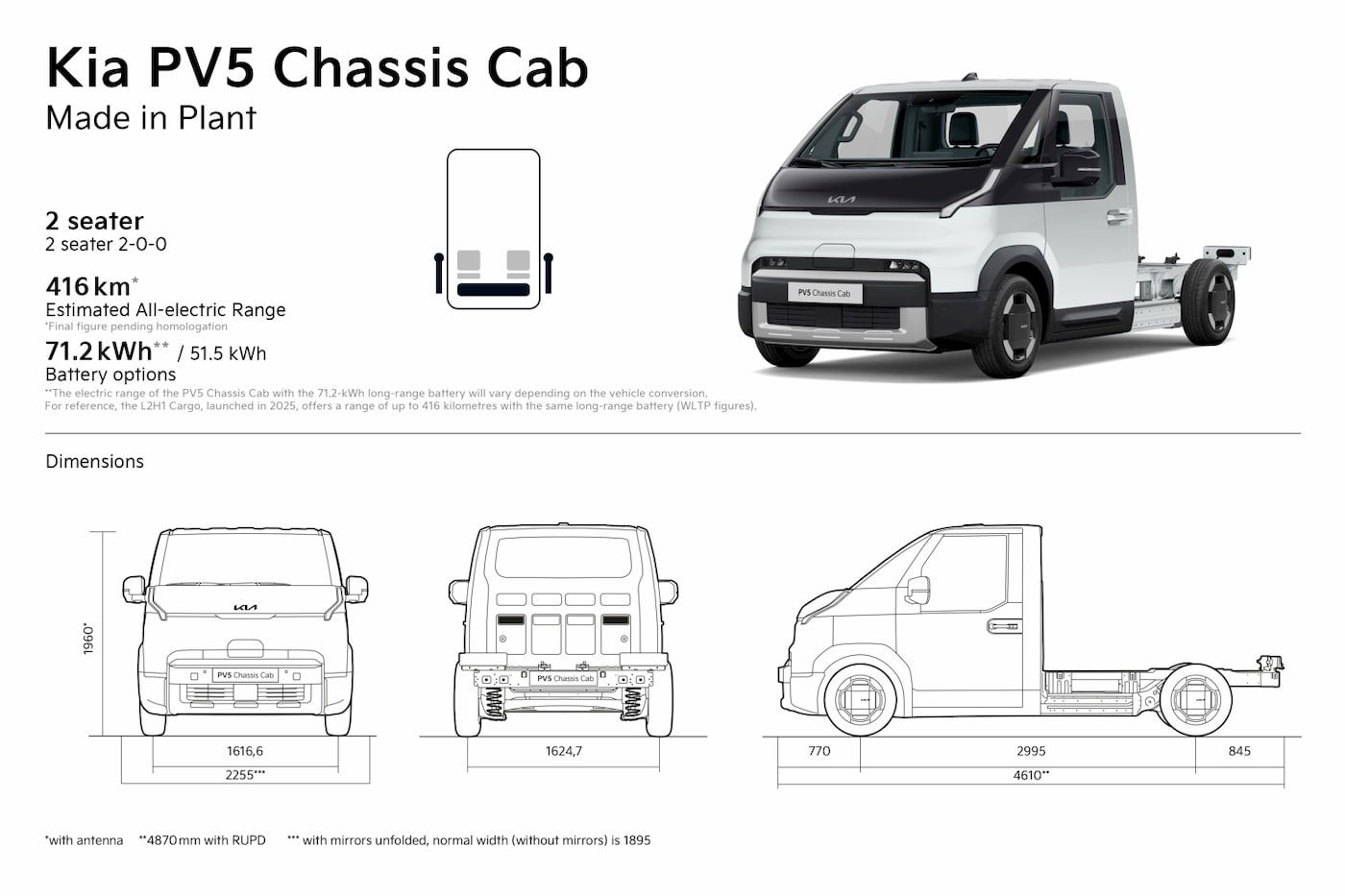
Powering the UK-spec PV5 Chassis is a long-range 71.2 kWh lithium-ion battery pack, which is offered as standard equipment for this variant. This energy storage system delivers a projected WLTP combined driving range of up to 258 miles (416 kilometers) on a single charge, providing more than sufficient daily operational radius for metropolitan and regional delivery or service routes. The vehicle supports high-speed DC fast charging at up to 120 kW, allowing fleet operators to replenish the battery from 10% to 80% capacity in approximately 30 minutes during a standard driver break. For overnight depot charging, an onboard 11 kW AC charger enables a complete 10% to 100% replenishment cycle in roughly 6 hours and 30 minutes.
Payload capacities for the converted Chassis variants vary according to the specific superstructure selected. The factory-backed Dropside configuration offers a maximum payload capacity of up to 633 kilograms, while the heavier-duty Tipper variant delivers a payload rating of 561 kilograms. Inside the two-seat cabin, occupants are greeted by a modern, digital-first environment that starkly contrasts with the traditionally utilitarian interiors of older commercial vans. The cockpit features a prominent 12.9-inch central touchscreen running advanced navigation and telematics software, paired directly with a 7.5-inch digital driver display. Standard wireless integration for Apple CarPlay and Android Auto ensures that drivers remain seamlessly connected to dispatchers, mapping services, and client communications while on the move.
Pricing for the PV5 Chassis starts at a basic price of £30,605 (excluding VAT), translating to an on-the-road (OTR) price of £32,916 when factoring in the anticipated £5,000 UK Zero Emission Van Grant (ZEVG). Because the base Chassis is classified as an incomplete vehicle, fully converted variants command higher initial outlays: the PV5 Dropside begins at an OTR price of £40,110 including the grant, while the PV5 Tipper starts at £41,310.
Expansion of the Cargo Lineup: The PV5 Cargo L2/H2
In tandem with the Chassis rollout, Kia has opened orders for the PV5 Cargo L2/H2, a larger, high-roof iteration designed to maximize internal volume for couriers, logistics providers, and service technicians who require superior vertical clearance. The L2/H2 variant expands the physical dimensions of the standard cargo model, measuring 4,695 millimeters long, 1,895 millimeters wide, and 2,200 millimeters high, while retaining the same 2,995-millimeter wheelbase found across the core PV5 architecture.
The most notable functional improvement of the L2/H2 model is its elevated roofline, which opens up an internal cargo area height of 1,815 millimeters. This generous headroom allows many adult workers to stand upright inside the cargo compartment, drastically reducing physical strain during loading, unloading, and inventory organization. Consequently, the total load volume expands to an impressive 5.2 cubic meters, significantly outclassing the spatial efficiency of the smaller L1/H1 and standard L2/H1 configurations.
The PV5 Cargo L2/H2 is offered in both three- and four-door body configurations, with buyers able to select between two- and three-seat cabin layouts. Three-door variants boast a maximum payload capacity of up to 630 kilograms, whereas the four-door models—equipped with convenient dual sliding side doors for enhanced curbside accessibility—offer a maximum payload of up to 600 kilograms. Furthermore, both structural configurations demonstrate robust utility by supporting a maximum towing capacity of up to 1,500 kilograms, making the vehicle suitable for light trailer operations.
Like its sibling the Chassis, the UK-spec PV5 Cargo L2/H2 is equipped exclusively with the 71.2 kWh long-range battery pack, which delivers a WLTP-certified driving range of up to 239 miles. The cabin mirrors the advanced digital architecture of the wider PV5 family, featuring the 12.9-inch central infotainment display and the 7.5-inch driver instrument cluster. Trim levels for the Cargo L2/H2 are categorized primarily into "Essential" and "Plus" grades, with specialized configurations such as the "Plus Walk Through" model also available to cater to multi-drop delivery drivers who require direct internal access between the cabin and the cargo hold.
Pricing for the PV5 Cargo L2/H2 range kicks off at an OTR price of £35,016 (including the £5,000 ZEVG and applicable VAT) for the entry-level "Essential" two-seat and three-seat variants. Higher-spec "Plus" models start at £36,216, while the specialized "Plus Walk Through" variant is priced from £37,500 on the road.
Market Implications and Economic Analysis

The commercial rollout of the Kia PV5 variants in the United Kingdom arrives at a critical juncture for the domestic automotive and logistics sectors. As the UK government maintains its ambitious trajectory toward ending the sale of new internal combustion engine vans, fleet operators are actively seeking cost-effective, reliable, and technologically advanced battery-electric alternatives. The introduction of purpose-built EVs like the PV5 addresses several historical pain points associated with commercial vehicle electrification, notably range anxiety, charging infrastructure integration, and the lack of factory-supported conversion options.
From an economic perspective, the integration of the UK Zero Emission Van Grant—providing up to £5,000 in direct financial support per vehicle—serves as an essential catalyst for lowering the total cost of ownership (TCO). While the initial purchase price of electric LCVs typically exceeds that of their diesel-powered equivalents, the significantly lower operating costs associated with electricity versus fossil fuels, combined with reduced maintenance requirements and favorable tax treatments, present a compelling financial case for early adopters. Fleet analysts project that businesses operating high-mileage urban delivery routes will achieve parity in TCO within the first few years of vehicle deployment.
Moreover, the modularity enabled by the E-GMP.S platform presents profound supply chain and manufacturing implications. By standardizing the skateboard chassis while allowing regional partners like TGS Automotive Group to handle specialized bodywork, Kia can achieve economies of scale while remaining flexible enough to satisfy niche market demands. This decentralized conversion model minimizes factory bottlenecks and accelerates delivery times for specialized fleet operators who would otherwise face prolonged custom-build wait times.
Industry Reactions and Future Outlook
Early responses from commercial vehicle leasing companies, logistics providers, and automotive trade associations have been broadly positive. Fleet management experts have praised Kia for adopting an ecosystem-driven approach rather than simply electrifying an existing diesel van chassis. The inclusion of advanced driver-assistance systems (ADAS), connected telematics, and intuitive cabin technology aligns directly with the modern commercial driver’s expectations, potentially aiding fleet operators in driver recruitment and retention.

Looking ahead, Kia plans to scale its PBV manufacturing footprint and expand the availability of the PV5 family across broader European and international markets. Additional body styles, including passenger-focused shuttle variants and ultra-long-range configurations utilizing standard-range 51.1 kWh battery options in select global territories, are expected to follow in subsequent production phases. As initial customer deliveries of the PV5 Chassis and Cargo L2/H2 commence in the UK, industry observers will closely monitor real-world operational metrics, energy efficiency, and durability data to gauge how effectively Kia’s purpose-built electric vehicle philosophy reshapes the future of commercial transport.