White House Network Compromised as Staffers Unknowingly Turn Official Devices into Commercial Proxy Exit Nodes

Security researchers have uncovered a severe operational security vulnerability within the Executive Office of the President, revealing that multiple White House staffers have been utilizing computers and mobile devices connected to commercial residential proxy services. This misconfiguration has inadvertently transformed highly sensitive government IP addresses into public exit nodes available for rent by anyone on the internet.
The alarming discovery places critical government infrastructure at risk, exposing a broader, systemic digital hygiene issue that affects not only the highest levels of political power but also corporate enterprises, financial institutions, and healthcare providers worldwide.
The Discovery: Layer3 Intel and Synthient Findings
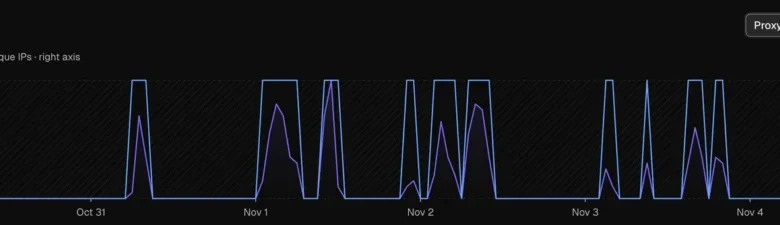
The breach came to light when threat intelligence and security firm Layer3 Intel detected consistent, suspicious outbound beaconing originating from internet address network AS2650, a block explicitly reserved for the Executive Office of the President. According to Layer3’s telemetry, this proxy activity was active and relatively persistent between October 5 and November 3.
A granular review of the available proxy endpoints revealed that traffic successfully exited from the White House network a staggering 236 times during this single-month window. The malicious or unauthorized routing occurred across six distinct IP addresses belonging to the network, spanning 26 out of 30 observed days. Intriguingly, the vast majority of this unauthorized activity concentrated during evening hours, specifically between 5:00 p.m. and midnight, suggesting personal device usage or after-hours connectivity by personnel working remotely or late at the office.
Simultaneously, proxy-tracking firm Synthient identified specific technical markers within the traffic coming from AS2650. Their analysis tied the activity directly to Windows 11 installations running a service called Infatica. Infatica is a prominent commercial proxy program frequently bundled into or integrated within seemingly harmless free desktop and mobile applications via monetization software development kits (SDKs).
What makes the Infatica connection particularly concerning is its corporate lineage. Infatica was founded by Vladimir Fomenko, a Russian national whose previous web hosting enterprise, King Servers, served as the infrastructure core for cyberattacks targeting state election systems in Arizona and Illinois back in 2016. During those historic intrusions, King Servers hosted six of the eight specific IP addresses utilized by Russian state-sponsored actors to breach and exfiltrate voter database systems.
The Mechanics of Residential Proxies and the Scale of the Threat
To understand the gravity of the situation, one must understand how residential proxy networks operate. Unlike traditional data-center proxies, which are easily flagged and blocked by website security systems, residential proxies use real internet connections assigned to ordinary households by Internet Service Providers (ISPs).
Dozens of residential proxy providers—many operating out of jurisdictions with lax regulatory oversight such as Russia and China—offer these networks as a service. For a few dollars, customers can rent the legitimate IP address of an unsuspecting user to mask their identity, route malicious web traffic, spoof their geographical location, or bypass digital geofences. From the perspective of a targeted website, the incoming traffic appears to originate locally from the rented residential or corporate IP address, completely masking the identity of the proxy customer.
While researchers initially suspected Infatica as the sole culprit, Layer3 Intel’s deeper probe yielded an even more staggering revelation: the network infrastructure of the White House was not tethered to just one proxy provider. Instead, researchers discovered that 28 separate residential proxy services were capable of routing their traffic and exiting directly through the executive network.
“This is public access,” the Layer3 Intel research team emphasized in their published analysis. “Anybody can obtain it by signing up to a public residential proxy service, paying a few dollars and sending requests through it. We did not selectively target this network or try to make our probes exit from it. We caught this by chance, simply by requesting global rotating access through these services.”
Because many proxy resellers offer bandwidth at rates as low as 60 cents per gigabyte—and frequently bypass standard Know Your Customer (KYC) verification protocols—bad actors can acquire high-trust, confidential network access for less than the cost of a cup of coffee.
A Chronology of Vulnerabilities: From Local Networks to Global Botnets
The discovery at the White House is the latest in a string of warnings regarding the dangers of residential proxies, a threat landscape that security researchers have tracked with mounting alarm over the past year.
- Late 2025: Cybersecurity analysts uncovered a widespread architectural flaw inherent to many commercial proxy applications. Criminal syndicates began mass-exploiting a vulnerability that allowed them to actively probe the local networks of users running proxy nodes, searching for vulnerable connected systems to infect with secondary malware payloads.
- January 2026: Dozens of commercial proxy services were forced to scramble emergency patches after Synthient Founder Ben Brundage publicly demonstrated how malicious actors were actively abusing proxy service vulnerabilities to hijack total control of local devices residing behind corporate and residential firewalls. This exploit mechanism, often dubbed the "Kimwolf" threat vector, turned user devices into local reconnaissance tools.
- January 2026 Webinars: Highlighting the widespread adoption of these risky apps among professionals, proxy-tracking service Spur published data from a corporate webinar revealing that residential proxies were actively operating within nearly 300 government-owned and operated networks. Additionally, Spur identified nodes inside 318 utility companies, 166 healthcare providers and hospitals, and 141 financial and banking institutions.
- Early 2026: Security firm Infoblox released empirical findings demonstrating that an astounding 65% of its enterprise customer base routinely queried one or more residential proxy-related domains, illustrating that employees constantly bring these shadow IT risks into secure environments via corporate laptops and BYOD (Bring Your Own Device) policies.
- October 5 – November 3: Layer3 Intel detects consistent residential proxy beaconing and 236 successful exit connections originating directly from the White House network (AS2650), culminating in the public disclosure of the security lapse.
Official Silence and Immediate Implications
As of press time, the White House has not issued an official statement or responded to media inquiries regarding the security lapse. The lack of an immediate public response underscores the delicate nature of executive branch cybersecurity, where internal device auditing and mobile device management (MDM) policies must balance personal privacy with rigorous national security standards.
The implications of this incident extend far beyond simple data privacy or advertising fraud. For years, security experts have warned that residential proxy networks serve as prime vectors for account takeovers, web scraping for unauthorized artificial intelligence training models, and large-scale cybercrime. However, when these networks breach secure government boundaries, the threat landscape shifts from commercial annoyance to a profound national security vulnerability.
By unknowingly running software development kits containing proxy code—often bundled into desktop utilities, PDF converters, browser extensions, or mobile games downloaded on personal or hybrid-use devices—staffers effectively punched a hole through the perimeter defenses of the Executive Office of the President.
Industry experts argue that the incident highlights an urgent need for federal agencies to enforce stricter endpoint management, implement deep-packet inspection capable of identifying outbound proxy traffic, and ban the installation of unvetted consumer applications on devices that connect to sensitive government assets. Until such measures are universally and rigorously applied, the digital back doors of the world’s most powerful offices will remain open to the highest bidder.
Related posts: