The Enough Phone Is Attempting To Revive The Compact Smartphone Market In A Landscape Dominated By Giants

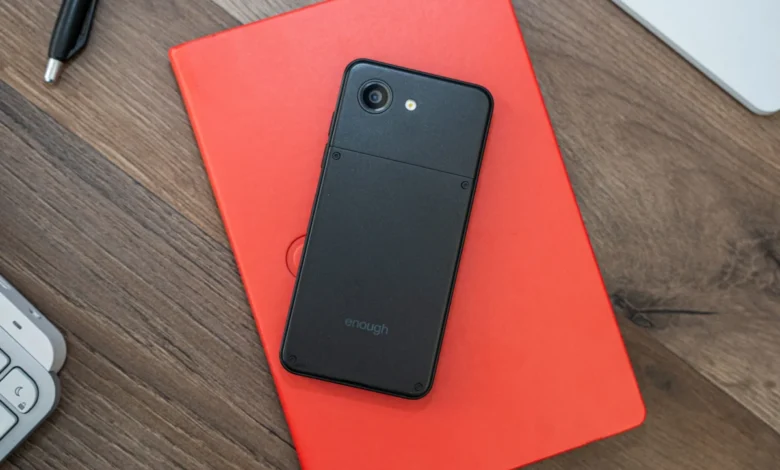
For years, the smartphone industry has trended toward a singular, uncompromising vision: bigger is better. As display real estate expanded to accommodate high-definition streaming, mobile gaming, and complex multitasking, the compact handset—once the industry standard—was systematically pushed to the margins. Today, the 5.3-inch screen of the newly announced Enough Phone stands as an anomaly in a market where the average flagship device, such as the iPhone 17, commands a footprint of roughly 6.3 inches or larger. As major manufacturers have abandoned smaller form factors due to stagnant sales and shifting consumer preferences, a new venture is looking to prove that the demand for "pocketable" technology is not dead, but merely underserved.
The Enough Phone, which launched today via a Kickstarter campaign with an early-bird price of $499, seeks to bridge the widening gap between the modern high-performance smartphone and the burgeoning "dumb phone" movement. By offering users a choice between a full-featured Android 17 experience and a restricted, utility-focused operating system known as OdysseyOS, the creators are betting that a niche but loyal demographic is ready to move away from the massive, attention-sapping devices that have become ubiquitous.
The Rise and Fall of the Compact Phone
To understand the current landscape, one must look at the trajectory of the last decade. In the mid-2010s, devices like the iPhone SE and various Sony Xperia Compact models were staple offerings for consumers who prioritized ergonomics. However, as the 2020s began, market data consistently showed that consumers were trading physical comfort for screen size.
Apple’s attempt to reignite the small-phone category with the iPhone 12 Mini and 13 Mini was widely lauded by tech enthusiasts, yet the company ultimately discontinued the line in 2023. Financial reports indicated that the Mini series failed to capture the sales volume required to justify its place in Apple’s premium lineup. Similarly, the Android ecosystem saw the steady decline of compact hardware. Asus, long the champion of the "small flagship" with its Zenfone series, pivoted its mobile strategy toward AI and specialized robotics earlier this year. Sony, too, retreated from the US market and eventually sunset its compact Xperia 5 series.

This industry-wide pivot left a vacuum. Smaller, independent companies have since rushed to fill the void, often catering to specific subcultures. Unihertz, for instance, has found success with niche, keyboard-equipped devices, while companies like Light and Mudita have introduced "minimalist" phones that intentionally strip away the traditional smartphone experience to promote digital well-being. The Enough Phone enters this fray with a hybrid identity, hoping to capture both the productivity-focused professional and the digital minimalist.
A Different Kind of Hardware Philosophy
The Enough Phone, developed by a team comprised of Austin Boer, Brennan Jordan, and William Stults, is designed with a focus on longevity and repairability. The device features a polycarbonate chassis with a distinct, utilitarian aesthetic characterized by four visible Torx screws on the back. This design choice is not merely stylistic; it is a nod to the growing "Right to Repair" movement and impending European Union regulations that mandate user-replaceable batteries in mobile devices.
At 12 millimeters thick, the handset is intentionally chunkier than its sleek, modern counterparts. This added depth accommodates a 3,500 to 4,000 mAh battery, a capacity designed to facilitate "all-day" usage despite the hardware’s modest footprint. Under the hood, the device is powered by a MediaTek Dimensity 7500 processor, paired with 8 GB of RAM and 128 GB of internal storage. While these specifications place the Enough Phone firmly in the midrange category, the inclusion of 5G connectivity, eSIM support, and a high-resolution 50-megapixel Sony sensor suggests a device that is not meant to be a secondary "toy," but a primary communication tool.
Software Flexibility: The Dual-Identity Approach
Perhaps the most significant differentiator for the Enough Phone is its software versatility. Upon purchase, users are presented with a binary choice: a standard, open-access Android 17 environment, or the proprietary OdysseyOS. The latter is a curated, restricted Android fork designed to curb screen addiction.
OdysseyOS represents a strategic response to the "always-on" nature of modern apps. It excludes social media, games, and web browsers, instead prioritizing utility-focused applications such as Uber, Spotify, and Google Authenticator. For communication, the OS integrates with Beeper, allowing users to aggregate various chat services into a single interface, thereby eliminating the need to have a dozen individual apps competing for attention.

For those who need to perform quick queries, the OS provides a text-based search bar powered by Perplexity, emphasizing answers over the infinite-scroll environments of traditional search engines. According to Brennan Jordan, the team anticipates that a significant portion of their customer base will opt for this "smart-dumb" configuration, effectively using the phone as a tool rather than an entertainment hub.
The Business Case for the Niche
The team behind the Enough Phone brings a unique blend of experience to the table. Boer and Jordan operate Sleke, a company that has spent the last year refining OdysseyOS through the refurbishment of older Google Pixel handsets. Stults, meanwhile, runs Dumbwireless, an e-commerce platform that acts as a gatekeeper for users seeking to transition away from mainstream devices. By combining their expertise in software restriction and market distribution, the trio is attempting to build a sustainable business model that does not rely on the high-volume, low-margin tactics of the major tech giants.
"We don’t want people to have this for a year and put it in the drawer," says Stults. The company’s commitment to longevity is underscored by a pledge to provide software support through 2032. This seven-year support cycle puts them in direct competition with major flagship manufacturers, signaling a desire to be viewed as a serious, long-term player in the mobile space.
Broader Implications and Market Impact
The launch of the Enough Phone highlights a growing tension in the tech sector: the conflict between feature-heavy devices and the rising consumer desire for digital agency. While major corporations have largely concluded that the "small phone" market is too small to be profitable, the founders of the Enough Phone argue that they are playing a different game.
"What’s not a success for Apple could be a home run for us," Jordan notes. This sentiment reflects a shift in how some tech startups are viewing market viability. By lowering overhead and focusing on a specific pain point—the unwieldy size of modern phones—they are able to operate profitably on a scale that would be considered a failure for a trillion-dollar company.

The success of this project will likely depend on whether they can maintain the build quality and software polish necessary to compete with established brands. If the Enough Phone manages to ship in May 2027 as planned, and if it delivers on its promise of a high-quality, compact experience, it could set a precedent for other hardware startups.
Furthermore, the existence of this device poses a question to the wider industry: if a small team can produce a modular, repairable, and software-flexible phone for under $600, why have the industry leaders moved away from such designs? The answer may lie in the industry’s reliance on advertising-driven engagement, which necessitates large screens and addictive software. By rejecting that model, the Enough Phone is not just selling a piece of hardware; it is advocating for a different philosophy of technology ownership.
As the crowdfunding campaign proceeds, industry analysts will be watching closely to see if the "cult of the Mini" is indeed a viable market force or a loud, but ultimately small, demographic. Regardless of the outcome, the Enough Phone has successfully placed a stake in the ground, challenging the assumption that the smartphone’s future must be defined by ever-increasing dimensions. In an era of "more is more," the Enough Phone is a deliberate attempt to prove that, for many users, less is exactly enough.