Fine-Tuning vs. Frozen Embeddings: When to Adapt the LLM vs. the Sklearn Head

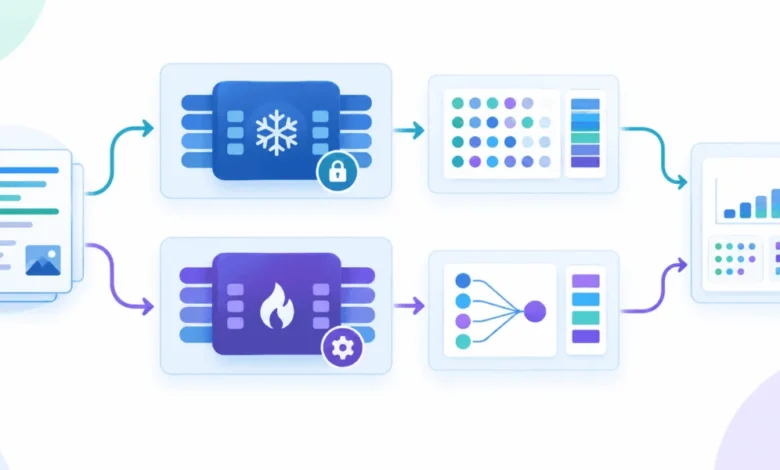
In the rapidly evolving landscape of artificial intelligence, organizations are increasingly tasked with adapting Large Language Models (LLMs) to specialized domains. While the industry standard has long leaned toward full or parameter-efficient fine-tuning, a growing number of developers are questioning whether such intensive resource allocation is always the optimal path. The debate centers on two primary methodologies: performing parameter-efficient fine-tuning via Low-Rank Adaptation (LoRA) or leveraging a frozen LLM as a sophisticated feature extractor for a downstream scikit-learn classifier. As compute costs mount and the pressure for efficient deployment intensifies, understanding the trade-offs between these two strategies has become a critical competency for machine learning engineers.
The Evolution of Model Adaptation
Historically, the machine learning community treated domain adaptation as a monolithic task. Early iterations required updating all parameters of a model, a process that was computationally prohibitive for the massive architectures that emerged following the 2020 explosion of transformer-based models. The introduction of parameter-efficient fine-tuning (PEFT) techniques, specifically LoRA, revolutionized this workflow. By injecting small, trainable adapter matrices into the pre-trained backbone, developers could achieve high-quality results while training only a tiny fraction of the model’s total parameters—typically 1% to 2%.
However, the "frozen embedding" approach represents a different philosophical stance. By keeping the LLM entirely static, it serves solely as a high-dimensional encoder. The intelligence of the system is then shifted to a lightweight, traditional machine learning head, such as a Random Forest or Support Vector Machine (SVM). This approach effectively isolates the LLM’s representational power from the classification logic, providing a buffer against the catastrophic forgetting that can occur during intensive fine-tuning.
A Comparative Chronology of Workflow
To evaluate these strategies, one must examine the operational timeline. The frozen embedding workflow is defined by its front-loaded compute requirements. Because the LLM does not learn, every input sample must pass through the transformer layers to extract hidden states. This is essentially an inference-heavy task. In contrast, the fine-tuning workflow requires a continuous back-and-forth between the model and the GPU, as weights are adjusted through gradient descent over multiple epochs.
In a controlled experiment using the AG News dataset—a standard benchmark consisting of categorized news articles—the differences become stark. Extracting frozen embeddings for a subset of data requires significant time during the initial pass, as the model performs inference across the entire dataset. Once those vectors are stored in memory, however, the training of a scikit-learn classifier is nearly instantaneous, often taking mere seconds. Conversely, the LoRA fine-tuning process requires a sustained period of high-utilization compute, as the trainer iterates through the dataset to optimize the adapter weights. While the LoRA method typically results in higher accuracy, the temporal cost of training can be three to five times higher than the frozen embedding counterpart.
Data-Driven Performance Metrics
Quantifying the trade-offs is essential for enterprise deployment. In the aforementioned trial using the Qwen-2.5-1.5B model, the frozen embedding strategy yielded an accuracy of approximately 82%. This is a commendable result for a system that requires zero training of the transformer itself. The LoRA-tuned variant achieved 87% accuracy. While this 5% gain is statistically significant, it begs the question: is that delta worth the increased power consumption, GPU hours, and infrastructure overhead?
Supporting data suggests that for tasks involving well-defined, objective classification, the gap between frozen embeddings and fine-tuned models is narrowing. As models like Llama-3, Mistral, and Qwen are trained on increasingly diverse datasets, their native embeddings are becoming robust enough to distinguish complex semantic nuances without further modification. This reduces the necessity of "teaching" the model the language of a specific domain, allowing the classifier head to do the heavy lifting of mapping those pre-existing representations to specific task labels.
Engineering Perspectives and Strategic Implications
Industry practitioners often weigh these decisions based on the "cost-to-accuracy" ratio. Leading AI researchers argue that for internal tools, chatbots, or rapid prototyping, the frozen embedding approach is vastly superior. It allows for modularity; one could theoretically swap the downstream classifier in minutes without needing to retrain or even touch the massive LLM weights. This modularity is a significant advantage when handling shifting class definitions or updating categorization schemas in real-time.
On the other hand, for high-stakes environments—such as legal document analysis or medical diagnostics—where the difference between 82% and 87% accuracy could have cascading financial or safety consequences, fine-tuning remains the gold standard. The ability of LoRA to "deeply learn" the syntax and jargon of a specific industry ensures that the model is not just mapping features, but internalizing the logic of the domain.
The Broader Impact on Compute Constraints
The environmental and financial impact of these choices is profound. In a cloud-native environment, GPU usage is the primary driver of operational expenditure. By opting for frozen embeddings, organizations can perform the extraction once, store the resulting vectors in a vector database, and perform subsequent classification at a fraction of the cost. This strategy also simplifies the deployment stack; the inference engine for the LLM can be decoupled from the inference engine for the classifier.
Conversely, fine-tuning creates a dependency on high-memory hardware for the duration of the training lifecycle. While QLoRA (Quantized LoRA) has mitigated much of the VRAM requirement, the energy cost of backpropagation remains non-trivial. As global regulations begin to demand greater transparency regarding the carbon footprint of AI models, the efficiency of the "frozen head" approach may transition from a technical convenience to a compliance-driven necessity.
Conclusion: Matching Strategy to Goal
Ultimately, there is no one-size-fits-all solution. The verdict rests on the specific requirements of the application. The frozen embedding methodology is the most prudent choice for scenarios where speed-to-market, low compute overhead, and system modularity are prioritized. It is an ideal starting point for developers who are in the early stages of building domain-specific tools and want to avoid the complexities of model drift and overfitting.
However, fine-tuning via LoRA is indispensable when the "base" knowledge of a model is insufficient to grasp the subtleties of a niche field. When the model must understand deep, implicit context that standard embeddings might miss, the extra investment in fine-tuning is justified. As the ecosystem matures, we can expect to see hybrid models—where frozen base embeddings are fed into small, fine-tuned "adapter heads"—becoming the new standard, bridging the gap between efficiency and performance. By carefully evaluating the accuracy-to-compute threshold, engineers can ensure that their AI deployments are not only accurate but also sustainable and scalable for the long term.