Pentagon Plots $30 Million Overhaul of Lie Detector Tech Amid High-Stakes Government Leak Investigations

The United States Department of Defense is seeking to invest $30.3 million over the next five years to develop and deploy an advanced iteration of the traditional lie detector. According to budgetary justification documents submitted for fiscal year 2027, the Pentagon’s new initiative—dubbed “Polygraph+” or “Polygraph Next”—aims to fundamentally transform federal credibility assessment technologies through the integration of artificial intelligence, machine learning algorithms, and contactless monitoring techniques.
The program arrives at a volatile moment for national security administration. Under the leadership of Defense Secretary Pete Hegseth, the Pentagon has increasingly relied on polygraph examinations as an aggressive internal mechanism to trace unauthorized disclosures to the press. The push for next-generation lie detection highlights a long-standing tension between the federal government’s desire for absolute security and the scientific community’s persistent skepticism regarding the validity of physiological deception detection. While defense officials argue that modernization is crucial for national defense and insider threat mitigation, legal scholars, psychologists, and civil liberties advocates warn that marrying unproven science with opaque machine learning models creates a dangerous and discriminatory surveillance apparatus.
Background Context and the Urgency of Leak Probes
The impetus behind the Polygraph+ funding request is deeply rooted in recent security breaches that have rattled the highest tiers of the American military establishment. In September, reports surfaced detailing that approximately 50 officers serving on the elite Joint Staff were subjected to mandatory polygraph examinations. This extraordinary investigative sweep was triggered by media coverage—specifically by the New York Times—revealing critical depletions in United States weapons stockpiles amid ongoing military engagements and heightened tensions involving Iran.
Faced with sensitive leaks that exposed strategic military vulnerabilities, the Pentagon turned to its most visible, albeit scientifically contested, internal security tool. Polygraphs have historically served as a psychological cudgel within intelligence and defense agencies, used primarily during pre-employment background vetting and periodic reinvestigations. However, their weaponization in response to specific, high-level intelligence leaks underscores a systemic paranoia within the department regarding institutional loyalty.
The Defense Counterintelligence and Security Agency (DCSA), the primary federal entity responsible for conducting background investigations and security clearances, will spearhead the execution of the Polygraph+ program. Despite the ambitious funding request outlined in the DCSA’s congressional budget justification, the proposal has yet to receive final authorization from Capitol Hill. Furthermore, representatives for the DCSA declined to provide public clarification regarding the specific technical frameworks or defense contractors intended to execute the project.
A Century of Pseudoscience: The Historical Trajectory of the Polygraph
To understand the magnitude of the Pentagon’s new gamble, one must examine the static nature of lie detection technology. The foundational mechanics of the modern polygraph have remained virtually unchanged since its invention in the 1920s. Standard polygraph instruments measure peripheral physiological responses—specifically blood pressure, pulse rate, respiration depth, and galvanic skin response (sweat production).
During an interrogation, a trained examiner establishes a baseline of physiological reactivity by asking neutral questions, such as whether the sky is blue, before progressing to target inquiries, such as whether the subject has ever committed espionage or engaged in subversive activities. The underlying premise assumes that deception triggers an autonomic nervous system response distinguishable by spikes in stress, which manifest as measurable physiological changes.
Despite the federal government administering tens of thousands of these tests annually for security clearances, the scientific validity of the polygraph has faced continuous indictment for decades. The legal system largely recognizes these limitations, making polygraph results strictly inadmissible in most judicial proceedings due to their high error rates.
Historical government reviews have consistently underscored these vulnerabilities:
- 1983: The congressional Office of Technology Assessment (OTA) released a landmark report concluding that there was very limited scientific evidence supporting the validity of polygraphs in personnel security screening.
- 2003: The United States National Research Council (NRC) published an exhaustive evaluation stating that the scientific evidence regarding the polygraph’s efficacy for security screening was “weak at best.”
Independent research has routinely demonstrated that human beings without technical assistance can spot a deception slightly more than half the time—barely above random chance. Conversely, the American Polygraph Association asserts an accuracy rate between 80% and 94%. Yet, as the 2003 NRC report emphasized, even an 85% accurate screening tool applied across a vast workforce carries catastrophic statistical implications. With the Department of Defense employing approximately 2.8 million military and civilian personnel, a false-positive rate of even five to ten percent would result in the wrongful accusation or denial of security clearances for tens, if not hundreds, of thousands of loyal personnel.
Technological Evolution: AI, Machine Learning, and Standoff Sensing
The core mandate of Polygraph+ is to overcome these historic limitations by updating federal capabilities through two primary technological pillars: AI-driven scoring algorithms and “standoff sensing.”
Standoff sensing refers to the capability to capture physiological metrics without physically attaching monitoring devices—such as blood pressure cuffs, pneumograph chest bands, or finger electrodes—to the subject’s body. This non-contact approach aligns with prior exploratory work conducted by the Pentagon’s Defense Innovation Unit (DIU). In 2023, the DIU launched an open solicitation process seeking commercial prototypes capable of automated deception detection.

The DIU ultimately selected two private entities to develop prototype systems:
- Presage Technologies: A firm asserting the capacity to monitor real-time heart rate and breathing frequency exclusively through standard optical cameras.
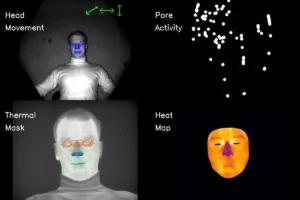
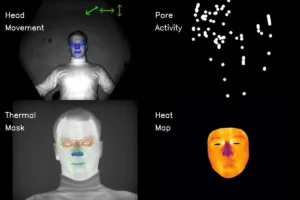
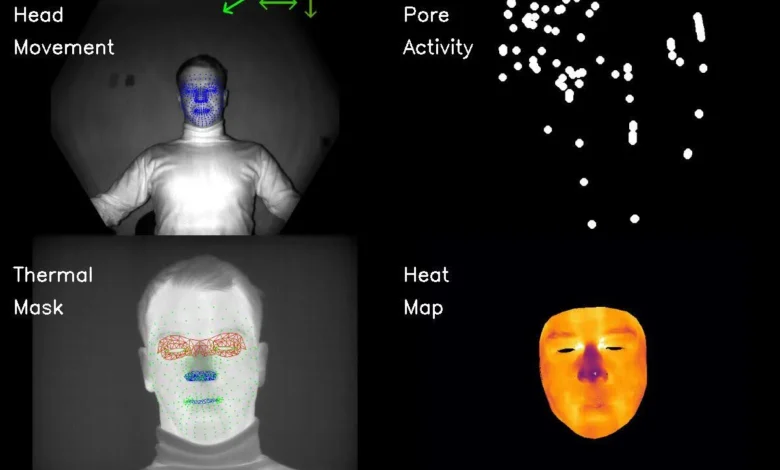
- Altec Research: A medical sensor developer transitioning into non-contact physiological surveillance. Released DIU screenshots of Altec’s prototype reveal a system designed to track minute, involuntary physical phenomena, including localized facial skin temperature variations, micro-head movements, and subdermal pore activity.
Proponents of artificial intelligence argue that machine learning models can process multi-modal datasets far beyond the analytical capabilities of a human examiner. While traditional polygraphs track only physiological stress, deception theorists note that lying inherently involves three distinct psychological components: heightened physiological arousal, elevated cognitive load, and the conscious effort required to suppress truth while generating a plausible falsehood.
Over the decades, various global initiatives have attempted to synthesize these elements into automated scores. In the 2000s, researchers at Manchester Metropolitan University developed “Silent Talker,” a system designed to evaluate deception through video-analyzed body movements and facial micro-expressions. This initiative later influenced iBorderCtrl, an EU-funded automated border control pilot. Domestically, the Department of Homeland Security pursued the Automated Virtual Agent for Truth Assessments in Real-Time (AVATAR), combining eye-tracking, vocal analysis, and postural monitoring at border crossings. Ultimately, these ambitious programs failed to achieve widespread operational deployment, quietly fading away as laboratory curiosities unable to withstand the complexities of real-world application.
Expert Skepticism and the Illusion of Objectivity
Legal scholars and cognitive scientists have met the Pentagon’s funding request with immediate alarm, warning that computational sophistication cannot cure a fundamentally flawed premise.
“It’s a misguided effort to reduce the complex to something that is tangible,” asserts Kyri Kotsoglou, a legal scholar at Northumbria University in the United Kingdom who specializes in the integration of forensic technologies within the justice system. Kotsoglou argues that attempting to merge artificial intelligence with the polygraph represents “the worst of both worlds,” as it layers computational opacity over an unproven scientific foundation. Even if machine learning algorithms successfully identify novel correlations within physiological data streams, they remain incapable of establishing a genuine ground truth regarding human intent.
“Even if you have all the records in the world from polygraph tests, you don’t know whether those polygraph tests are right or not,” observes Marion Oswald, a law professor who has collaborated extensively with Kotsoglou on the legal implications of automated credibility assessments. Oswald contends that the deployment of advanced lie detection infrastructure is transparently reactionary, serving the current administration’s anxieties surrounding information security and perceived administrative disloyalty.
Furthermore, researchers point out that traditional and automated polygraphs alike suffer from severe subjective bias and vulnerability to countermeasures. Studies consistently indicate that minority groups are disproportionately evaluated as deceptive during polygraph assessments due to cultural variances in physiological baselines and emotional expression. Additionally, knowledgeable subjects can easily manipulate the results through physical countermeasures—such as altering breathing patterns or applying hidden physical pain (like stepping on a thumbtack concealed in a shoe)—to artificially spike their reactivity during control questions.
“If you know how it works, you can beat it,” explains Sophie van der Zee, an associate professor studying deception and forensic psychology at Erasmus University in Rotterdam. According to van der Zee, the utility of the polygraph has never rested in its scientific precision, but rather in its psychological theater. The machine functions primarily as a deterrence mechanism, frequently eliciting confessions from guilty subjects prior to the test’s completion due to the intimidating aura of technological omniscience.
“But that only works if people think a polygraph works,” van der Zee notes, emphasizing that there remains no biological equivalent to Pinocchio’s nose—no single, universal physiological indicator of lying that applies uniformly across diverse human populations.
Broader Implications for National Security and Civil Liberties
As Congress weighs the authorization of the $30.3 million budget request for Polygraph+, the implications extend far beyond the immediate fallout of Pentagon intelligence leaks. The normalisation of AI-enhanced, contactless biometric surveillance within federal vetting protocols establishes a troubling precedent for public and private sector employment screening.
Critics emphasize that when lie detection is embraced by institutions as powerful as the Department of Defense, it ceases to function as a diagnostic instrument and solidifies into an instrument of intimidation. By framing internal dissent and unauthorized press disclosures as technical anomalies detectable by algorithms, the Pentagon risks creating a chilling effect on internal whistleblowing and accountability.
Ultimately, while the march toward automated, contactless, and multi-modal deception detection promises a future of frictionless security screening, historical precedent and contemporary legal scholarship suggest a sobering reality. Without a scientifically validated ground truth for human honesty, pouring millions of dollars into algorithmic lie detectors merely modernizes an ancient form of interrogation, substituting the subjective intuition of a human examiner with the unaccountable bias of a machine.