
, Security, and Market Positioning
The digital security landscape has shifted dramatically over the past two years, marked by an aggressive evolution of legacy antivirus brands expanding into specialized privacy tools. Among the most notable transformations is the rapid maturation of Norton VPN. Once categorized as a rudimentary and secondary feature bundled within broader cybersecurity suites—originating back to its 2017 launch as Norton WiFi Privacy—the service has undergone a systemic overhaul. Following structural changes catalyzed by the 2022 merger between Avast and Norton under parent company Gen Digital, the VPN service has systematically dismantled its historical shortcomings, emerging as a high-performance contender challenging established industry leaders like NordVPN and Surfshark.
This review synthesizes rigorous laboratory testing and day-to-day functional evaluations conducted throughout recent development phases, providing an exhaustive look at Norton VPN’s current protocol lineup, global server infrastructure, speed benchmarks, streaming capabilities, privacy frameworks, and commercial pricing models.
A Chronological Evolution: From Antivirus Extension to Standalone Contender

Norton’s journey within the virtual private network sector reflects a broader industry trend of convergence between traditional endpoint protection and network-layer encryption. For years, the product suffered from intermittent connection instabilities, limited feature sets, and documented DNS leaks that kept it far behind dedicated market competitors.
The turning point arrived following the formation of Gen Digital, which initiated a multi-phase technical integration combining "best-of-breed" technologies from Avast, AVG, Avira, and Norton. Throughout 2024 and 2025, Norton VPN rolled out a rapid sequence of feature enhancements, including the introduction of a third-party-audited no-logs policy in August 2024, followed by advanced capabilities in April 2025 such as Double VPN routing, manual and automated IP rotation, a Pause VPN function, and a high-performance ad-blocking browser extension.
Most recently, in March 2026, Norton expanded its platform availability by integrating WireGuard support across all Apple ecosystems (iOS and macOS) and deploying native applications for Amazon Fire TV devices. These sequential rollouts underscore a sustained corporate commitment to closing the functionality gap with premier standalone VPN providers.
Protocol Infrastructure and Feature Integration
At the architectural core of Norton VPN is a diverse selection of tunneling protocols designed to balance speed, efficiency, and obfuscation. Users can select from industry standards including OpenVPN and WireGuard, alongside IPSec (primarily for legacy Apple configurations) and Mimic, Norton’s proprietary obfuscation protocol.
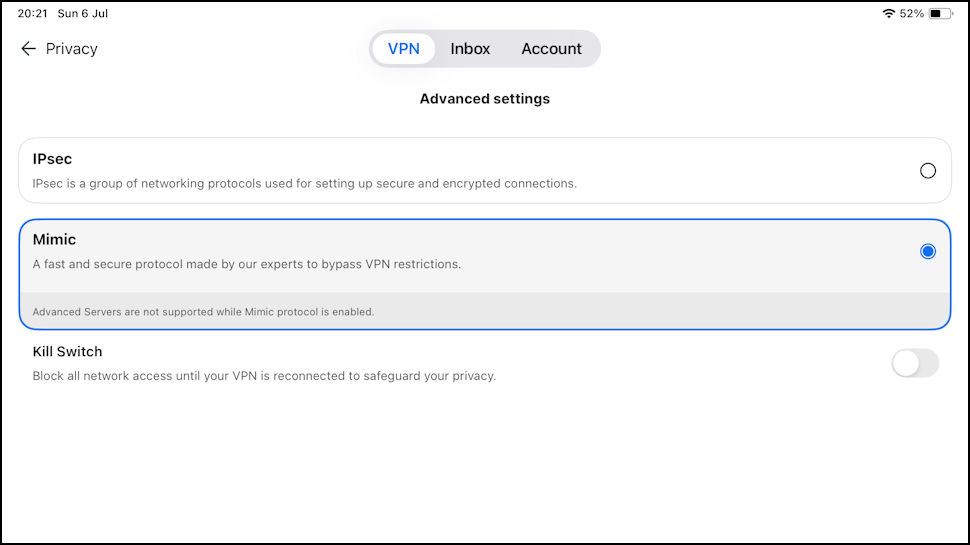
The integration of WireGuard across iOS and macOS marks a vital technical milestone. Previously, Apple users were restricted to IPSec and Mimic, limiting performance optimization and placing a higher computational toll on mobile devices. WireGuard now runs natively alongside ML-KEM-1024 post-quantum cryptography, positioning Norton ahead of many competitors in preparing its encryption standards for future quantum computing threats.
Beyond basic tunneling, the service incorporates several practical utilities:
- Wi-Fi Security Detection: Automatically initiates a secure connection upon detecting unsecured public wireless access points.
- Ad and Tracker Blocking: Employs a DNS-level tracker blocker alongside a dedicated browser extension. In standardized testing, the browser extension achieved a 96% ad-blocking efficacy rate, outperforming specialized tools like uBlock Origin (which scored 91% in comparative testing), though the underlying tracker log continues to exhibit synchronization delays.
- Kill Switch: Halts outbound traffic during unexpected connection drops, preventing unencrypted data leakage. Users can configure local area network (LAN) exemptions depending on operational needs.
- Double VPN (Multihop): Available across eight fixed bidirectional server pairings (including routing configurations through the US, Canada, Germany, Australia, and the UK), enhancing anonymity by routing traffic through two consecutive servers.
- IP Rotation: Offers both manual refreshes and automated IP cycling across major regions (US, UK, Germany, Canada, Australia, Japan) every few seconds, complicating external traffic analysis.
- Pause VPN: Allows temporary disconnection for predefined intervals (starting at 15 minutes), automatically restoring protection upon expiration.
Global Server Network Expansion
Norton VPN’s infrastructure has experienced measurable geographical scaling. The network now spans 143 worldwide locations across 101 distinct countries, representing a substantial increase from previous benchmarks of 74 countries. Recent additions incorporate strategic nodes in emerging regions such as Bangladesh, Ethiopia, Kazakhstan, Malta, and Sri Lanka.
Despite this expansion, the network architecture remains heavily weighted toward North America and Europe, which account for approximately 63% of total locations. Asian coverage comprises 29 locations, leaving the provider trailing market leaders like Proton VPN (51 Asian locations) and NordVPN (43).
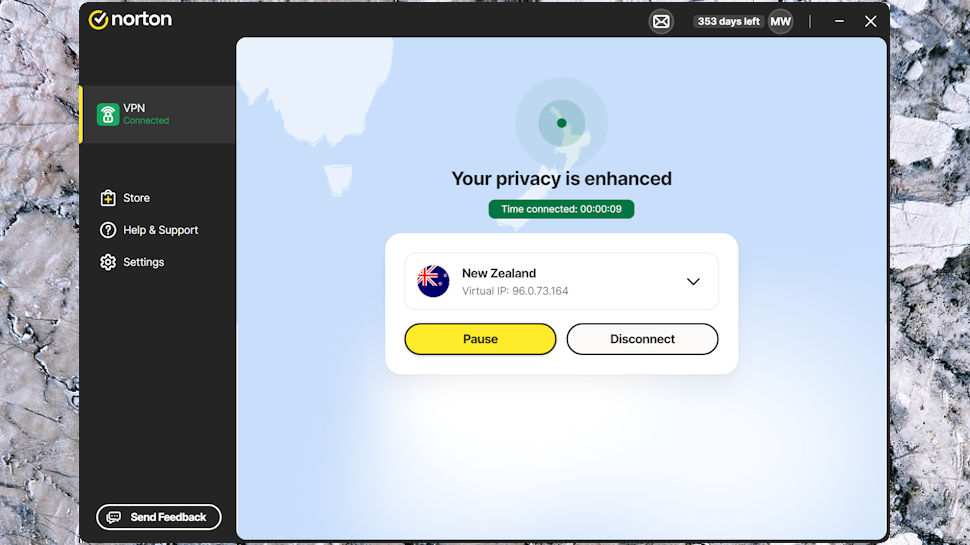
A notable operational observation involves the deployment of virtual server locations. While virtual servers provide valid IP addresses matching the target nation, certain assignments route through geographically distant physical hardware—such as routing a virtual Brunei node through a London server. While functional, such routing configurations can introduce latency penalties that impact optimal connection speeds.
Speed and Performance Benchmarks
In performance evaluations utilizing standardized 10 Gbps virtual testing environments in the Eastern United States, Norton VPN demonstrated remarkable throughput capabilities, frequently outpacing competitors in raw speed output.
Operating over the WireGuard protocol, local connections to nearby Norton servers recorded average speeds of 2,406 Mbps—marking some of the highest figures recorded in contemporary VPN testing categories. Long-distance stability also improved significantly; connections from the US East baseline to a UK server yielded an average of 1,730 Mbps, a substantial leap from historical measurements.
OpenVPN performance mirrored these high-speed trends, registering 1,756 Mbps locally and 1,943 Mbps on transatlantic routes. When engaging Double VPN multihop configurations, speeds experienced a predictable performance reduction of approximately 42%, though remaining more than sufficient for high-bandwidth tasks such as 4K video streaming and large file transfers.

Streaming Unblocking and Torrenting Capabilities
Compatibility with major content streaming libraries remains a primary evaluation metric for consumer VPNs. Norton VPN delivers consistent access to primary platforms, including global Netflix libraries, Disney+, YouTube, and Amazon Prime Video. However, edge-case failures were noted during recent testing cycles regarding specific regional portals, including Japanese Netflix libraries, certain Australian and Canadian YouTube feeds, and the Australian streaming service 7 Plus. Consequently, while highly competent, it sits slightly behind NordVPN in aggregate streaming reliability.
For peer-to-peer (P2P) file sharing, Norton provides five dedicated P2P-optimized servers with automated connection triggers upon launching supported torrent clients. However, the service does not currently support port forwarding, a feature often required by advanced users and found in competitors like Private Internet Access (PIA) and ExpressVPN.
Privacy Policy, Logging, and Security Audits
Transparency and data governance are critical factors for security-conscious consumers. Norton’s no-logs policy explicitly states that browsing histories, traffic contents, and DNS requests are never stored or logged on company-managed servers, with DNS queries handled via private, internal infrastructure to mitigate Internet Service Provider (ISP) surveillance.
An independent audit conducted by VerSprite in August 2024 evaluated the no-logs framework, identifying and resolving minor disclosure vulnerabilities to confirm policy integrity.
However, privacy advocates often scrutinize the auxiliary data collected by the application client. Norton retains anonymized diagnostic telemetry, including connection timestamps for the preceding 12 months, operating system details, time zones, application crash logs, and general event histories (such as installation, updates, and user interactions) for up to 18 months. While standard for many commercial software suites, users requiring absolute zero-knowledge metadata retention may lean toward specialized privacy alternatives like Proton VPN. Furthermore, implementing RAM-only server infrastructure—which purates all data upon reboot—would further strengthen Norton’s technical privacy posture.
Commercial Pricing, Subscription Tiers, and Value Proposition
Norton VPN is commercialized through three distinct subscription tiers, structured to integrate with the company’s broader digital security ecosystem:
- Standard VPN Package: Priced at an introductory rate of $59.76 for the initial two-year term (averaging $2.49 per month) before renewing at an annual rate of $99.99. This tier supports up to 10 device installations.
- Norton VPN Plus: Priced at approximately $3.49 per month initially ($119.99 upon annual renewal), bundling the VPN alongside comprehensive endpoint security tools including antivirus protection, a password manager, dark-web monitoring, and 10GB of encrypted cloud storage.
- Ultimate Package: Positioned at $4.49 per month initially ($149.99 upon annual renewal), expanding device allowances to 20 connections, incorporating family safety and parental controls, and providing 50GB to 150GB of secure cloud storage.
A distinguishing commercial factor is Norton’s inclusion of a true 7-day free trial alongside a generous 60-day money-back guarantee, offering users an extended evaluation window that surpasses the industry-standard 30-day trial period.

Market Outlook and Strategic Implications
Norton VPN’s transformation from an auxiliary antivirus add-on into a high-speed, feature-rich network security tool reflects the shifting demands of the cybersecurity market. By introducing advanced protocols like WireGuard and Mimic with post-quantum encryption, expanding global server distribution, and delivering industry-leading raw connection speeds, Gen Digital has positioned the service as a viable mainstream competitor.
While minor limitations persist—including device installation management caps, the absence of native Linux command-line support, and auxiliary telemetry collection—the overarching trajectory indicates a disciplined commitment to technical refinement. For everyday consumers and beginners seeking reliable digital privacy backed by a recognized security brand, Norton VPN represents an increasingly compelling option in an intensely competitive marketplace.