Nio sees new single-day battery swap service record during peak travel period in China

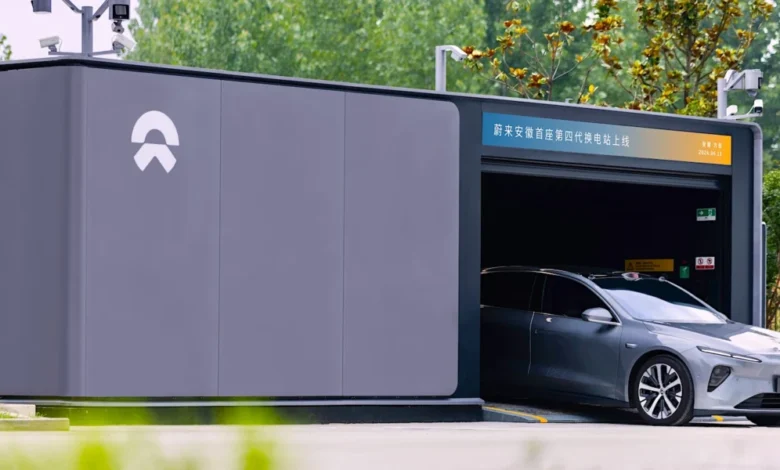
The electric vehicle landscape in China is undergoing a structural realignment following a landmark agreement between high-end EV maker Nio and automotive manufacturing giant Geely Holding. Under the terms of the definitive agreements announced on Sunday, a subsidiary of Geely will acquire a 30% equity stake in Nio Power, the dedicated division responsible for operating Nio’s extensive network of battery-swapping stations and electric vehicle chargers. The transaction values Nio Power at a post-money valuation of approximately RMB 16 billion, equivalent to roughly $2.4 billion USD.
This high-stakes agreement marks a critical evolution in the commercialization of battery-swapping technology. Rather than relying entirely on a straightforward capital infusion, the deal is structured as a complex asset-and-equity swap. Geely is paying for its majority share of the acquired stake by contributing its own commercial battery-swapping business, alongside a cash injection of RMB 640 million, or approximately $94 million USD. In a parallel transaction designed to foster cross-collaboration, Nio China is simultaneously subscribing to newly issued shares in Zhejiang Haohan Energy Technology, Geely’s dedicated charging infrastructure business, thereby securing a 10% equity stake in that entity.
The successful completion of this transaction remains contingent upon customary regulatory approvals. However, once cleared, the partnership promises to reshape the competitive dynamics of China’s rapidly expanding New Energy Vehicle (NEV) market, uniting two major industry players in the pursuit of standardized, rapid-energy-replenishment infrastructure.
The Financial Architecture and Deal Terms
A granular examination of the agreement reveals a carefully calculated balancing act between asset valuation and performance milestones. At the baseline valuation of RMB 16 billion, a 30% ownership interest in Nio Power commands a worth of approximately RMB 4.8 billion. Subtracting the RMB 640 million cash component provided by Geely, the remaining value is heavily anchored by the integration of Geely’s commercial swapping enterprise, known as Yiyi.
Industry analysts note that Nio is effectively valuing the Yiyi commercial swapping business at slightly more than RMB 4.1 billion, or roughly $610 million USD. To mitigate potential valuation discrepancies or underperformance risks, the agreement incorporates structured milestone clauses. Should Yiyi fail to meet specific operational and financial deliverables over time, the final equity distribution adjusts downward, ensuring that Geely receives a proportionately smaller share of Nio Power.
Concurrently, the secondary leg of the transaction operates in reverse. Nio China’s acquisition of a 10% stake in Zhejiang Haohan Energy Technology involves Haohan utilizing the newly invested capital to acquire select charging assets directly from Nio. While the precise monetary value of the asset transfer was not publicly disclosed, the maneuver effectively constitutes an asset swap, allowing Nio to divest portions of its traditional plug-in charging infrastructure in exchange for a strategic equity footprint in Geely’s parallel charging network.
A Chronology of Collaboration: From Handshakes to Capital Integration
The road to this definitive agreement has been paved over several years, transitioning from conceptual overtures to binding corporate restructuring. The chronology of Nio’s efforts to universalize its battery-swapping ecosystem highlights the immense capital expenditures required to maintain and scale such infrastructure.
In July 2021, Nio formally announced its intention to open its proprietary battery-swapping stations to other electric vehicle manufacturers, a bold move aimed at transforming a proprietary moat into an industry-wide utility. For years, market skeptics questioned whether legacy automakers or rival EV startups would embrace a competitor’s proprietary standard.
A significant milestone occurred in November 2023, when Geely and Nio signed a strategic partnership memorandum. That initial agreement established a framework for joint standards regarding battery-swapping technologies for both private passenger vehicles and commercial applications. However, that arrangement was largely programmatic and lacked the binding financial commitments and asset integrations formalized in the current deal.

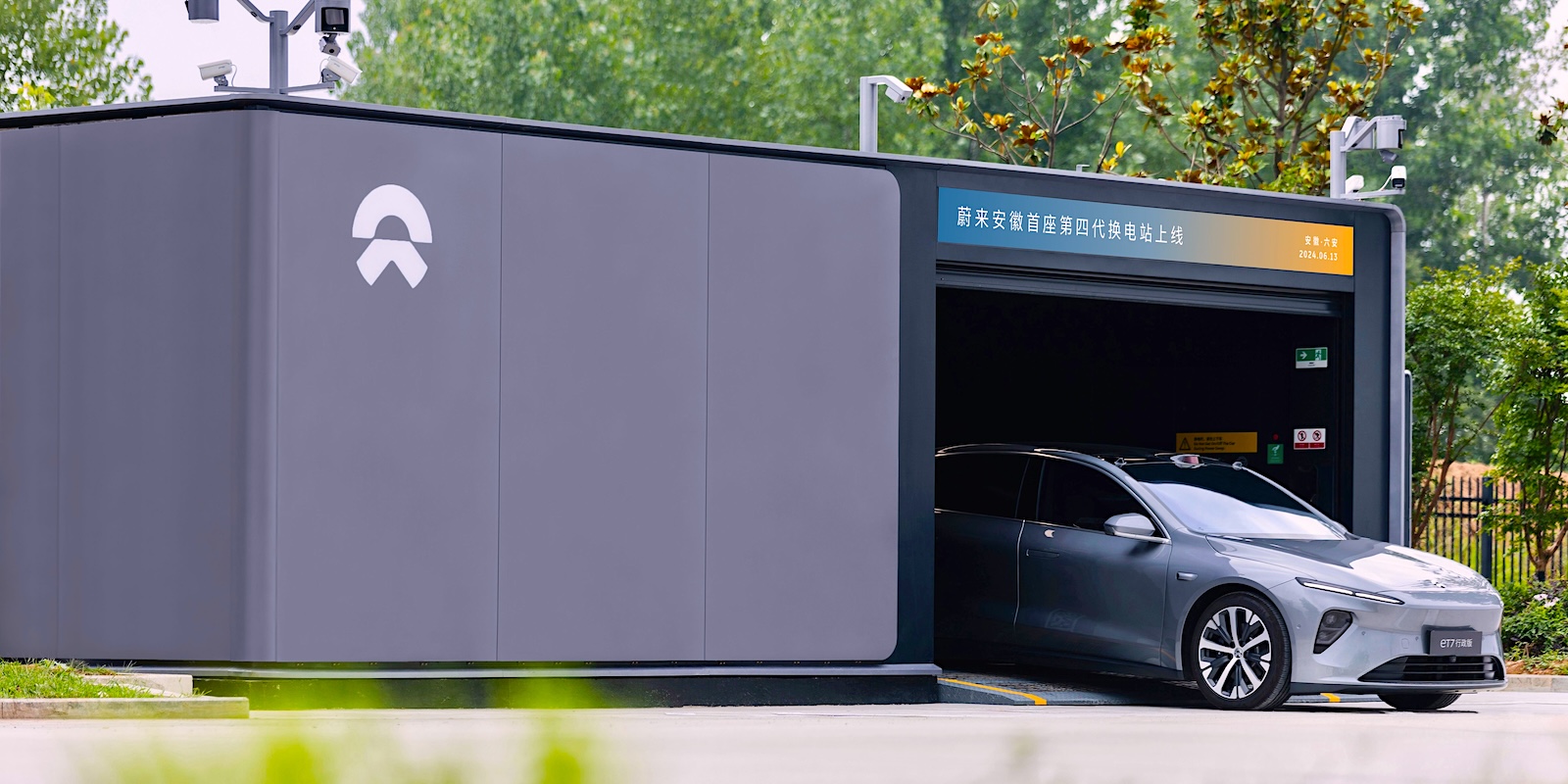
As Nio continued to scale, the physical footprint of its infrastructure grew exponentially. By February of the current year, Nio surpassed a cumulative total of 100 million completed battery swaps, supported by a network of 3,790 active swap stations. The company’s operational capacity was further underscored when it established a single-day record of 175,976 battery swaps during a heavy travel holiday period, eclipsing previous daily throughput metrics.
Despite these operational triumphs, the construction and maintenance of heavy-duty swapping infrastructure demand continuous capital expenditure. Nio Power’s first external financing phase occurred in May 2024, securing RMB 1.5 billion in an investment round led by the Wuhan Guangchuang fund, an entity that maintains a notable position on Nio Power’s capitalization table. Subsequent announcements in March 2025 indicated that major battery manufacturer CATL was advancing an investment capped at RMB 2.5 billion into Nio Power, though CATL’s specific equity positioning was absent from the disclosures surrounding the latest Geely transaction.
Evaluating Nio’s Financial Health
Nio enters into this partnership not from a position of distress, but from a foundation of operational resilience. Financial results for the second quarter of the current fiscal year demonstrate solid vehicle delivery volumes, with the company handing over 107,658 vehicles to customers. Nio reported a healthy vehicle margin of 18.5% and achieved a modest non-GAAP profitability milestone.
While the company still recorded a GAAP net loss of RMB 528 million for the quarter, its liquidity position remains robust, bolstered by cash reserves totaling RMB 56.7 billion at the close of June. This strong balance sheet allowed Nio to negotiate the Geely partnership from a position of strategic strength, rather than out of an urgent need for operating capital.
Strategic Implications for Geely Holding

For Geely Holding—the sprawling automotive conglomerate that parent-controls Geely Auto, Zeekr, Lynk & Co, Volvo Cars, and Polestar—the partnership unlocks immediate synergies in the commercial fleet sector. Geely’s Yiyi subsidiary has historically concentrated its operations on commercial vehicle swapping rather than private consumer cars. By merging Yiyi into Nio Power, Geely gains immediate access to a mature, high-throughput consumer-facing swapping network.
According to statements released by Nio, the two corporate entities maintain preliminary plans to introduce battery-swapping technology into future consumer-facing models produced by Geely-affiliated brands, alongside expansions within their commercial mobility and logistics fleets. While these consumer integration plans remain subject to finalization, the strategic weight of the maneuver is unmistakable.
The Broader Market Impact on China’s EV Ecosystem
The Chinese New Energy Vehicle market is currently witnessing a high-stakes strategic divergence in energy replenishment methodologies. The market is effectively splitting into distinct infrastructural camps: Nio’s consolidated battery-swapping network, which now absorbs Geely’s commercial footprint; CATL’s competing "Choco-Swap" modular battery ecosystem; and automakers like BYD, which continue to double down on ultra-fast cable charging technologies.
Should Geely brands begin mass-producing and distributing consumer vehicles compatible with Nio-standard battery packs, the strategic implications for the industry will be profound. Such a move would instantly cement Nio’s network as the de facto industry standard for a massive cross-section of the Chinese automotive market, dramatically expanding utilization rates at swap stations and optimizing return on capital for Nio Power.
By standardizing battery dimensions and exchange protocols across multiple automotive brands, the Nio-Geely alliance addresses one of the primary consumer adoption hurdles for electric vehicles: long charging wait times and battery degradation anxieties. As regulatory bodies review the transaction, the market watches closely to see if other domestic or international manufacturers will follow Geely’s lead and align with Nio’s pioneering energy network.