Google Unveils Gemini 3.8 Live and Gemini 3.8 Live Extended Thinking in Major Advancement for Real-Time Voice AI

Google has officially announced the rollout of its most sophisticated live dialogue models to date: Gemini 3.8 Live and Gemini 3.8 Live Extended Thinking. Spearheaded by a team of principal engineers and technical staff from the Gemini Audio division, these newly launched models represent a watershed moment in artificial intelligence. By introducing major upgrades in near real-time reasoning, parallel processing, and multimodal capabilities, the tech giant aims to transform how humans interact with voice agents across consumer applications, enterprise infrastructure, and developer ecosystems.

The announcement, updated mid-September 2026, details how these models are designed to bridge the gap between robotic voice prompts and fluid, human-like collaboration. Whether deployed via the Gemini Live API for enterprise workflows or accessed natively within consumer applications like Google Workspace and Search, the Gemini 3.8 iteration promises to elevate the standard for speed, contextual awareness, and agentic task execution.
The Evolution of Conversational AI: Background and Context
The release of Gemini 3.8 Live and its sibling model, Gemini 3.8 Live Extended Thinking, arrives at a critical juncture in the artificial intelligence industry. Over the past several years, the race to build reliable, low-latency conversational voice agents has intensified. While early voice-activated assistants excelled at simple commands—such as setting timers or retrieving weather forecasts—they historically struggled with multi-step workflows, interruptions, background processing, and complex reasoning tasks.
Google’s strategic focus with the Gemini 3.8 series has been to address these precise bottlenecks. By integrating advanced parallel reasoning directly into the audio architecture, the models are built to think and speak simultaneously. This breakthrough eliminates the awkward pauses traditionally associated with voice-based AI interactions, allowing for a more natural conversational rhythm. The incorporation of real-time visual processing further broadens the scope of application, transforming Gemini from a purely auditory assistant into an active visual collaborator capable of interpreting live environments, reading technical charts, and guiding users through complex physical or digital tasks.
Benchmark Performance and Quantitative Analysis
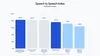
Industry benchmarks and evaluation metrics underscore the technical leap achieved by the Gemini 3.8 series. According to evaluations by Artificial Analysis, Gemini 3.8 Live Extended Thinking has captured the number one overall position on the Speech-to-Speech Quality Index, scoring an impressive 82.6. Furthermore, the model has demonstrated exceptional capability in agentic task completion, registering 68.6% on the Pi-Voice benchmark and 35.1% on Sierra’s Pi-Voice-banking benchmark. In pure reasoning evaluations, the model achieved a 97.7% score on Big Bench Audio, positioning it at the very frontier of conversational AI capabilities while maintaining a competitive cost structure relative to rival architectures.
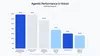
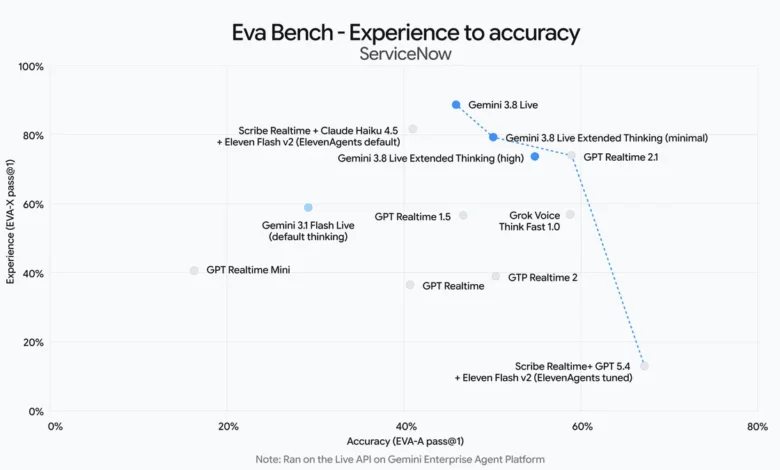
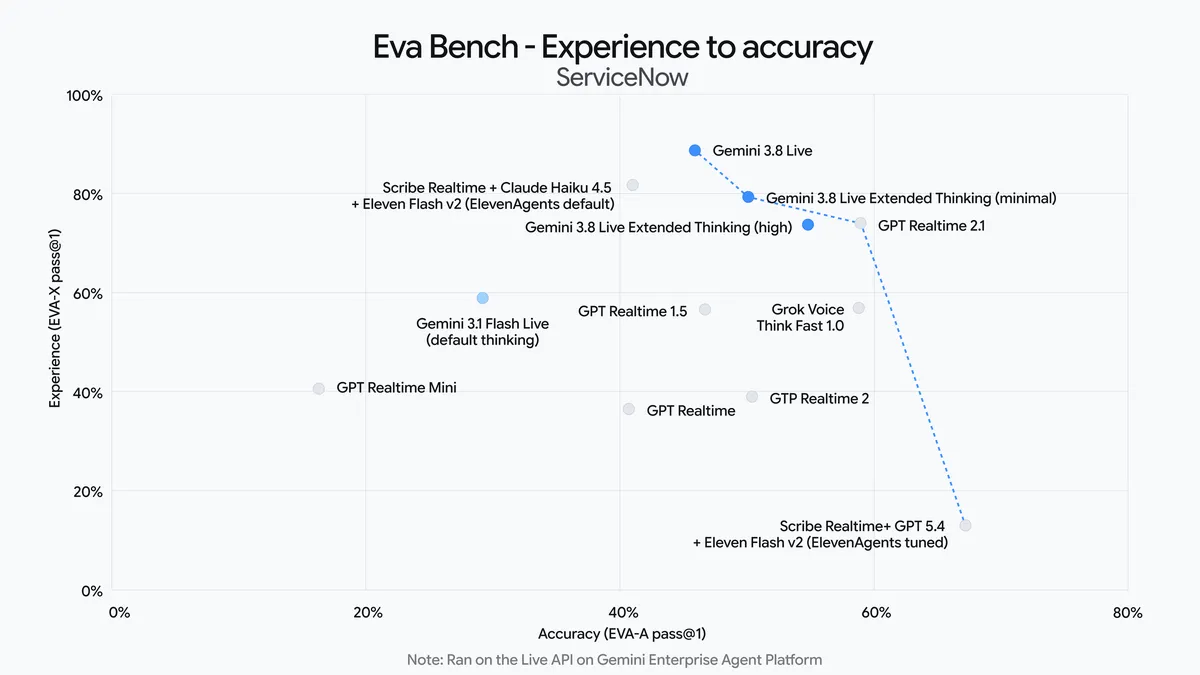
Meanwhile, Gemini 3.8 Live has earned high marks in the Speech Agent Arena, securing the second-overall spot for user preference. Beyond raw intelligence and user satisfaction, Google has emphasized economic efficiency. The models are engineered to provide enterprises and developers with scalable performance without prohibitive operational costs. On ServiceNow’s EVA-Bench—a rigorous evaluation framework designed to test voice agents across complex workflows—the Gemini 3.8 models successfully push the Pareto Frontier, striking a delicate and highly effective balance between high task accuracy and natural conversational quality.
Multimodal Capabilities and Architectural Innovations

At the core of the Gemini 3.8 Live release are several distinct architectural advancements that differentiate it from previous iterations. First, the models are equipped with near real-time visual input processing. This capability allows users to share live camera feeds or visual documents, enriching the conversational context. For instance, in enterprise settings, the model can assist with employee onboarding by answering contextual questions about workspace equipment, or it can engage in complex strategy sessions by analyzing raw sketches and translating them into functional code, such as React components, on the fly.
Second, the models feature an advanced language-handling capability that automatically detects and transitions between 97 supported languages mid-conversation. This eliminates manual language switching and opens up global deployment opportunities for multinational enterprises.
Third, the integration of asynchronous tool execution addresses one of the most persistent frustrations in voice computing. Gemini 3.8 Live can execute background API calls, database queries, and multi-step bookings without halting the conversation. While tasks process in the background, the model uses early verbal cues—such as "Let me check that…"—and live progress narration to keep the user informed, maintaining an uninterrupted conversational flow until the request is fulfilled.
Enterprise Adoption and Developer Ecosystem Integration
To accelerate adoption, Google has integrated Gemini 3.8 Live into its Gemini Live API, making it immediately accessible to a robust network of developer platforms. Infrastructure and developer tool providers including Agora, Fishjam, LangChain, LiveKit, Pipecat, Vercel, and Vision Agents have built out support for the new models. These integrations handle the complex real-time media streaming infrastructure behind the scenes, enabling software developers to focus entirely on designing intuitive user experiences.
Major enterprise software providers and digital platforms have already signaled strong support for the new release. Industry leaders such as Salesforce, Genspark, Lumeris, Lenskart, and ServiceNow have praised the models for their remarkably low latency, high fluidity, and advanced tool-calling mechanics. For corporate environments, these capabilities translate into automated customer service agents capable of handling secure financial transactions, complex healthcare navigation, and comprehensive business planning through natural speech alone.

Integration Across Consumer Touchpoints
For everyday users, the deployment of Gemini 3.8 Live and Gemini 3.8 Live Extended Thinking is rolling out directly across Google’s most ubiquitous product ecosystems. In Google Workspace, new features like Docs Live, Gmail Live, and Keep Live allow users to dictate, draft, and organize documents through conversational collaboration. In Google Search, Search Live provides step-by-step, real-time troubleshooting assistance for complex inquiries. Within the dedicated Gemini application, users can leverage the models to manage daily schedules, request comprehensive daily briefs, achieve inbox zero through voice dictation, or delegate routine to-do lists seamlessly.

Commitment to Safety, Transparency, and Responsible AI
As generative AI technologies become increasingly integrated into sensitive sectors like finance, healthcare, and daily communications, questions surrounding authenticity and security remain paramount. To mitigate the risks of synthetic media misuse and misinformation, Google has embedded its proprietary SynthID watermarking technology into all audio generated by the Gemini 3.8 models.

SynthID embeds an imperceptible watermark directly into the audio output of the AI. While completely undetectable to the human ear, the watermark remains identifiable by automated detection tools, allowing platforms and regulators to verify whether an audio file was generated by artificial intelligence. This measure aligns with Google’s broader framework for responsible AI development, detailed extensively in the official Gemini 3.8 audio model card.
Implications and Future Outlook

The commercial release of Gemini 3.8 Live and Gemini 3.8 Live Extended Thinking marks a significant milestone in the maturation of voice-first computing. By successfully uniting low-latency audio processing, advanced visual reasoning, asynchronous task execution, and enterprise-grade security, Google has established a new benchmark for what conversational agents can achieve.
As developers begin deploying these models across global customer service networks, healthcare systems, and productivity suites, the boundary between human-to-human communication and human-to-machine collaboration will continue to blur. With robust developer backing, proven benchmark superiority, and a strong emphasis on verifiable safety through SynthID watermarking, the Gemini 3.8 series is poised to accelerate the widespread adoption of autonomous voice agents across industries worldwide.