The perennial struggle of augmented reality (AR) technology has long been its inability to compete with the sheer intensity of natural sunlight. For years, users attempting to navigate city streets, read digital menus, or view floating navigation prompts have been hampered by the limitations of waveguide display technology. In bright daylight, these transparent lenses often render projected imagery nearly invisible or severely washed out. However, a significant collaborative effort between researchers at Pohang University of Science and Technology (POSTECH) and Samsung Research may have finally bypassed this fundamental physical hurdle.
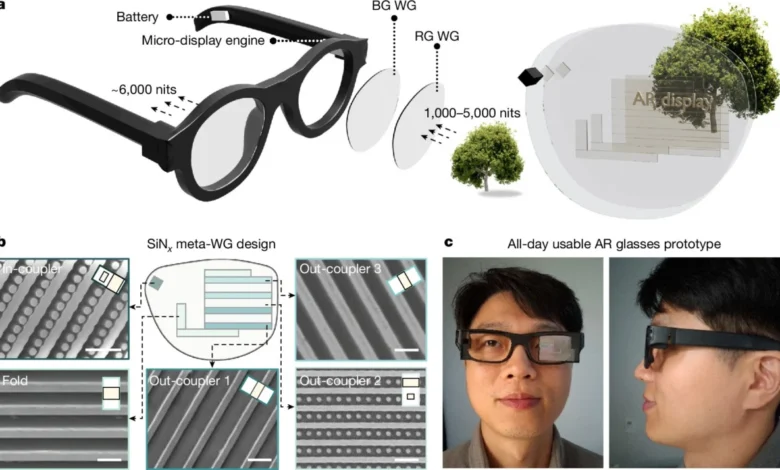
A study recently published in the journal Nature details a breakthrough in optical engineering: a 1.5mm thin-film system capable of projecting crisp, white text onto the real world while maintaining high visibility, even in challenging lighting conditions. This development marks a transition from theoretical optical research to a tangible proof of concept, potentially clearing the path for the next generation of consumer-grade wearable AR hardware.

The Physics of the "Eye-Box" Dilemma
To understand the magnitude of this discovery, one must first look at the mechanics of contemporary AR eyewear. Current devices typically rely on a small light engine that pumps imagery into a thin waveguide—essentially an "optical hallway" that bounces light internally until it reaches the user’s eye. A critical metric in this design is the "eye-box," which represents the spatial window where the projected image remains sharp and readable.
If an engineer attempts to expand the eye-box to accommodate different eye positions and facial structures, the system invariably suffers from light leakage. As the waveguide struggles to contain the light, the projected image loses its intensity, resulting in the "washed-out" effect that plagues current AR headsets.
The team led by Professor Junsuk Rho at POSTECH, alongside lead authors Jeong-Geun Yun and Hyunjung Kang from Samsung Research, addressed this by designing a nanoscale light-path architecture. By implementing a sophisticated light-trapping mechanism, they have effectively minimized light leakage while maintaining a generous 8-by-8-millimeter viewing window with a 30-degree field of view. This design ensures that the projected data remains vivid and legible even when the user’s eye shifts or the ambient light environment changes drastically.

Solving the Chromatic Imbalance
Beyond mere brightness, the challenge of color reproduction has historically hindered the transition from bulky prototypes to practical, everyday eyewear. Because red, green, and blue light waves interact differently with optical microstructures, AR displays have often struggled to produce a pure, consistent white light. This frequently results in a "tinted" display, where the projected interface appears color-shifted—an effect similar to low-quality projection equipment that has fallen out of calibration.
To rectify this, the research team utilized a tiered, stacked approach. By layering a blue- and green-transmitting film over a red- and green-transmitting substrate, the researchers were able to achieve color neutrality without significantly increasing the thickness of the lens. This "stacking" methodology allows for a balanced, high-fidelity image that mimics the clarity of a high-end smartphone screen while maintaining the transparency required for augmented reality.
Chronology of AR Advancements
This breakthrough follows a series of incremental developments in the wearable tech sector over the past twenty-four months. The push toward "invisible" computing has seen a pivot away from the bulky, visor-like headsets of the early 2020s toward a more discreet, glasses-first form factor.

- Early 2026: The introduction of materials like copper aluminum oxide (CuAlO2) by various research institutions, including KAIST and UNIST, began to suggest that optical components could be reduced in size by up to 120 times, fueling industry interest in ultra-thin waveguides.
- Mid-2026: Consumer brands like Viture and RayNeo released iterations of smart glasses that, while visually sleek, still struggled with the outdoor visibility issue that Samsung and POSTECH have now directly addressed.
- Late 2026: Samsung Research’s publication in Nature signifies the first major corporate-academic breakthrough in solving the outdoor contrast ratio problem, moving the goalposts from "functional indoors" to "usable anywhere."
While Samsung has already launched "Intelligent Eyewear"—devices primarily focused on AI-assisted shopping and information retrieval without integrated displays—this new optical system points toward a future where true, high-resolution AR overlays become a standard feature of the product line.
Implications for the Consumer Market
The broader implications of this research are substantial. The primary barrier to the mass adoption of AR has been the "dork factor"—the necessity of wearing large, opaque, or thick-framed devices to accommodate complex optics. If display components can be manufactured as thin as 1.5mm without sacrificing brightness, it enables the integration of AR into frames that are indistinguishable from standard prescription eyewear.
Furthermore, the integration of AI-based personalized image processing is the next phase of this development. As Professor Junsuk Rho noted, the ability to control light paths at the nanoscale opens the door for real-time, adaptive display adjustments. Future glasses could theoretically monitor the ambient lighting levels of a user’s environment and use AI to adjust the intensity and color balance of the display on a millisecond-by-millisecond basis.

Challenges Ahead: From Prototype to Product
Despite the excitement surrounding the Nature publication, industry analysts warn that a commercial rollout is not imminent. A significant gap exists between a lab-based proof of concept and a durable, mass-producible consumer electronic.
The research team is currently navigating several technical hurdles. First, the current prototype must meet stringent industry standards for average brightness, which is vital for outdoor safety—if a user cannot read a navigation arrow due to glare, the device becomes a liability. Second, the issue of "rainbow artifacts"—a common diffraction byproduct in thin-film optics—must be minimized before the hardware can be considered ready for public use. Finally, the manufacturing cost of such high-precision, nanoscale-layered optics remains high. Moving from the small-batch fabrication of a research lab to the high-volume manufacturing lines required for millions of consumer units will necessitate significant investment in new lithography and thin-film deposition techniques.
Broader Industry Context
Samsung’s involvement in this research is part of a larger, aggressive push into the wearables market. As competition with companies like Meta and Apple intensifies, the ability to deliver a superior visual experience will likely become the primary differentiator for the next generation of smart devices.

While the Galaxy Fit series continues to serve as the entry-level tier for Samsung’s wearable ecosystem, the company is clearly positioning its future R&D toward devices that bridge the gap between simple fitness tracking and sophisticated, heads-up spatial computing. By solving the outdoor visibility problem, Samsung has effectively removed one of the last major technological barriers to making augmented reality a practical, daily-carry tool for the average consumer.
Whether these specific findings make their way into a consumer product in 2027 or 2028 remains to be seen. However, the precedent has been set: the era of washed-out, indoor-only AR is coming to a close. As the technology moves toward mass production and further optimization, the vision of lightweight, unobtrusive glasses capable of projecting crisp, daylight-readable information is finally shifting from the realm of science fiction into reality. The convergence of nanoscale materials science and advanced optical engineering is not merely an academic exercise; it is the blueprint for the next major evolution in human-computer interaction.