Abbott Laboratories Investigates Dual Cybersecurity Breaches as Ransomware Gangs Claim Theft of Millions of Patient Records and Proprietary Data

Abbott Laboratories, a global leader in medical devices and healthcare diagnostics, is currently navigating a complex cybersecurity crisis involving two separate and distinct digital intrusions. The Illinois-based multinational confirmed that it is investigating unauthorized access to internal legacy systems within its Cancer Diagnostics business, specifically involving infrastructure associated with its acquisition of legacy Exact Sciences assets. Simultaneously, the company is addressing a second, independent claim from a different threat actor alleging a breach of the LabCentral customer portal, a hub used by its Core Laboratory diagnostics division. These incidents highlight the escalating targeting of the healthcare and medtech sectors by sophisticated extortion groups, raising significant concerns regarding the security of patient data and proprietary corporate intelligence.
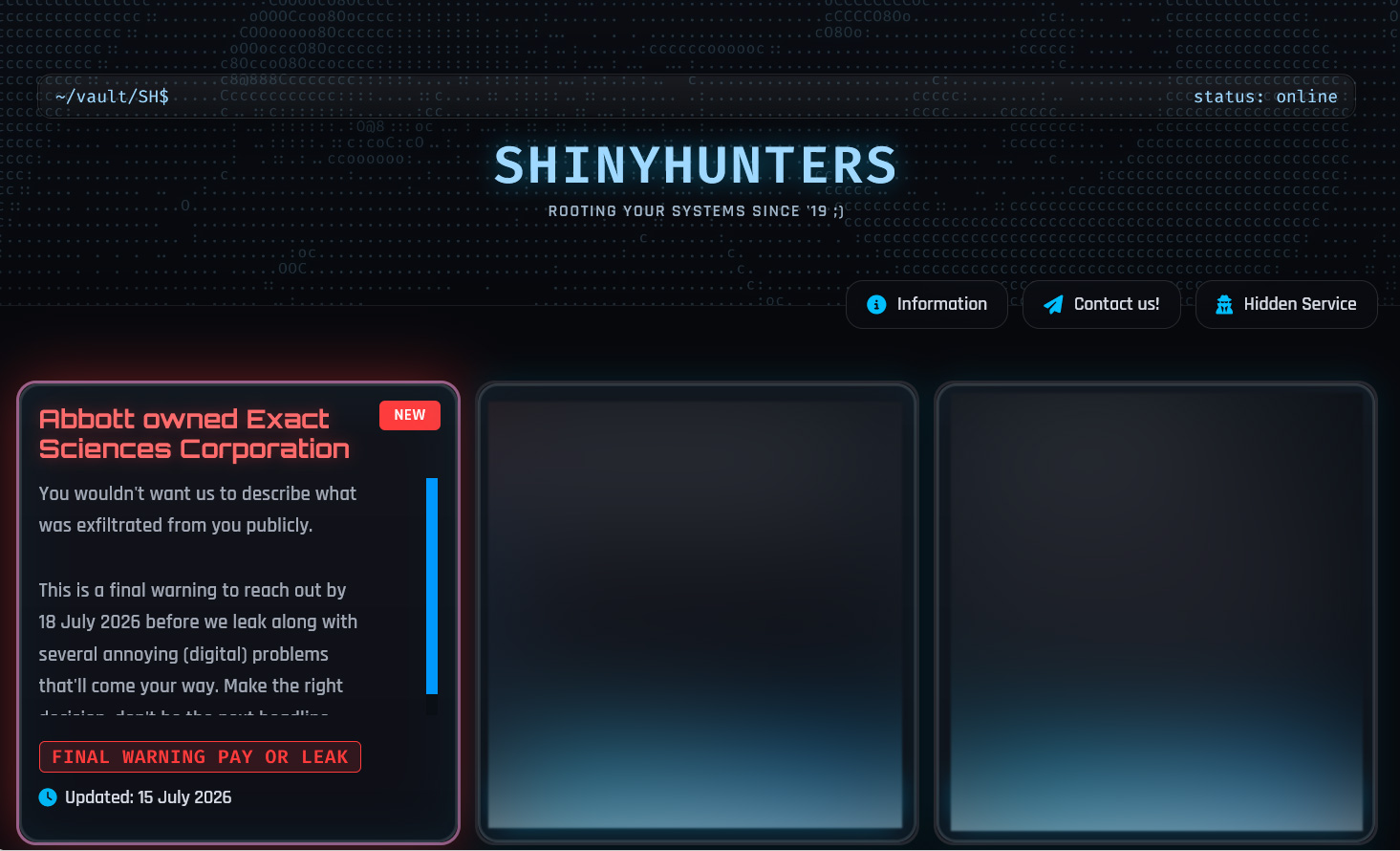
The situation first gained public attention when the notorious extortion collective known as ShinyHunters added Abbott Laboratories to its dark web leak site. The group initially set a deadline of July 18 for the company to enter negotiations to prevent the release of stolen data, a deadline that was subsequently extended to July 21. While Abbott has acknowledged the breach of its Cancer Diagnostics systems, the company has sought to minimize the perceived operational impact, stating that the incident was confined to a limited number of internal systems and did not disrupt manufacturing, lab operations, or patient services. However, the claims made by the attackers suggest a much more expansive and damaging exfiltration of sensitive information than the company’s initial statements might imply.
The ShinyHunters Intrusion: Vishing and SSO Compromise
The breach involving the Cancer Diagnostics business appears to be the result of a highly effective social engineering campaign. According to communications from ShinyHunters, the group gained access to Abbott’s network in mid-June through a "vishing" (voice phishing) attack. By impersonating IT personnel or other trusted entities, the attackers successfully manipulated several Abbott employees into surrendering their credentials. This allowed the threat actors to compromise a Microsoft Entra (formerly Azure Active Directory) single sign-on (SSO) account.
Once inside the SSO environment, the attackers leveraged the interconnected nature of modern enterprise software to move laterally across various Software-as-a-Service (SaaS) applications. ShinyHunters claims to have exfiltrated data from a wide array of critical business platforms, including ServiceNow, SharePoint, Databricks, and Coupa. The sheer volume of data allegedly stolen is staggering: the group claims to possess over 30 million rows of customer personally identifiable information (PII). This dataset reportedly includes full names, email addresses, phone numbers, physical addresses, and dates of birth. Most alarmingly, the group asserts that the haul includes more than one million Social Security numbers.
Beyond standard PII, the extortionists claim to have accessed deeply sensitive medical and corporate records. This includes over 22 million client notes detailing doctor-patient conversations and more than 20 million medical orders. If verified, this would represent one of the most significant breaches of patient confidentiality in recent years, carrying immense regulatory and legal implications under frameworks such as the Health Insurance Portability and Accountability Act (HIPAA) in the United States and the General Data Protection Regulation (GDPR) in Europe. The group also claims to have secured internal contracts, non-disclosure agreements (NDAs), and sensitive customer agreements, which could provide competitors or other malicious actors with a roadmap of Abbott’s business strategies and partnership structures.
The LabCentral Portal Incident: API Exploitation
As Abbott worked to contain the fallout from the ShinyHunters extortion attempt, a second threat actor operating under the handle ShadowByt3$ emerged with claims of a separate breach. This incident allegedly targeted the LabCentral customer portal, an externally facing platform used by Abbott’s Core Laboratory diagnostics business to provide technical documentation and support to its clients.
ShadowByt3$ informed security researchers that they gained access to the portal on July 4, 2026, by exploiting what they described as a "weak point" in the environment combined with compromised customer credentials. Unlike the broad sweep of the ShinyHunters attack, the LabCentral breach appears to have been a more surgical operation focused on technical and regulatory data. The attacker reportedly targeted specific API endpoints to slowly exfiltrate files over a period of several days.
The data allegedly stolen from LabCentral includes CE manufacturing certificates, operation manuals, technical specifications, and regulatory documentation. While ShadowByt3$ noted that no direct customer PII was taken in this specific incident, they claim to have obtained sensitive intellectual property and internal product requirement archives. Abbott has contested the severity of this particular claim, stating that the LabCentral portal is intended to house publicly available technical reference documents and does not contain proprietary or sensitive business information. Despite this, the unauthorized access to a customer-facing portal remains a significant security concern, as it demonstrates a vulnerability in the supply chain communication channel.
A Chronology of the Abbott Cybersecurity Crisis
The timeline of these events suggests a multi-week period during which Abbott’s internal security teams were likely unaware of the ongoing exfiltrations.
- Mid-June 2026: ShinyHunters initiates a vishing campaign against Abbott employees, successfully compromising Microsoft Entra SSO accounts.
- Late June to Early July 2026: Threat actors move laterally through Abbott’s SaaS environment, exfiltrating millions of records from SharePoint, Databricks, and other platforms.
- July 4, 2026: ShadowByt3$ gains access to the LabCentral portal via API exploitation and begins downloading technical documentation.
- Mid-July 2026: ShinyHunters lists Abbott Laboratories on its data leak site, issuing an initial ultimatum for July 18.
- July 17, 2026: Abbott issues an official statement confirming the Cancer Diagnostics incident and the engagement of law enforcement and third-party cybersecurity experts.
- July 18, 2026: The initial extortion deadline passes; ShinyHunters extends the deadline to July 21, citing ongoing developments.
- July 20, 2026: Details of the LabCentral breach emerge publicly as ShadowByt3$ provides proof of intrusion to media outlets.
Contextualizing the Threat: The Rise of MedTech Extortion
The targeting of Abbott Laboratories is not an isolated incident but rather part of a broader, aggressive trend where cybercriminal syndicates focus on the healthcare and medical technology sectors. These industries are viewed as high-value targets due to the extreme sensitivity of the data they hold and the critical nature of their operations. For an extortion group, the potential for a massive payout is higher when the victim company faces not only reputational damage but also the threat of multi-billion dollar regulatory fines and life-threatening service disruptions.
ShinyHunters, in particular, has established a formidable track record of high-profile breaches. In the past, the group has claimed responsibility for attacks on Microsoft, AT&T, Ticketmaster, and Santander Bank. More recently, they have pivoted toward medtech giants, having previously targeted Medtronic, OneMedical, and AdaptHealth. Their methodology—focusing on SSO accounts through social engineering—is particularly effective against large multinationals that rely on a sprawling ecosystem of cloud-based applications. By bypassing the traditional network perimeter and targeting the identity layer, they can access a wealth of data without ever needing to deploy traditional malware or ransomware.
Analysis of Implications and Regulatory Scrutiny
The dual breaches at Abbott Laboratories present several critical challenges for the company and the broader healthcare industry. First is the issue of "materiality." Under new Securities and Exchange Commission (SEC) rules in the United States, public companies are required to disclose any cybersecurity incident that they determine to be material within four business days. Abbott has currently stated that it does not expect the incident to have a material impact on its financial results. However, if the claims regarding the theft of 30 million PII records and millions of doctor-patient notes are verified, the resulting legal liabilities, class-action lawsuits, and regulatory penalties could significantly alter that assessment.
Furthermore, the breach of legacy systems—specifically those related to the Exact Sciences business—highlights the persistent danger of technical debt. When large corporations acquire smaller entities, they often inherit aging IT infrastructure that may not meet the parent company’s modern security standards. These "legacy" systems are frequently the weakest link in a corporate network, providing an entry point for attackers who then pivot to more modern systems.
From a patient safety perspective, while Abbott maintains that lab operations and patient services are unaffected, the psychological impact of a breach involving medical notes cannot be overstated. The disclosure of doctor-patient conversations is a profound violation of privacy that could erode trust in digital health platforms.

Official Responses and Next Steps
In its formal communications, Abbott has emphasized its commitment to security and its rapid response to the detected threats. "Abbott is investigating a cyber incident in which there was unauthorized access to a limited number of internal systems in our Cancer Diagnostics business only," the company stated. "We have activated our incident response procedures, engaged leading cybersecurity experts, and are working with law enforcement."
The company continues to monitor the situation and has not yet confirmed whether it will enter into negotiations with the extortionists. Traditionally, security experts and government agencies advise against paying ransoms or extortion demands, as it funds further criminal activity and offers no guarantee that the stolen data will be destroyed.
As the July 21 deadline approaches, the cybersecurity community and Abbott’s global customer base remain on high alert. The outcome of this investigation will likely serve as a pivotal case study in how major healthcare corporations manage concurrent breaches and the evolving tactics of identity-based extortion. For now, the focus remains on forensic analysis to determine the true extent of the data loss and the implementation of more robust multi-factor authentication (MFA) and employee training to prevent future vishing successes.
Related posts: