The Evolution of RAG and the Chunking Problem
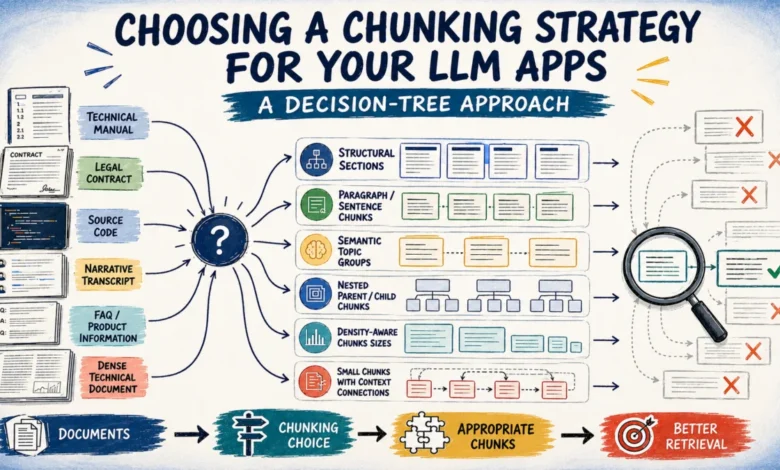
In the early days of RAG, developers often treated documents as monolithic blobs of text, arbitrarily splitting them into fixed-length segments of 512 or 1,024 tokens. While this method was computationally efficient, it frequently severed sentences, tables, and logical arguments, leading to "context fragmentation." This issue creates a systemic failure in the retrieval pipeline: when a user asks a specific question, the vector database may return a chunk that is technically similar in vector space but lacks the semantic anchors necessary for the LLM to construct a coherent answer.
Data scientists have since recognized that chunking is not merely a preprocessing step but a strategic configuration that dictates the limits of an application’s intelligence. The challenge is balancing the "semantic integrity" of the data with the constraints of embedding models, which operate within strictly defined input token windows.
A Structured Decision-Tree Framework
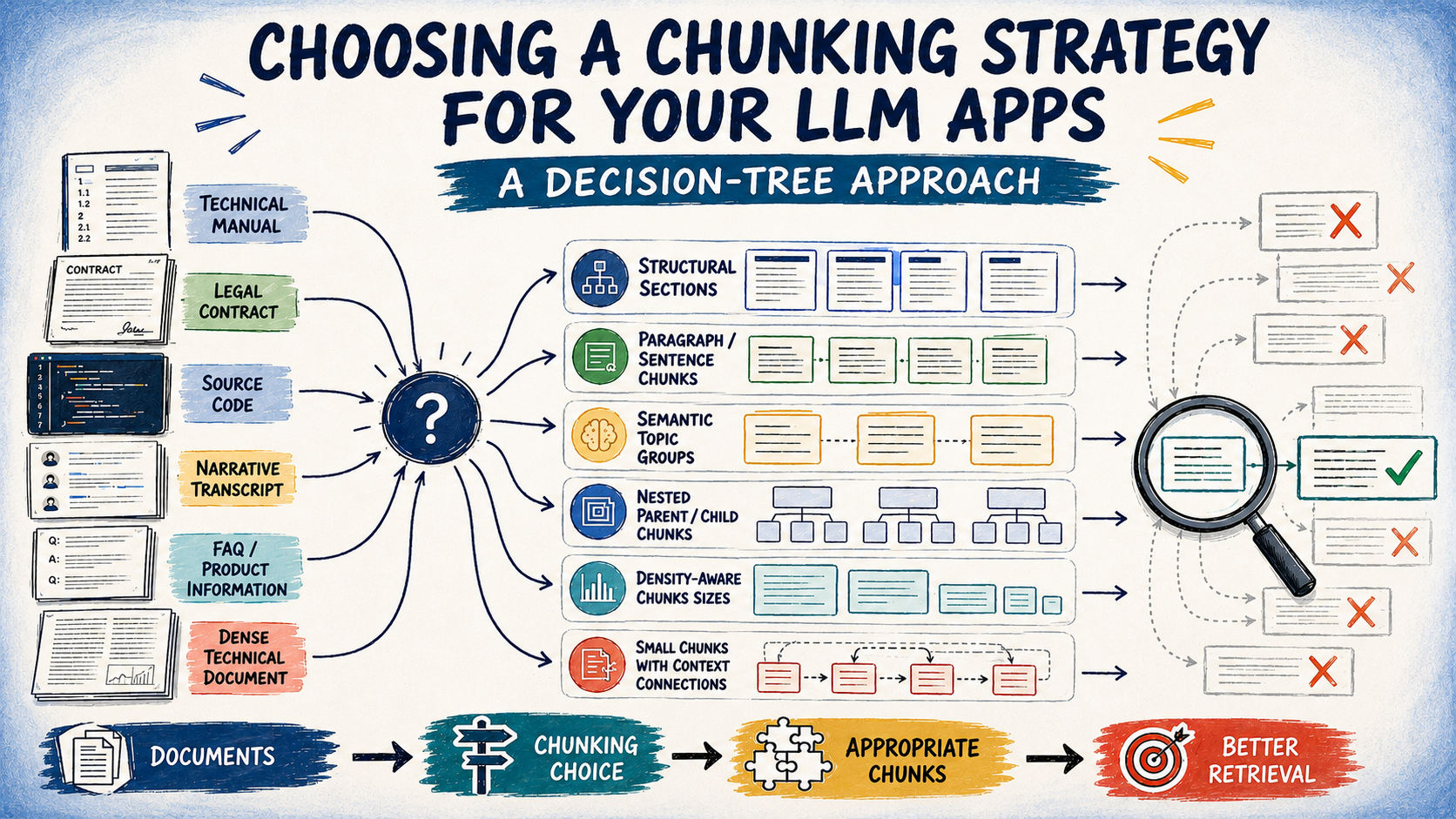
To address these challenges, engineers are moving toward a systematic decision-tree approach. By evaluating documents based on their innate structure and the specific needs of the retrieval task, developers can choose from a range of strategies, including fixed-size, recursive, semantic, hierarchical, and agentic chunking.
1. The Necessity of Preprocessing
The decision process begins with a fundamental question: does the document require segmentation at all? For compact information—such as FAQ entries, specific product metadata, or isolated configuration files—the answer is often no. By embedding these documents in their entirety, developers avoid the overhead of managing fragment relationships, thereby preserving the original intent of the content. If the document exceeds the context window or contains multifaceted topics, the workflow proceeds to structural evaluation.
2. Evaluating Internal Document Architecture
When content is structured, such as technical documentation in Markdown or legal filings in PDF format, the document’s inherent hierarchy—headers, sections, and tables—serves as the optimal boundary. Document-based chunking utilizes these natural break points. This is particularly effective in corporate environments where documents are authored with clear signposting. By maintaining these boundaries, the system ensures that the retriever captures complete thematic units rather than arbitrary segments.
3. Addressing Contextual Dependencies
Complex documents, such as academic research or legal contracts, often feature "cross-document dependencies," where a term defined in the introduction is essential for interpreting later sections. For these use cases, late chunking has emerged as a high-performance solution. In this model, the full document is processed by a long-context embedding model, and chunks are derived post-processing. This allows each individual segment to retain a "semantic trace" of the entire document, bridging the gap between localized retrieval and global context.
4. Balancing Information Density and Complexity
Not all content is created equal. A technical manual may be dense with facts, while a narrative report may be sparse. Adaptive chunking addresses this disparity by adjusting segment size based on information density, ensuring that high-value sections remain consolidated while tangential content is streamlined. Furthermore, hierarchical chunking—a method that stores both summary-level and detail-level chunks—is increasingly used for systems that must handle both broad, exploratory queries and highly specific, targeted requests.
Comparative Analysis of Chunking Strategies
| Strategy | Primary Utility | Complexity Level |
|---|---|---|
| Fixed-size | Rapid prototyping | Low |
| Recursive | Uniform, large-scale corpora | Moderate |
| Semantic | Unpredictable, non-structured text | High |
| Agentic | Heterogeneous data collections | Very High |
| LLM-based | High-stakes, precision-required tasks | Highest |
Economic and Technical Implications
The choice of a chunking strategy carries significant implications for the Total Cost of Ownership (TCO) of an AI system. LLM-based chunking, which uses a model to interpret and segment text, offers the highest retrieval accuracy but introduces substantial latency and token consumption costs. Conversely, recursive chunking offers a cost-effective, "good enough" middle ground for most uniform datasets.
Industry analysts observe that companies often fail to consider the "caching" potential of their preprocessing. For large-scale data lakes, performing complex, agentic-driven chunking on every retrieval cycle is unsustainable. Best practices suggest that metadata and chunk boundaries should be calculated at the point of ingestion and cached within the vector database, transforming a dynamic, costly process into a static, highly optimized lookup.
Troubleshooting and Performance Optimization
Even the most robust strategies encounter failure modes. A common symptom of misconfiguration is "mid-sentence truncation," where the retriever returns fragments that lack syntactic completeness. In these instances, the data suggests that switching from a structure-blind approach to a recursive, rule-based method typically resolves the issue.
Furthermore, if semantic chunking results in highly inconsistent segment counts, it is often a sign of a miscalibrated similarity threshold. Tightening this threshold or augmenting the process with LLM-assisted validation can stabilize the system. For organizations managing heterogeneous collections—where the data ranges from code repositories to unstructured emails—agentic chunking is becoming the industry standard, despite its complexity. By delegating the choice of strategy to an agent, the system can dynamically adapt to the specific document type at the point of ingestion.
Broader Impact on Enterprise AI
The shift toward more intelligent chunking reflects a broader maturity in the enterprise AI space. As the initial "hype" cycle of generative AI gives way to rigorous engineering, the focus has shifted from the power of the model itself to the quality of the data pipeline.
Retrieval-augmented generation is not a "set-it-and-forget-it" technology; it is a living system. The decision-tree methodology described here empowers developers to treat their data not as a static input, but as an active component of the model’s reasoning process. By aligning the granularity of the data with the logic of the retrieval task, organizations can achieve a significant increase in the precision and reliability of their AI applications, ultimately reducing hallucinations and increasing user trust.
As the ecosystem continues to evolve, the development of standardized, automated chunking pipelines will likely become a core competency for any organization seeking to leverage LLMs for high-stakes, knowledge-intensive tasks. The objective remains clear: provide the model with the right context, at the right time, in the right size, to ensure that the output is not just generated, but fundamentally accurate.