Volkswagen’s Zwickau Plant Opens Industrial Dismantling Line to Diversify Revenue Amid EV Pressures

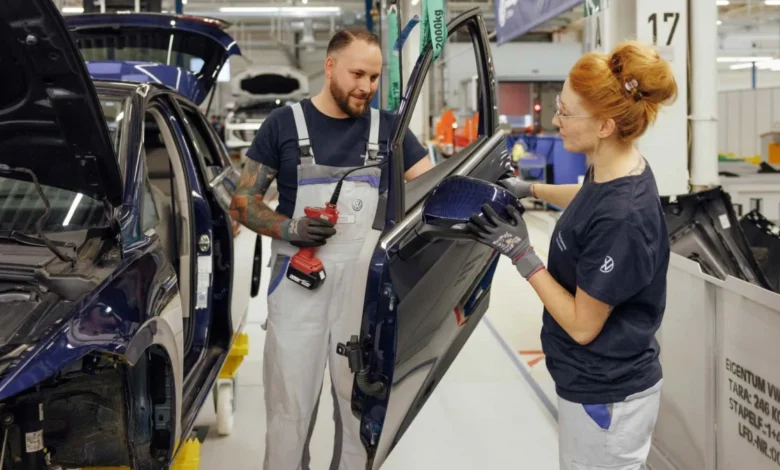
Volkswagen’s historic Zwickau factory in Germany, which spent years and billions of euros transforming into a dedicated hub exclusively for the mass production of battery-electric vehicles (BEVs), has embarked on a surprising new operational chapter. Moving beyond simply assembling new cars, the facility has officially inaugurated an industrial dismantling line, creating an entirely new revenue stream aimed at used parts resale and high-efficiency material recovery.
The introduction of this specialized dismantling facility arrives at a critical financial crossroads for the German automotive giant. As Volkswagen navigates a complex European electric vehicle market characterized by softening demand growth, compressed profit margins, and fierce global competition, initiatives that maximize resource efficiency and unlock secondary market revenue have shifted from experimental projects to strategic necessities.
A Massive Industrial Evolution: From Combustion to Electrons
To understand the weight of Zwickau’s new mission, one must examine the monumental transformation the plant underwent over the past several years. Beginning in 2018, Volkswagen committed a staggering €1.2 billion to completely overhaul the Saxony-based facility. The goal was nothing short of total industrial conversion: phasing out the production of internal combustion engine (ICE) vehicles entirely to construct a state-of-the-art production ecosystem exclusively for electric cars.
The timeline of Zwickau’s conversion highlights the rapid pace of Volkswagen’s initial EV push:
- November 2019: Production of the Volkswagen ID.3 hatchback officially begins, marking the dawn of the MEB (Modular Electric Drive Matrix) platform era.
- June 2020: The final traditional combustion vehicle rolls off the Zwickau assembly lines, turning a historical page on decades of gasoline and diesel car manufacturing at the site.
- January 2022: The structural transformation is formally completed with the integration and launch of the Audi Q4 e-tron and Cupra Born sister models, alongside Volkswagen’s own ID.4 and ID.5.
Through heavily retooled production lines, elevated levels of automation, and extensive workforce retraining programs, Zwickau evolved into the primary manufacturing heartbeat for the Volkswagen Group’s MEB-based electric vehicle portfolio. Today, the facility possesses the capacity to build up to six distinct battery-electric models spanning multiple group brands.
Inside the New Eight-Stage Dismantling Operation
Despite its status as a premier EV assembly plant, Zwickau faces long-term planning realities, with no vehicle production officially scheduled at the site beyond 2031. To bridge operational gaps, optimize sustainability metrics, and diversify income, Volkswagen constructed an advanced, eight-stage industrial dismantling line at the plant.
The construction and regulatory approval process for the dismantling line was remarkably swift, taking a mere nine months and concluding three months ahead of schedule. Volkswagen attributed this efficiency largely to the strategic reuse of existing manufacturing equipment, which significantly curbed capital expenditure.
Initially, the dismantling line is processing pre-production vehicles—prototypes and test units that cannot be legally or commercially sold to retail customers. However, operations are slated to scale significantly. By 2027, the line is projected to process roughly 4,100 vehicles annually across a two-shift operational schedule. Crucially, the initiative has secured employment for 100 workers, all of whom underwent specialized retraining to transition from vehicle assembly to precision teardown and material sorting.
Capitalizing on the Secondary Parts Market
A core driver behind Zwickau’s new dismantling venture is the lucrative market for recycled and recovered automotive components. Volkswagen began commercially offering usable original parts harvested at the facility as early as July. According to factory reports, components such as body panels, doors, bumpers, electric motors, and transmission assemblies have experienced particularly robust demand.
These verified second-life components are channeled directly into the market through Volkswagen’s established dealer and service networks, independent automotive workshops, and certified spare parts retailers. The overarching corporate strategy is twofold: to provide vehicle owners with more affordable repair alternatives and to deter premature vehicle write-offs, thereby extending the lifecycle of older vehicles currently on European roads.
While the consumer benefits are clear, industry analysts note that Volkswagen has yet to disclose comprehensive retail metrics regarding the program. Specifics concerning pricing structures, overall sales volumes, warranty terms, and the exact multi-point inspection protocols used to certify components before resale remain undisclosed. Furthermore, while the facility primarily handles electric platforms, photographic evidence from the plant suggests that traditional combustion models—such as the Volkswagen Golf—are also being processed, indicating that the parts business is designed to capture a broad cross-section of the legacy fleet.
Precision Material Recovery and Circular Economy Goals
Beyond harvesting individual mechanical and structural components, the Zwickau dismantling line serves as a vital engine for closed-loop material recycling, focusing heavily on plastics and high-value composites.
In traditional automotive shredding, different types of plastics often get mixed together, rendering the resulting recyclate low-grade and suitable only for rudimentary applications. Zwickau’s manual and semi-automated dismantling protocol allows workers to meticulously separate various polymer types prior to shredding. This presorting preserves the physical and chemical integrity of the plastics, ensuring they retain maximum utility for future automotive applications.
Volkswagen has highlighted the efficiency of this process, noting that high-grade plastic recovered from a single dismantled vehicle can supply sufficient recycled raw material for components spread across up to three newly manufactured cars.
Building on this momentum, Volkswagen is actively looking to expand its broader recycling footprint. The automaker, alongside the Saxony state government—which has pledged €10.7 million—is planning investments of up to €90 million into regional recycling infrastructure. Over the long term, these expanded circular-economy initiatives have the potential to support up to 1,000 jobs in the region.
Broader Market Implications and Financial Pressures
The launch of the Zwickau dismantling line does not exist in a vacuum; it occurs against a backdrop of acute financial strain within Volkswagen’s passenger car division. While the automaker continues to scale its overall battery-electric vehicle deliveries, structural hurdles persist. Manufacturing costs for EVs remain stubbornly high, and profit margins on electric models continue to lag significantly behind their traditional internal combustion counterparts.
This margin compression has forced executive leadership in Wolfsburg to enact strict budgetary discipline across the board. Notably, the financial squeeze prompted Volkswagen to temporarily pause the development of its upcoming electric Golf hatchback until capital expenditure can be more comfortably absorbed by the balance sheet.
Against this backdrop, the Zwickau dismantling line represents an intriguing operational experiment. While it introduces a novel revenue stream and aligns perfectly with European Union directives regarding vehicle end-of-life recycling and circularity, its long-term profitability at industrial scale has yet to be fully proven. It remains an open question whether parts harvesting and material recovery can generate sufficient volume and financial return to fundamentally alter the long-term economic outlook for a massive manufacturing plant like Zwickau past 2031.
For now, Volkswagen is positioning Zwickau not just as a monument to Europe’s electric vehicle transition, but as a testing ground for the entire automotive lifecycle. By bridging the gap between vehicle production, component reuse, and raw material recovery, the German automaker is attempting to squeeze maximum value out of every vehicle that enters its ecosystem—whether it is rolling off the assembly line or being carefully taken apart piece by piece.