MacSync Malware Evolves to Weaponize Public iCloud Calendars for Stealthy macOS Payload Delivery

Cybersecurity researchers have uncovered a sophisticated new campaign involving an advanced variant of the MacSync information-stealing malware, which has adapted its infection vectors to abuse legitimate cloud infrastructure. According to a detailed technical analysis published by Kaspersky, the Swift-based macOS threat now utilizes public iCloud calendar events to securely deliver fresh payloads and execute hidden commands on compromised Apple systems. This latest evolution highlights a growing trend among cybercriminals: leveraging trusted, native cloud services to bypass traditional network security controls and blend malicious traffic with everyday user activity.
The discovery underscores the continuous adaptation of macOS-targeted malware. While early iterations of MacSync shared lineage with the notorious AMOS (Atomic macOS Stealer) family, recent variants have broken away to incorporate modular architectures, sophisticated social engineering campaigns, and stealthy persistence mechanisms. As threat actors increasingly pivot toward Apple’s desktop ecosystem—long perceived by casual users as inherently immune to malware—security analysts warn that the barriers to entry for sophisticated macOS attacks are dropping significantly.
Evolution and Background of the MacSync Threat Landscape
MacSync first materialized in the threat landscape around April 2025, quickly establishing itself as a potent weapon in the cybercriminal arsenal. Initially distributed via deceptive social engineering strategies, the malware has frequently appeared in the wild through "ClickFix" campaigns—a tactic where victims are tricked into executing terminal commands under the guise of fixing a software error, updating an application, or installing popular developer tools like Homebrew and macOS disk space analyzers.
Throughout its lifespan, MacSync has relied heavily on multifaceted distribution chains. Attackers have packaged the malware as free utilities, cracked versions of commercial software, or entirely novel applications designed to lure unsuspecting users. In one prominent campaign identified by researchers, threat actors engineered a fake cryptocurrency wallet application named "Toria." This fraudulent app featured a professionally designed, dedicated website and was heavily promoted across various social media platforms to drive traffic and maximize infections.

As the malware matured, its creators moved beyond simple information theft, expanding its capabilities to include modular components. This modular approach allows operators to deploy specific tools tailored to the environment of the compromised machine, minimizing the malware’s overall footprint and reducing the likelihood of detection by modern endpoint detection and response (EDR) solutions.
The iCloud Calendar Delivery Chain: Mechanics of the Attack
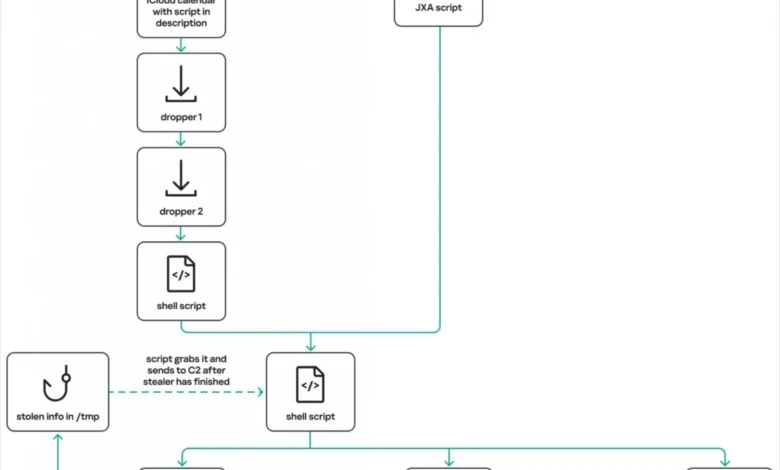
The most notable innovation in the latest MacSync campaign is its complex, multi-stage delivery mechanism utilizing Apple’s own iCloud infrastructure. Kaspersky researchers detailed a two-pronged distribution method, with the more sophisticated variant relying entirely on public calendar events to orchestrate the infection chain.
In this attack vector, a lightweight initial downloader script fetches hidden commands embedded directly within the description field of a public iCloud calendar event. The downloader then feeds this retrieved calendar data straight into the native macOS Unix shell, zsh. Because calendar event descriptions typically contain unstructured human-readable text, the vast majority of the calendar data produces syntax errors when executed by the shell. However, the threat actors ingeniously place targeted malicious commands directly after the standard DESCRIPTION: line marker.
Once executed, these commands quietly fetch a compressed archive containing subsequent malware components from iCloud. Inside the archive is a specialized application bundle acting as a dropper, which initiates further multi-stage processes that ultimately pull down the core MacSync infostealer payload. By weaponizing iCloud calendars—a service routinely allowed through corporate and personal firewalls—the attackers ensure seamless, unhindered communication with their command-and-control infrastructure.
The New Objective-C Backdoor and Persistent Surveillance
Once MacSync successfully establishes a foothold on a victim’s machine, it deploys a dual-pronged assault. The core infostealer module operates much like its predecessors, systematically harvesting sensitive data. It targets browser histories, cookies, saved user credentials, cryptocurrency wallet extensions and associated application data, Telegram messenger databases, the macOS Keychain file, detailed system and hardware configurations, as well as configuration files for developer utilities including SSH, AWS, Kubernetes, and Git.
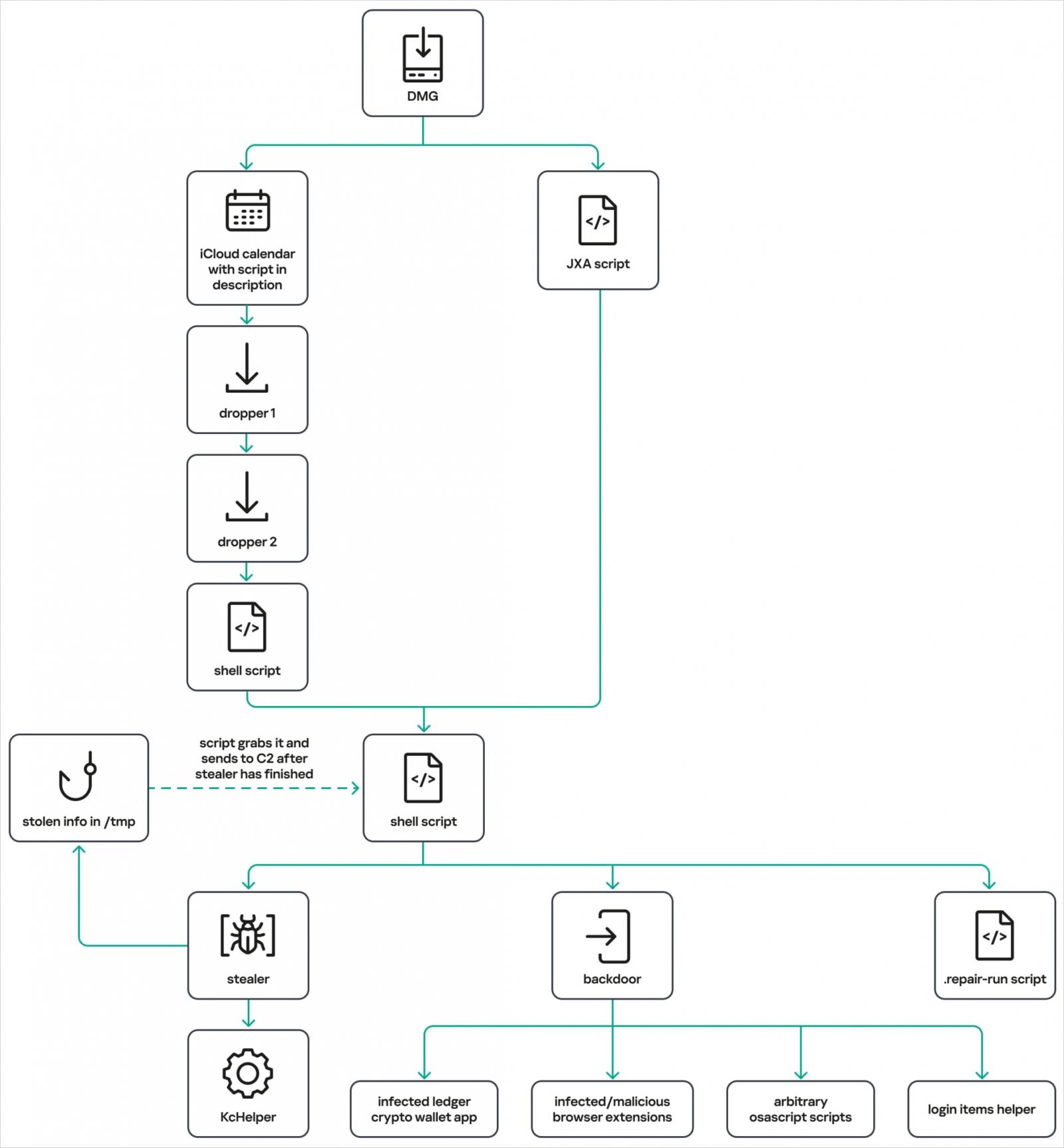
However, the introduction of a completely new Objective-C backdoor module significantly elevates the threat level. Disguised cunningly as Finder—the fundamental, trusted file manager built into every macOS system—this backdoor is engineered for long-term espionage and control.
During installation, the backdoor embeds itself deeply into the operating system. It establishes persistence by registering a new LaunchAgent, modifying the user’s .zshrc shell profile, and installing global Git hooks. To prevent the victim from realizing their system has been compromised, the malware actively terminates native macOS notification processes, effectively suppressing any system alerts or warning dialogs that might otherwise draw the user’s attention.
While researchers were unable to fully analyze the AppleScript code executed by the backdoor due to technical visibility limitations, they successfully inferred the operational purposes of various backdoor commands based on their internal names and status messages. Additionally, analysts identified a cryptic command designated as live_browser, which downloads and executes an auxiliary component known as sn_relay. The precise functionality and ultimate objective of sn_relay remain undetermined, representing a persistent blind spot that security teams continue to investigate.
Broader Implications for Enterprise and Consumer Security
The weaponization of cloud services like iCloud for malware delivery signals a troubling maturation in macOS-focused cybercrime. Historically, malware authors concentrated the vast majority of their efforts on the Windows operating system, leaving macOS security tooling to evolve at a slower pace. The rapid professionalization of macOS infostealers, evidenced by MacSync’s modular design and creative use of native Apple services, demonstrates that threat actors view Apple devices—frequently used by software developers, executives, and financial sector employees—as high-value targets.
Furthermore, the reliance on social engineering tactics such as ClickFix highlights that technical controls alone are insufficient to prevent these infections. When users are actively manipulated into pasting malicious commands into their terminals or authorizing installations from untrusted sources, the operating system’s built-in safeguards are effectively bypassed with the user’s own administrative privileges.
Industry Recommendations and Defensive Best Practices
In response to the evolving MacSync campaign, cybersecurity experts and industry analysts are urging both individual consumers and enterprise security teams to adopt heightened vigilance regarding macOS security hygiene.
First and foremost, users are strongly advised to avoid executing raw commands found in online forums, social media posts, or troubleshooting guides—particularly those instructing the user to paste text into the Terminal or zsh shell. Additionally, individuals should exercise extreme caution when downloading disk image (DMG) files or applications from unofficial websites, promotional social media links, or suspicious third-party software repositories.
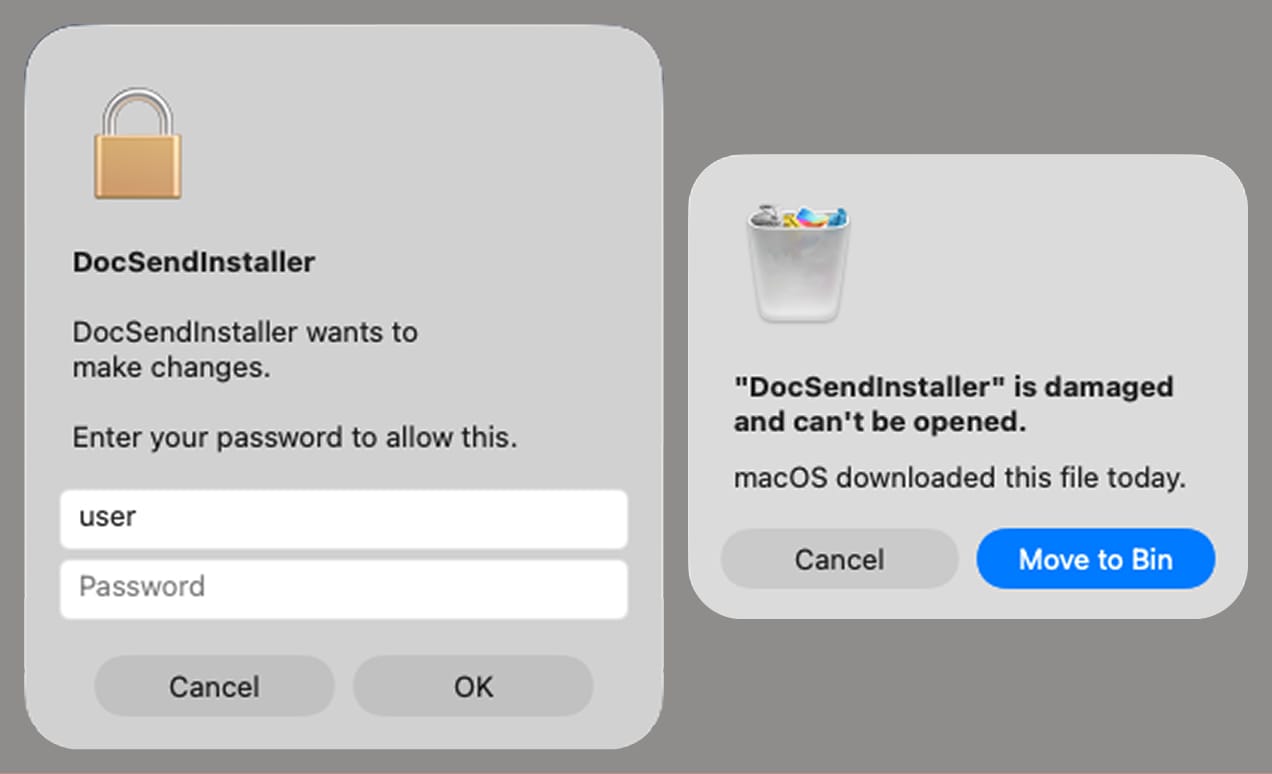
Security professionals emphasize that administrative password prompts on macOS should never be treated lightly. If an application or script requests elevated privileges unexpectedly, users should halt the process and verify the software’s authenticity through trusted channels. Enterprise environments should ensure that endpoint protection solutions are updated with the latest behavioral detection rules capable of spotting unauthorized shell modifications, unexpected LaunchAgent creations, and abnormal use of native scripting languages tied to cloud resource queries.
As threat actors continue to refine their methodologies and find novel ways to abuse trusted cloud infrastructure, the cybersecurity community must remain proactive in analyzing these emerging vectors to safeguard the growing population of macOS users worldwide.
Related posts: