Liquid Web Named Best VPS Hosting Provider Overall Despite Complex Pricing Structures and Hidden Management Costs

Since its inception in 1997, Liquid Web has carved out a distinct niche within the crowded digital infrastructure market. Rather than competing for the budget conscious, low-end consumer segment dominated by shared-hosting bundles, the company has consistently focused its offerings on small-to-medium enterprises, digital agencies, developers, and high-traffic online properties. Its specialized ecosystem spans cloud virtual private servers (VPS), managed virtual private servers, dedicated hardware configurations, and specialized managed platforms optimized for WordPress and WooCommerce environments. While this dedicated specialization grants the provider a level of infrastructure depth that standard hosting providers rarely match, it simultaneously introduces a layer of complexity regarding plan selection, pricing transparency, and configuration options that prospective clients must carefully navigate.
Examining the Current Plan Structures and Financial Commitments
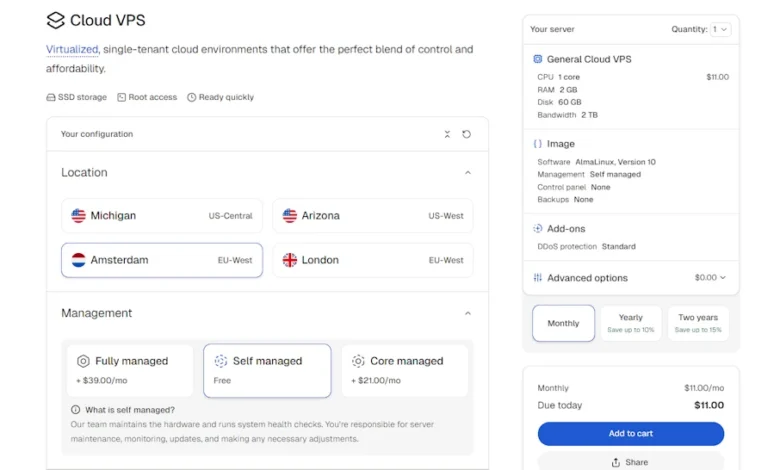
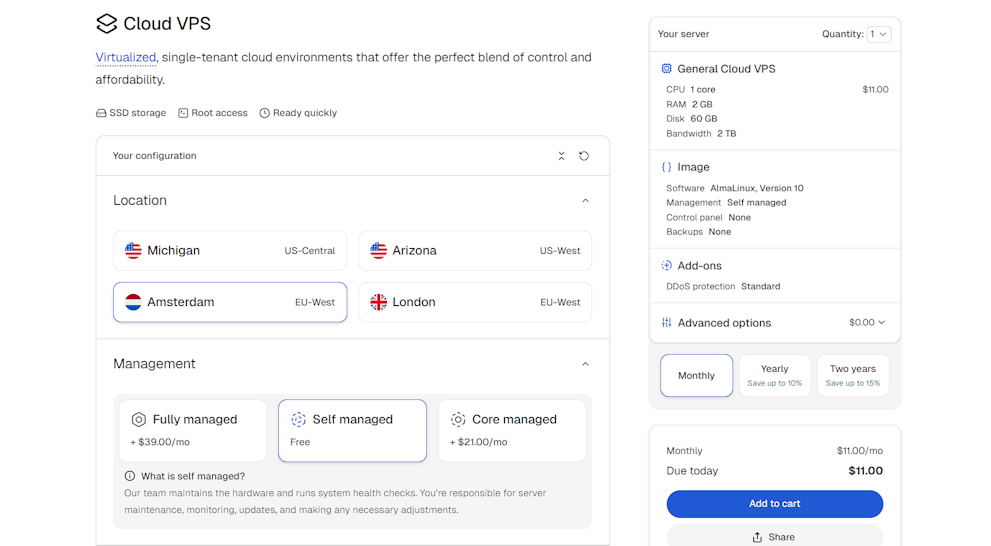
The financial architecture of Liquid Web’s hosting services requires careful scrutiny from enterprise buyers and independent developers alike. On paper, the company’s introductory entry-level Cloud VPS configuration is marketed at an attractive price point of $11 per month. This baseline tier provides a single CPU core, 2GB of RAM, 60GB of solid-state drive (SSD) storage, and 2TB of monthly data transfer bandwidth.
However, this entry-level pricing model comes with significant operational caveats. The $11 tier applies strictly to self-managed infrastructure. Clients who purchase this baseline package receive a raw server with no pre-installed control panel, no automated backup solutions, and zero management oversight. The consumer assumes complete administrative responsibility for the server’s operating system, security patch management, software updates, and application maintenance. Interestingly, data center location does not impact this base rate, with Amsterdam-based nodes priced identically to their United States counterparts.
Discrepancies between public-facing marketing collateral and live sales channels have also been a point of friction for buyers. While legacy promotional pages have occasionally advertised discontinued entry points—such as a 1GB server tier—live sales representatives direct customers toward the modernized $11 baseline or active promotional bundles, such as a discounted 4GB, two-vCPU server reduced from $17 to $8.50 for its initial two-month term.
The financial reality shifts dramatically once enterprise-grade features are incorporated into the package. According to verified corporate pricing schedules, upgrading that same 2GB server to include full server management alongside a cPanel Admin Cloud 5 license elevates the monthly expenditure to $86. Factoring in an automated enterprise backup solution, such as the entry-level Acronis option which taddles an extra $22 per month for 100GB of storage with configurable daily, weekly, and monthly retention cycles, pushes the total operating cost to $108 monthly. For organizations seeking a fully managed out-of-the-box experience without building upward from a bare metal baseline, pre-configured managed VPS packages officially start at $72 per month for two vCPUs, 4GB of RAM, 80GB of SSD storage, and 3TB of bandwidth before additional software licenses are applied.

By contrast, Liquid Web’s managed WordPress hosting division—marketed under the Spark brand—presents a much more approachable financial entry point for single-site operators. Starting at $5 per month under annual billing terms, the Spark Launch tier supports a single website with 15GB of storage, 2TB of bandwidth, unlimited visitor traffic, automated daily backups retained for seven days, integrated staging environments, Cloudflare Enterprise integration, robust DDoS protection, and an advanced web application firewall. Consequently, industry analysts recommend traditional VPS configurations primarily for complex workloads or environments demanding strict server-level root access, whereas single-site WordPress administrators are routinely steered toward the Spark ecosystem.
Prospective buyers must also account for rigid procurement policies. Liquid Web does not offer a free trial period for its Cloud VPS infrastructure, and corporate policy dictates that monthly Cloud VPS purchases are strictly non-refundable. This policy places a premium on upfront architectural planning, requiring system administrators to precisely determine their data center location, management tier, operating system, and backup protocols prior to executing a financial transaction.
Granular Customization and Ease of Use in Server Management
Despite the absence of a pre-purchase sandbox or demo environment allowing users to explore the administrative portal beforehand, hands-on evaluations of Liquid Web’s customer dashboard reveal a clean, highly intuitive user interface. The company’s server configurator is notable for its exceptional granularity. Depending on the chosen product line, users can fine-tune hardware specifications, select geographic data center zones, designate operating system distributions, and choose between self-managed, core-managed, and fully managed support levels. Furthermore, administrators can deploy industry-standard control panels such as InterWorx, Plesk, or cPanel directly from the provisioning menu.
For self-managed accounts, users retain complete root-level privileges to execute custom configurations. Conversely, fully managed support tiers delegate vital maintenance tasks to Liquid Web’s internal engineering teams, encompassing operating system updates, control panel patches, proactive server monitoring, firewall hardening, and advanced software troubleshooting.
Deploying foundational applications like WordPress within this ecosystem proves relatively frictionless. Modern provisioning tools, including AI-assisted site-building utilities, help developers rapidly establish a functional baseline. Furthermore, importing existing WordPress and WooCommerce architectures into Liquid Web servers generally proceeds without the database mapping or credential authentication hurdles commonly reported with competing infrastructure providers like InMotion Hosting.
To ease transitions for migrating businesses, Liquid Web maintains a dedicated professional migration team. For clients subscribing to managed service tiers, this internal team coordinates the wholesale transfer of website files, email accounts, databases, and control panel configurations with minimal service disruption. This concierge-style migration support represents a primary justification for businesses—particularly digital agencies managing revenue-generating client properties—to absorb the higher costs associated with managed infrastructure. However, because domain registration services are not natively bundled into these server packages, Liquid Web is poorly positioned for retail consumers seeking an all-in-one ecosystem for domain registration, email hosting, site building, and budget web hosting.
Rigorous Performance Benchmarks and Infrastructure Reliability
Performance metrics represent Liquid Web’s most compelling market advantage. In standardized server benchmark evaluations measuring core processing efficiency, memory throughput, file input/output (I/O) operations, database query handling, and network data transfer speeds, Liquid Web achieved an impressive overall server rating of 8.1 out of 10, significantly outperforming competitors such as InMotion Hosting, which averaged a score of 6.1 in identical tests.
Granular breakdowns of these benchmark evaluations highlight the platform’s technical strengths:
- Small-file I/O operations scored a maximum 10 out of 10.
- Local file copying and retrieval attained a 9.66 rating.
- Simple database execution efficiency reached 9.72.
- Complex database query processing scored 9.64.
- Network download bandwidth efficiency recorded a 9.53.
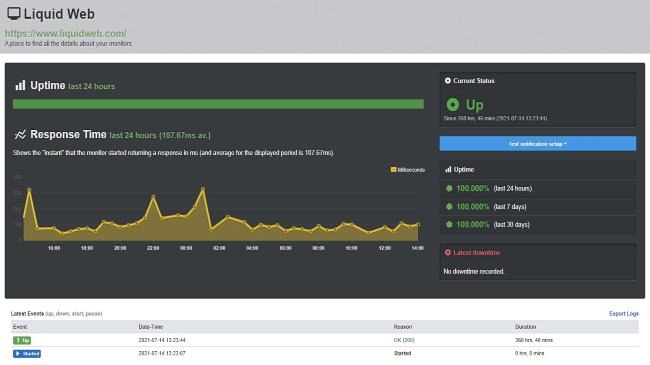
These empirical results validate the platform’s positioning as an elite hosting provider for resource-intensive business applications. External performance audits further corroborate these findings. Independent monitoring of Liquid Web’s primary corporate web properties via GTmetrix yielded a top-tier "A" performance grade and a 100% efficiency score, alongside stable real-world load behaviors. Over extended two-week uptime tracking periods utilizing automated monitoring services like UptimeRobot, platforms hosted on Liquid Web’s infrastructure recorded zero downtime coupled with average server response times hovering near 107 milliseconds.
Backing this performance hardware is a robust service level agreement (SLA) guaranteeing 100% network uptime. Crucially, the corporate SLA guarantees that core routing hardware within Liquid Web’s proprietary network data centers will remain continuously accessible from the global internet, rather than ensuring uninterrupted uptime for every individual software application running on a client’s server. Even with this explicit distinction, the corporate guarantee offers significantly stronger assurances than the standard 99.9% or 99.99% availability metrics common among general-purpose web hosts.
Support Infrastructure and Technical Responsibilities
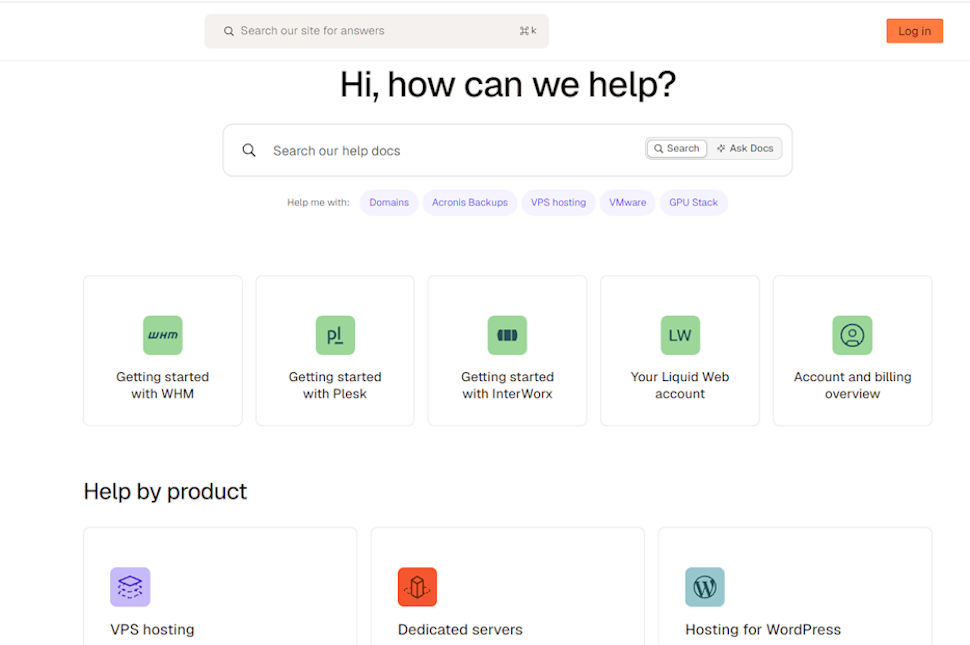
Liquid Web supports its client base through a 24/7/365 technical assistance framework, the operational scope of which scales directly with the chosen management tier. Self-managed clients receive hardware and network-level support, whereas core-managed and fully managed subscribers enjoy proactive operating system maintenance, security monitoring, and application-level troubleshooting. This support structure is supplemented by extensive documentation libraries, live chat portals, and ticketing systems.
Empirical testing of pre-sales and technical support response channels reveals strong adherence to internal metrics. Initial human contact via live chat typically occurs within 20 seconds—comfortably outperforming the company’s advertised 59-second response target. While comprehensive, substantive answers to complex infrastructure inquiries generally require a short verification window of roughly four minutes, support representatives consistently provide detailed, transparent technical documentation without evasive sales rhetoric.
It is worth noting that while Liquid Web heavily promotes its rapid initial response times as a core customer service pillar, corporate policy formally classifies these response targets as internal operational goals rather than legally binding SLA guarantees.
Competitive Landscape: Liquid Web versus ScalaHosting and Cloudways
When positioned against primary market competitors, Liquid Web occupies a distinct philosophical and financial tier.
ScalaHosting emerges as the closest direct alternative for users seeking a managed VPS experience combined with proprietary management tools. ScalaHosting’s SPanel ecosystem consolidates server administration tasks into a cost-effective package, allowing customers to bypass expensive third-party cPanel licensing fees. In direct WordPress benchmark comparisons, ScalaHosting achieved a slightly higher score of 8.3 compared to Liquid Web’s 8.1, indicating a remarkably close performance race. While Liquid Web maintains an advantage in enterprise infrastructure depth and high-end hardware scalability, ScalaHosting often undercuts Liquid Web on total cost of ownership once equivalent management and control panel options are factored in.
Cloudways adopts an alternative Software-as-a-Service (SaaS) methodology, acting as an intermediary layer that manages native VPS infrastructure deployed across third-party cloud providers such as DigitalOcean, Vultr, Amazon Web Services (AWS), and Google Cloud Platform. Cloudways provides a simplified onboarding process and moderate monthly pricing structures that appeal strongly to WordPress developers, but it deliberately omits cPanel support and traditional root-level server management relationships. Consequently, industry experts view Liquid Web as the superior choice for organizations requiring deep infrastructure control, white-glove migration assistance, and direct access to an in-house enterprise support team.
Final Industry Assessment and Market Implications
Liquid Web successfully defends its reputation as a premier infrastructure provider tailored specifically for demanding business websites, digital agencies, and high-traffic e-commerce operations. Its exceptional benchmark scores, granular hardware configuration options, and highly competent engineering support validate its position as a market leader in the managed VPS sector.
However, the platform is intentionally unsuited for budget-conscious consumers or novice webmasters managing single, low-traffic sites. The headline-grabbing $11 entry-level tier applies exclusively to bare, self-managed infrastructure, historical promotional discrepancies can confuse buyers, and fully configured enterprise environments equipped with automated backups and proprietary control panels frequently surpass $100 per month. Furthermore, the absence of a free trial and the enforcement of a strict no-refund policy on monthly cloud plans mandate that clients perform rigorous architectural planning prior to purchase.
Ultimately, organizations should invest in Liquid Web when absolute performance, configuration flexibility, concierge migration services, and expert technical support justify a premium operational expenditure. Conversely, users prioritizing low-barrier entry pricing and simplified management wrappers may find greater value in alternative ecosystems like ScalaHosting or Cloudways. Liquid Web’s ability to deliver an uncompromising enterprise-grade experience secures its four-star industry standing, provided buyers carefully evaluate the total cost of ownership hidden within the server configurator.