F5 Issues Urgent Security Patches for Critical NGINX Heap Buffer Overflow Vulnerability CVE-2026-42533

F5 has officially released critical security updates to address a high-severity vulnerability in NGINX, identified as CVE-2026-42533, which could allow remote, unauthenticated attackers to trigger a heap buffer overflow in the software’s worker processes. This vulnerability, which resides within the NGINX script engine, represents a significant threat to web infrastructure worldwide, as it can be exploited through specially crafted HTTP requests to cause a denial-of-service (DoS) condition or, in specific environments, facilitate remote code execution (RCE). The patches, issued on July 15, affect both the stable and mainline branches of the open-source NGINX server, as well as the commercial NGINX Plus offering. Administrators are urged to transition to NGINX 1.30.4 (stable), NGINX 1.31.3 (mainline), or NGINX Plus 37.0.3.1 immediately to mitigate the risk of exploitation.
Technical Anatomy of CVE-2026-42533
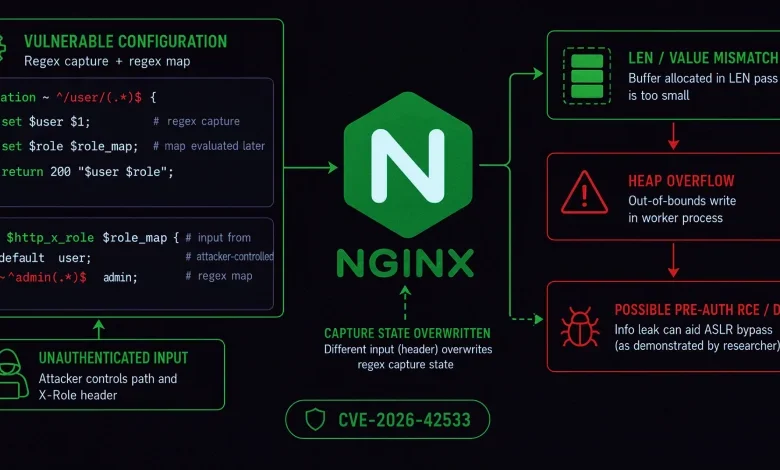
The core of the vulnerability lies in the NGINX script engine, the component responsible for assembling complex strings from various directives during the request processing phase. Specifically, the flaw manifests when a configuration utilizes a regular expression-based map directive where the output variable is subsequently referenced in a string expression following a capture from a preceding regular expression match. This specific sequence triggers a breakdown in the engine’s "two-pass" evaluation logic.
In a standard, secure operation, the NGINX script engine evaluates expressions in two distinct stages. During the first pass, the engine calculates the total number of bytes required for the final result and allocates a memory buffer of the exact size on the heap. In the second pass, the engine writes the actual data into that pre-allocated buffer. Under normal circumstances, both passes rely on consistent state data. However, CVE-2026-42533 arises because both passes read from a shared capture state. When a map directive’s regular expression is evaluated between the sizing pass and the writing pass, it overwrites the shared state.

Consequently, the first pass calculates the buffer size based on the original capture (such as a $1 variable from a location match), but the second pass populates that same buffer using a different, potentially much larger value provided by the attacker. Because the buffer is too small to accommodate the second set of data, a heap buffer overflow occurs. Notably, both the length of the overrun and the content of the data written beyond the buffer boundaries are directly controlled by the attacker’s request, making this a highly flexible vector for exploitation.
Impacted Versions and Extended Ecosystem
The scope of CVE-2026-42533 is remarkably broad, covering nearly every version of NGINX released over the last decade. Technical audits have confirmed that all versions from 0.9.6 through 1.31.2 are susceptible. This range traces the vulnerability back to 2011, the year regex support was first introduced to the map directive. The longevity of the bug suggests it has remained latent in the codebase through several generations of web architecture.
While the core NGINX server and NGINX Plus are the primary targets, F5’s security advisory clarifies that the vulnerability extends to several other products within the NGINX ecosystem. These include:
- NGINX Ingress Controller: Widely used in Kubernetes environments to manage external access to services.
- NGINX Gateway Fabric: A modern implementation of the Kubernetes Gateway API.
- NGINX App Protect WAF: A web application firewall designed to protect against advanced threats.
- NGINX Instance Manager: A tool used for discovering, configuring, and monitoring NGINX instances at scale.
At the time of the initial advisory, F5 had not yet provided specific version numbers for fixed builds of these four auxiliary products, though they are expected to follow the core server patches. The vulnerability has been assigned a CVSS v4 score of 9.2 and a CVSS v3.1 score of 8.1. While F5 rates the attack complexity as "high" due to the specific configuration requirements, the potential impact on confidentiality, integrity, and availability remains critical.

The ASLR Bypass and Researcher Insights
One of the most significant developments regarding CVE-2026-42533 comes from independent security researcher Stan Shaw, who operates under the moniker "cyberstan." Shaw was one of more than a dozen researchers who reported the flaw to F5, but his subsequent analysis suggests the threat may be more severe than the vendor’s initial assessment indicates.
F5’s advisory states that remote code execution is possible primarily in environments where Address Space Layout Randomization (ASLR) is disabled or can be bypassed. However, Shaw argues that the vulnerability itself provides the necessary mechanism to bypass ASLR. According to Shaw, the "clobbering" of the capture state can also work in reverse. If an attacker-controlled capture is smaller than the original, the oversized buffer allocated in the first pass will contain uninitialized heap data. By carefully crafting a request, an attacker can leak this uninitialized data back in a response.
Shaw demonstrated that on a default installation of Ubuntu 24.04, a single unauthenticated GET request was sufficient to recover memory addresses required to construct a functional exploit payload. "A reader of the F5 advisory could reasonably conclude this is DoS-only on default systems. It is not," Shaw stated. He further noted that in his internal testing, the exploit achieved a 100% success rate. While Shaw is currently withholding a public Proof-of-Concept (PoC) to allow organizations time to patch, he intends to release the exploitation details 21 days after the initial patch date.
Chronology of Recent NGINX Vulnerabilities
The discovery of CVE-2026-42533 marks the third major heap overflow vulnerability found in NGINX’s expression-evaluation code in just two months. This cluster of disclosures suggests a systemic weakness in how the software handles variable processing and memory allocation.

- May 2026: Discovery of CVE-2026-42945, internally referred to as "Rift." This vulnerability was actively exploited in the wild shortly after its disclosure, highlighting the speed at which threat actors can weaponize NGINX flaws.
- June 2026: Disclosure of CVE-2026-9256, a bug involving overlapping captures within the rewrite module. Like its predecessor, it involved a failure in the two-pass sizing and writing logic.
- July 15, 2026: Official patch release for CVE-2026-42533.
The recurring nature of these flaws—all rooted in the "two-pass" script engine design—indicates that while NGINX is renowned for its performance and efficiency, its method of trusting its own internal measurements during memory allocation is a recurring point of failure. Security analysts suggest that these incidents may prompt a more fundamental architectural review of how NGINX handles dynamic string assembly.
Mitigation Strategies and Configuration Risks
For organizations unable to perform an immediate software upgrade, F5 has suggested a temporary mitigation strategy: migrating from numbered captures to named captures within affected regex maps. For example, replacing a reference like $1 with a named variable like (?<name>...).
However, Stan Shaw has issued a warning regarding this workaround. His research identified a "narrower path" that remains open even when named captures are used. He found that if a map defines a named group that shares the same name as a group in the location regex, the overflow can still be triggered through a secondary code path. Shaw confirmed this persistent risk using AddressSanitizer, a tool used to detect memory corruption. Because of this edge case, Shaw maintains that upgrading to the latest patched versions is the only comprehensive solution to the problem.
To assist administrators in identifying vulnerable configurations, Shaw has released a "Config Scanner" on GitHub. This tool automates the process of auditing NGINX configuration files, including those linked via include directives. It specifically flags instances where a regex-based map variable appears in a string expression alongside a numbered capture from a previous regex, where the capture is positioned ahead of the map variable. This tool is intended for defensive auditing and does not contain exploitation code.

Broader Implications for Web Security
The disclosure of CVE-2026-42533 underscores the precarious nature of modern web infrastructure. NGINX is a cornerstone of the internet, powering a vast percentage of high-traffic websites, content delivery networks (CDNs), and API gateways. A vulnerability that has existed for over 13 years suggests that even the most scrutinized open-source projects can harbor deep-seated architectural flaws.
The potential for RCE is particularly concerning for cloud service providers and enterprises that allow user-defined configurations or utilize complex routing logic. If an attacker can achieve code execution on an NGINX worker process, they could potentially intercept sensitive traffic, pivot to other areas of the internal network, or disrupt critical services.
As of July 20, 2026, the vulnerability has not yet appeared on the Cybersecurity and Infrastructure Security Agency’s (CISA) Known Exploited Vulnerabilities (KEV) catalog. However, given the history of "Rift" (CVE-2026-42945), experts predict that exploitation attempts will begin as soon as technical details or PoCs become available in the public domain. The 21-day window provided by researchers like Shaw offers a brief period of grace for global IT teams to secure their systems.
F5 has not yet responded to inquiries regarding the timeline for patches for downstream products like the Ingress Controller or the specific technical bypasses identified by Shaw. In the interim, the industry consensus remains clear: immediate patching of the core NGINX binaries is the most effective defense against this critical flaw. Organizations are advised to treat this update as a high-priority event, conducting thorough audits of their nginx.conf files to ensure that all instances—including those hidden within containerized environments—are brought up to the latest security standards.
Related posts: