Bambu Lab R1 Review: A Professional-Grade 55W CO2 Laser Cutter Elevates the Maker Space

Bambu Lab has officially expanded its manufacturing footprint beyond desktop additive fabrication with the introduction of the Bambu Lab R1, a professional-grade 55W CO2 laser cutter and engraver. Priced at $2,499 in the United States and £2,249 in the United Kingdom, pre-orders are scheduled to open on September 22, 2026, with commercial and consumer shipping commencing in October. While the company has previously integrated lower-capacity diode laser modules into multi-functional platforms like the H2D, the R1 represents Bambu Lab’s first standalone, dedicated laser system designed to challenge established market leaders such as xTool, Glowforge, LaserPecker, and Creality.
Background and Industry Context
The desktop laser cutting and engraving sector has experienced a profound evolution over the past five years. Historically, hobbyists and small-business owners relied on open-frame diode systems that demanded extensive manual assembly, calibration, and continuous user supervision regarding safety protocols. As safety standards tightened and manufacturing precision improved, the market shifted decisively toward fully enclosed Class 1 laser systems.
While diode lasers remain popular for basic surface engraving and light cutting, they generally plateau around 40W of optical output and struggle significantly with transparent materials like clear acrylic and glass. By choosing a 55W CO2 laser configuration for the R1, Bambu Lab has positioned the machine to process a substantially broader material catalog. The CO2 technology unlocks high-speed precision cutting on thicker woods, dark and clear acrylics, leather, fabrics, and specialized paper, while extending deep engraving capabilities to ceramics, coated metals, and glass.
Design and Physical Specifications
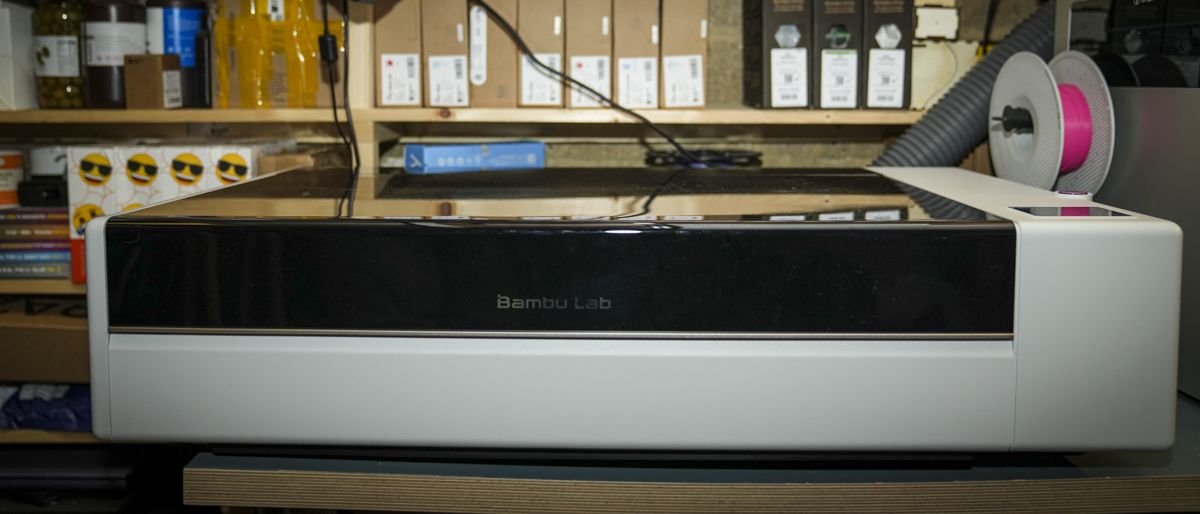
Measuring 940 x 560 x 200mm and weighing 33.5kg, the R1 strikes a calculated balance between a robust internal working volume and a manageable desktop footprint. The primary bed provides a standard working area of 600 x 300mm, which accommodates standard material panels side-by-side for batch processing or multi-part component assembly. For operations requiring continuous feeding or long-format output, an optional Conveyor accessory expands the longitudinal working length up to 3,000mm while maintaining the standard 600mm width.
The industrial design reflects Bambu Lab’s characteristic aesthetic, utilizing clean lines, high-grade injection-molded chassis components, and a tight factory configuration that minimizes user setup time. Upon unboxing, operators must connect the integrated exhaust system—typically paired with an optional E1 Pro air purification unit—and fill the internal cooling reservoir with distilled or de-ionized water. For operating environments prone to freezing temperatures, the system manual explicitly advises adding antifreeze rated down to -10°C.
Unlike many competing CO2 systems that route nearly all operational controls exclusively through a host computer, the R1 incorporates an onboard touchscreen interface. This addition allows users to execute basic system checks, initialize calibrations, and manage direct execution tasks locally. An easily accessible emergency stop switch is prominently mounted on the chassis to ensure immediate intervention capabilities in commercial or educational workshops.
Automation and Technological Integration
The defining characteristic of the Bambu Lab R1 is its heavy reliance on automated calibration and computer vision systems—technologies directly imported from the company’s extensive experience in the 3D printing industry. CO2 laser systems fundamentally rely on a series of mirrors to direct the high-energy beam through the optical path. Traditionally, aligning these mirrors requires meticulous, hands-on manual adjustments with alignment tools to prevent power loss and beam distortion.
The R1 eliminates much of this friction via an automated mirror actuator system coupled with a magnetic Laser Alignment Sensor. Operators simply snap the sensor onto the toolhead, initiate the calibration sequence via the touchscreen or software, and allow the machine to self-align in approximately five minutes.
Furthermore, the machine incorporates the proprietary TriSense system. This sensor suite integrates a BirdsEye overhead camera, a secondary toolhead camera, a pinpoint targeting laser, a surface-distance measurement laser, and high-resolution XY encoders. Together, these components map material thickness, automatically adjust focal points, and monitor exact spatial coordinates across the workspace.
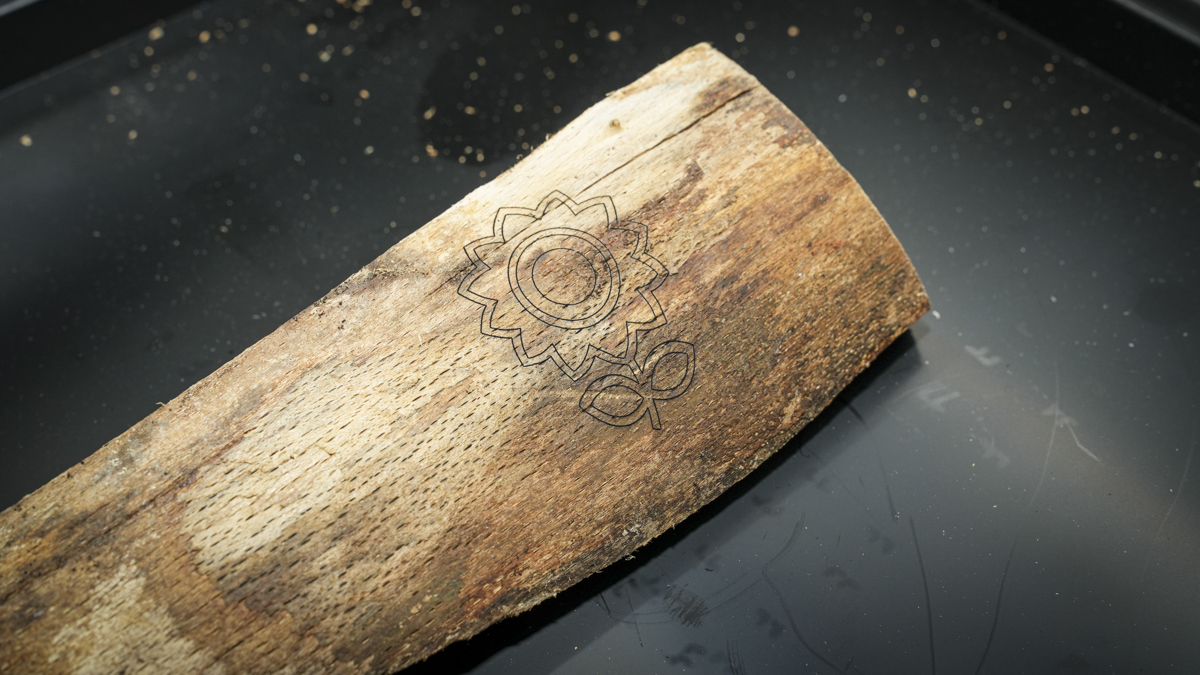
This automation extends to curved-surface engraving, a historically complex procedure requiring specialized rotary axes or manual height mapping. On the R1, users can place irregular, three-dimensional items—such as bowls, curved timber, or cylindrical blanks—inside the chamber. The system executes a multi-point surface scan to generate a precise height map, dynamically adjusting the focal height of the laser in real-time as it carves vectors across undulating geometries.
Software and Workflow Analysis
The hardware capabilities of the R1 are managed via Bambu Suite, a proprietary software environment adapted from the company’s established slicing software. During rigorous multi-week testing protocols, the software demonstrated robust operational stability on macOS and Windows, though reviewers noted that the workflow logic retains a learning curve for operators transitioning from traditional vector design packages.
For instance, file ingestion currently requires selecting an "Open Image" prompt for specific vector layouts where an "Open File" designation would be more intuitive. Additionally, separating design import parameters from material preparation steps introduces minor workflow friction when users need to modify cut, line, or fill assignments late in the setup phase.
Despite minor interface inconsistencies, the inclusion of robust material profiles significantly reduces setup times. Operators are spared the traditional trial-and-error process of running exhaustive power-and-speed test grids for standard substrates such as 3mm basswood plywood, MDF, and cast acrylic. Custom profiles can also be saved locally as presets for experimental materials.
Performance and Cutting Capabilities
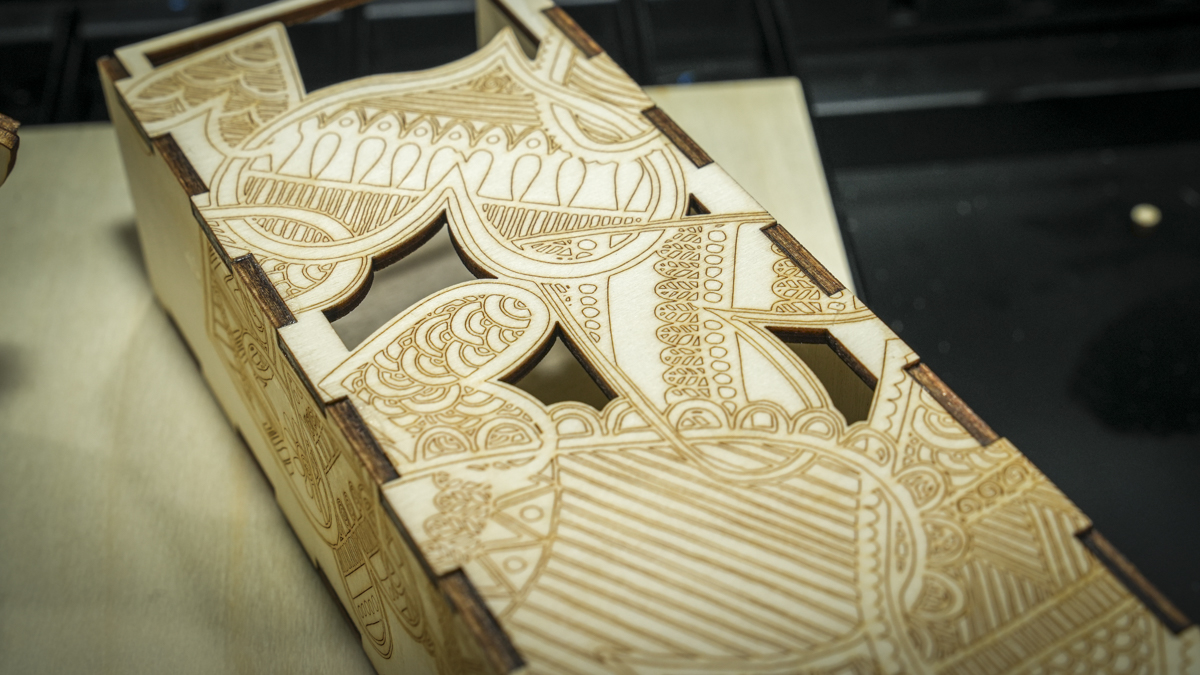
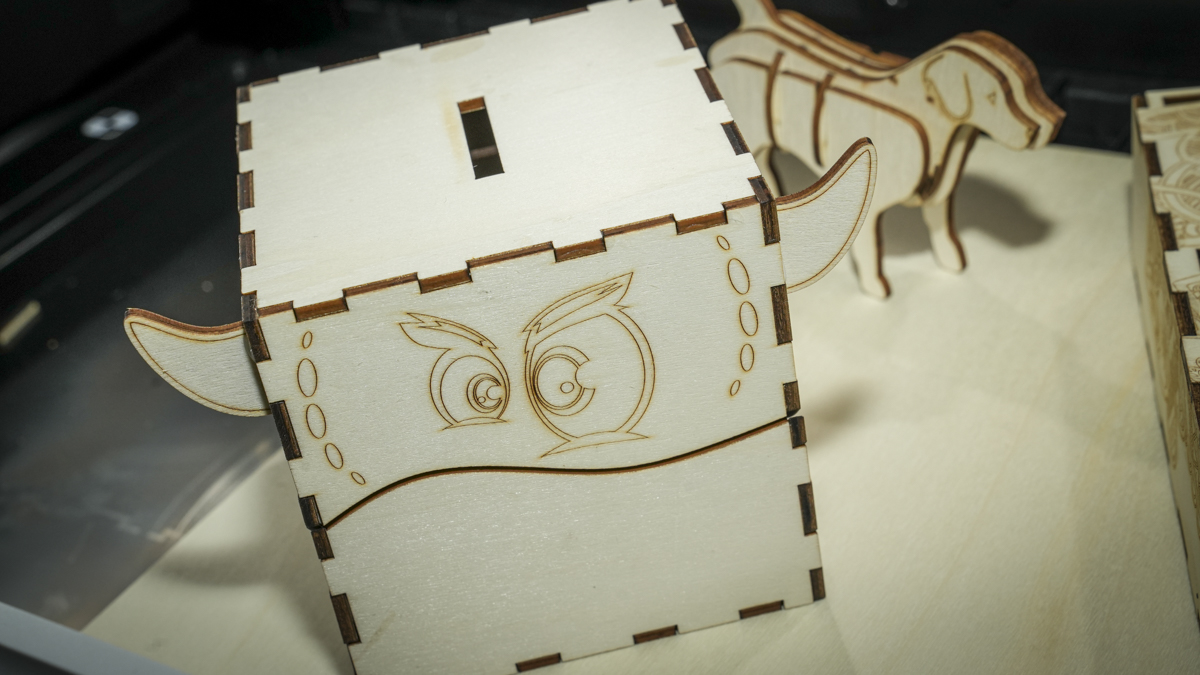
In practical evaluations across wood, acrylic, and composite substrates, the R1 exhibited exceptional cutting and engraving fidelity. Utilizing the default short-focus lens, the machine cleanly cuts through 3mm basswood plywood at high speeds, producing crisp edges with minimal charring when paired with the integrated Air Assist system.
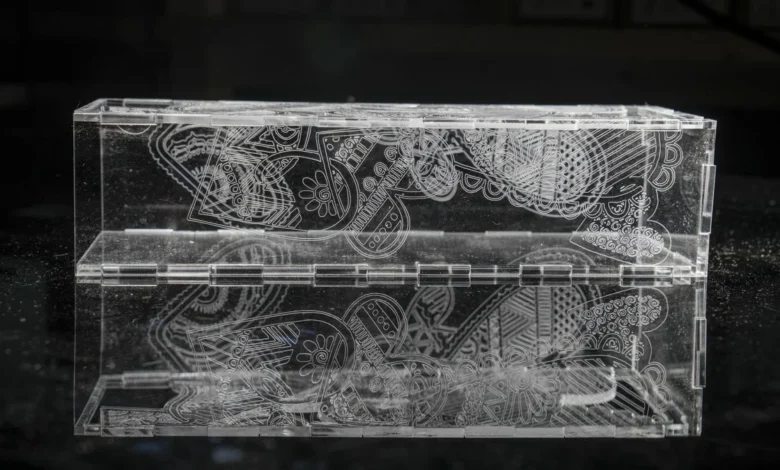
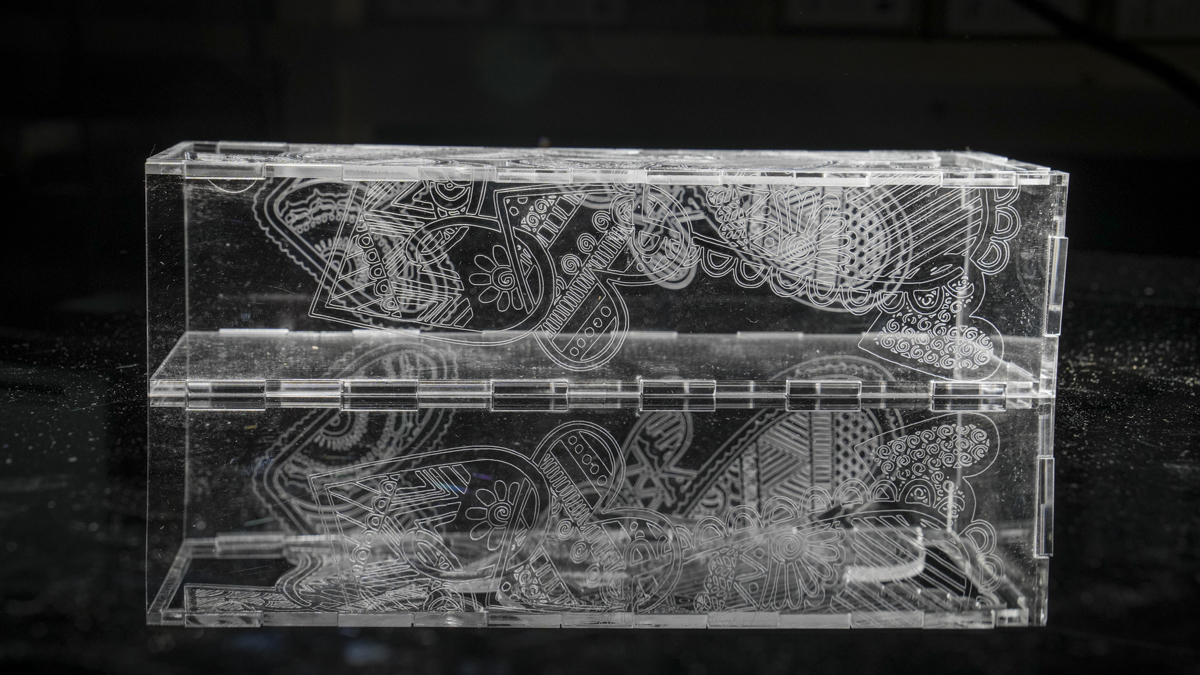
When processing 3mm cast acrylic, the R1 delivered clear, polished edge finishes over a 29-minute multi-part test run, highlighting the clear advantages of the 55W CO2 configuration over standard diode alternatives. Pushing the machine to its mechanical limits with slower speeds and maximum power output enabled successful penetration through 18mm black walnut and heavy MDF panels.
However, certain physical limitations were observed during intensive cutting operations. The standard interior utilizes removable metal slats to support sheet materials. While functional, small cut-out components frequently slip through the gaps during processing, occasionally resulting in minor underside scorching if they intersect subsequent laser paths. For intricate, high-precision projects, a traditional honeycomb grid bed—currently offered as an optional accessory rather than standard equipment—remains the preferred material support medium.
Market Implications and Economic Positioning
At a price point of $2,499 / £2,249, the Bambu Lab R1 occupies a strategic tier within the market. It undercuts several legacy industrial CO2 systems while offering a level of automation and closed-loop feedback that surpasses many entry-level competitor models.
By targeting small businesses, professional design studios, advanced educational institutions, and serious makers, Bambu Lab is attempting to replicate its success in the 3D printing market. The ecosystem approach—allowing users to seamlessly combine 3D printed structural components with laser-cut wood and acrylic parts—provides a compelling value proposition for rapid prototyping and micro-manufacturing.
Summary and Purchasing Verdict
The Bambu Lab R1 successfully bridges the gap between complex industrial CO2 machinery and accessible desktop fabrication tools. Its primary strengths lie in its robust hardware engineering, automated optical alignment, advanced computer vision positioning, and superior processing power across a wide spectrum of materials.
Buy it if: You are already invested in the Bambu Lab ecosystem and require an integrated workflow combining additive manufacturing with precise laser cutting, or if high-accuracy positioning on irregular and pre-cut objects is vital to your production pipeline.
Don’t buy it if: Workspace dimensions are severely restricted, or if you prefer a simplified, zero-friction software workflow that requires no adaptation to proprietary design suites.
Ultimately, while the accompanying software requires continued optimization and refinement, the R1 establishes a new technological benchmark for desktop CO2 laser systems, promising significant disruption in the professional maker and small-business hardware sectors.