Acer Predator X27U Gaming Monitor Drops to $509.99 in Rare High-End Display Discount

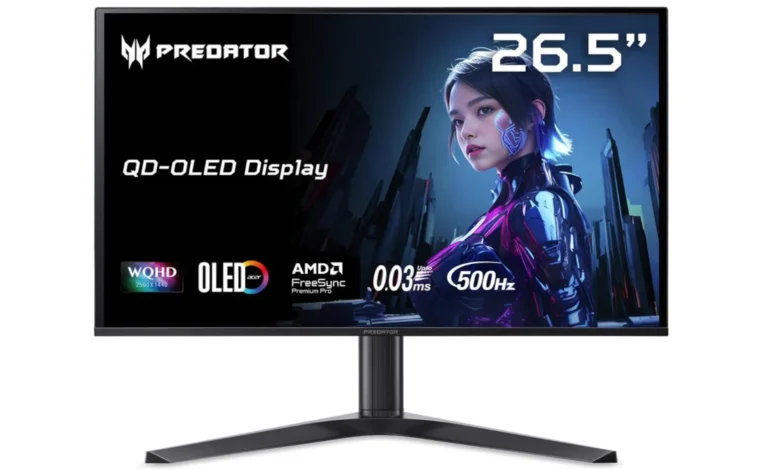
At a time when the consumer hardware market is experiencing sustained financial friction due to inflated pricing trends across memory modules, solid-state drives, and mechanical hard drives, PC enthusiasts and competitive gamers have received a welcome reprieve. Retailer Newegg has introduced a significant price reduction on the Acer Predator X27U (model F5bmiippruzx), a high-end 27-inch gaming monitor utilizing Quantum Dot Organic Light Emitting Diode technology. Originally positioned as a premium luxury purchase for high-refresh-rate aficionados, the display is currently available for $509.99, marking a notable departure from its standard retail positioning and offering a compelling value proposition within the upper echelon of modern display hardware.
The persistent inflationary pressures affecting system components such as RAM and storage have made major hardware upgrades an expensive endeavor throughout the latter half of the decade. Supply chain adjustments, fluctuating production yields, and shifting global demand for silicon have consistently kept component prices elevated. Consequently, finding meaningful discounts on Tier-1 peripheral hardware has become increasingly rare. The current promotion on the Predator X27U provides a strategic window for consumers looking to upgrade their visual output architecture without navigating the heavily inflated costs currently plaguing internal system components.
Main Specifications and Display Technology
The Acer Predator X27U centers its appeal on a convergence of advanced panel engineering and ultra-high refresh rates. Utilizing a 27-inch Quantum Dot OLED (QD-OLED) panel, the monitor delivers the fundamental advantages inherent to organic light-emitting diode technology: infinite contrast ratios, true absolute blacks, and near-instantaneous pixel response times. Unlike traditional liquid crystal displays that rely on a communal backlight, every pixel on a QD-OLED panel generates its own illumination, allowing for precise local dimming at the pixel level and eliminating the common visual artifact known as blooming.
Beyond the baseline advantages of OLED, the inclusion of Quantum Dot technology enhances color volume and peak luminance output compared to standard WOLED alternatives. This combination allows the display to achieve VESA DisplayHDR True Black 500 certification. While peak brightness in high-dynamic-range scenarios is calibrated to meet this stringent industry standard—ensuring specular highlights pop with high fidelity without sacrificing shadow detail—the broader color accuracy makes the monitor suitable for both high-end gaming and color-sensitive content creation workflows.
Perhaps the most arresting technical specification of the F5bmiippruzx variant is its maximum refresh rate, which reaches an astonishing 500 Hz. While historical refresh rate milestones settled at 144 Hz, 240 Hz, and 360 Hz for competitive play, pushing the threshold to 500 Hz requires advanced display controller architecture and robust signal bandwidth, typically supplied via HDMI 2.1 and DisplayPort 1.4 or 2.0 interfaces. This ultra-high refresh rate significantly reduces motion blur, lowers input latency, and delivers maximum visual fluidity for esports titles where frame generation times dictate competitive advantages.
Market Context and Historical Pricing
To fully understand the significance of the $509.99 price point, it is necessary to examine the historical trajectory of OLED adoption within the desktop monitor market. When OLED technology first migrated from large-format consumer televisions to desktop computer monitors, barrier-to-entry costs were prohibitive. Early iterations commanded retail prices in excess of $1,000 to $1,500, restricting adoption primarily to professional studios and affluent enthusiasts.
Over the past twenty-four months, manufacturing efficiencies, improved panel cut yields from major display fabricators such as Samsung Display and LG Display, and intensified market competition have driven down baseline costs. However, high-refresh-rate variants exceeding 240 Hz—let alone reaching the elite 500 Hz threshold—have historically maintained a steep premium. Acer’s positioning of the Predator X27U at roughly the $500 mark represents a structural shift in how high-performance visual hardware is valued at retail, compressing the timeline for OLED democratization in the desktop ecosystem.
The broader context of the PC hardware market further magnifies the impact of this discount. While prospective builders currently face discouraging pricing structures for DDR5 memory kits, high-capacity PCIe 4.0 and 5.0 SSDs, and discrete graphics processing units, peripherals have occasionally served as the sole arena for consumer savings. Retailers eager to maintain consumer engagement during sluggish component sales cycles have increasingly relied on aggressive markdowns for monitors, peripherals, and chassis to stimulate spending.
Chronology of High-Refresh OLED Development
The journey toward affordable, ultra-fast OLED displays has been defined by rapid iterative milestones over a relatively short temporal window:
- 2020–2021: OLED technology establishes a firm foothold in the home entertainment sector via large-screen televisions, while early desktop prototypes struggle with thermal management, burn-in concerns, and prohibitive manufacturing costs.
- 2022: The first generation of dedicated 27-inch and 32-inch OLED gaming monitors reaches the market, typically limited to 144 Hz or 175 Hz refresh rates, with retail prices hovering near the $1,000 threshold.
- 2023: Panel manufacturers refine their production lines, introducing WOLED and QD-OLED variants. Refresh rates climb to 240 Hz, broadening the appeal to competitive esports players, though prices remain stubbornly high.
- 2024: The introduction of tandem OLED structures and advanced sub-pixel layouts pushes refresh rates to 360 Hz and beyond. Competition intensifies as multiple brands race to release flagship models.
- Late 2024–2025: Market maturation and supply chain stabilization lead to the first major generational price corrections. Models featuring elite specifications, such as the 500 Hz Acer Predator X27U, begin seeing targeted promotional discounts below historical cost baselines.
Technical Implications and Performance Analysis
From an engineering perspective, deploying a 500 Hz refresh rate on a 1440p (2560 x 1440) resolution QD-OLED panel presents significant technical challenges. Driving such a high frame rate requires not only a cutting-edge GPU—such as an NVIDIA GeForce RTX 4080/5080 or AMD Radeon equivalent—but also extreme signal processing capabilities within the monitor’s internal scaler and timing controller (TCON).
The pixel response time inherent to OLED technology, typically measured at 0.03 milliseconds (gray-to-gray), ensures that even at 500 frames per second, pixel ghosting and trailing are virtually nonexistent. This creates a motion clarity profile that surpasses even the fastest traditional fast-IPS panels, which have historically dominated the high-refresh esports market. Furthermore, the absence of a backlight eliminates backlight bleeding and IPS glow, resulting in a dark-room viewing experience that remains uniform across the entire surface of the 27-inch panel.
However, running displays at these extreme specifications is not without trade-offs. Power consumption scales with refresh rate and luminance, and thermal management within a slim monitor chassis requires efficient dissipation strategies to prevent long-term degradation. Acer’s inclusion of robust passive and active cooling design elements in the Predator series helps mitigate these concerns, ensuring that sustained peak performance does not compromise panel longevity. Additionally, modern OLED maintenance features—such as pixel shifting, automatic static logo detection, and periodic panel refresh cycles—are embedded within the firmware to safeguard against burn-in during prolonged desktop use, such as operating system navigation or productivity tasks.
Industry Impact and Consumer Takeaways
The availability of the Acer Predator X27U at $509.99 serves as an indicator of broader deflationary trends in specific segments of the display market, even as other hardware verticals remain locked in high-cost cycles. For the average consumer, this discount demonstrates that the price-to-performance ratio for premium display technology is improving at a faster rate than internal system components.
Analysts tracking the PC hardware ecosystem note that aggressive pricing on displays like the Predator X27U may force competing manufacturers—including ASUS, MSI, Dell Alienware, and Gigabyte—to adjust their pricing strategies for comparable high-refresh OLED hardware. As production capacities scale upward throughout the remainder of the decade, sub-$600 pricing for elite-tier gaming displays is expected to transition from a promotional anomaly to an established market standard.
For prospective buyers navigating the current macroeconomic climate of PC building, the choice to allocate budget toward a high-end display rather than overpaying for inflated memory or storage components represents a pragmatic shift in upgrade strategy. With visual fidelity and motion handling serving as the primary interface between the user and the digital environment, securing an industry-leading QD-OLED panel at a heavily reduced rate provides an immediate, tangible upgrade to the overall computing and gaming experience, independent of ongoing supply chain volatility elsewhere in the industry.